TorontoOntario · 36 tours
 Niagara FallsOntario · 25 tours
 New York CityNew York · 30 tours
 Las VegasNevada · 8 tours
 San FranciscoCalifornia · 16 tours
 VancouverBritish Columbia · 17 tours
 DubaiUAE · 54 tours
 Abu DhabiUAE · 5 tours
 Buenos AiresArgentina · 23 tours
 AthensGreece · 31 tours
 AucklandNew Zealand · 38 tours
 CancunMexico · 54 tours
No destinations match “”. Try searching all tours instead — that search understands full questions, not just place names.
Spain's national museum of 20th-century art, opened to the public in 1990 (permanent collection inaugurated in 1992), is best known for permanently housing Pablo Picasso's Guernica, his monumental anti-war painting. The collection also includes major works by Salvador Dalí and Joan Miró, making it a key stop alongside the Prado and Thyssen-Bornemisza in Madrid's 'Golden Triangle of Art.'
 Private Tours
A small-group (6 people maximum) tour of the Reina Sofía Museum, taking in Picasso's Guernica and other major works of Spanish modern art.
Private Tours
A private tour of the Reina Sofía Museum with a focused deep dive on Pablo Picasso's Guernica, plus works from the Spanish Surrealist school.
Visitor guide
The Museo Nacional Centro de Arte Reina Sofia is Madrid's national museum of modern and contemporary art, named after Queen Sofia. Opened to the public on 31 October 1990, with its permanent collection inaugurated on 10 September 1992, it stands near Atocha station at the southern end of the Golden Triangle of Art, alongside the Prado and the Thyssen-Bornemisza. It is best known as the home of Picasso's Guernica.
According to Wikipedia, the site was the first General Hospital of Madrid, created when Philip II centralised the city's scattered hospitals. In the eighteenth century Ferdinand VI commissioned a new building, designed by Jose de Hermosilla and carried out mostly by his successor Francisco Sabatini. The building began its hospital role in 1805, although only about one-third of Sabatini's project was completed, and it closed as a hospital in 1969 by one museum account (another gives 1965).
Renovation began in 1980. The building functioned as an arts centre from 1986, and in 1988 it became the Museo Nacional Centro de Arte Reina Sofia. In the last works of 1988, three glass-and-steel lift towers, designed in collaboration with the British architect Ian Ritchie, gave the building its distinctive exterior.
The museum's collection is mainly Spanish art, with Picasso and Dali as highlights. Guernica, painted by Picasso in 1937, is the best-known work. Other works include Dali's The Great Masturbator, Picasso's Les oiseaux morts of 1912, Miro's La casa de la palmera of 1918, and works by Juan Gris, Maria Blanchard and Julio Gonzalez.
Wikipedia also lists Spanish artists such as Chillida, Gargallo, Tapies and Oteiza, and international artists including Bacon, Beuys, Calder, Kandinsky, Magritte, Rothko, Richard Serra and Cindy Sherman. Serra's sculpture Equal-Parallel/Guernica-Bengasi is among the notable works.
The museum is organised around the idea of tracing twentieth-century art through its political and cultural context, and Spain's own history features strongly in the story it tells. Guernica, which Picasso painted in 1937 in response to the bombing of the Basque town of that name during the Spanish Civil War, is the clearest example, and it is displayed alongside related studies and documentation. The surrounding galleries place Picasso, Dali and Miro in dialogue with European and international movements such as Cubism and Surrealism, so that visitors can see how Spanish artists both took part in and shaped wider developments.
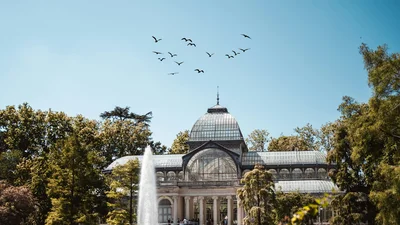
A major expansion designed by Jean Nouvel opened in September 2005, adding about 8,000 square metres at a cost given as 92 million euros. It includes temporary exhibition spaces, two auditoria, a bookshop, restaurants and offices. The museum also uses the Crystal Palace and the Velazquez Palace in Retiro Park for exhibitions.
The museum's art library holds over 100,000 books, more than 3,500 sound recordings and nearly 1,000 videos, according to Wikipedia. The museum drew 1,601,732 visitors in 2025. It has also appeared on screen, including as a major location in Jim Jarmusch's film The Limits of Control (2009).
The collection is large and spans many movements, so it helps to plan around a few themes. A private guided visit can focus on Guernica and Spanish modernism, and Voyzo can arrange this with a private vehicle and driver.
See every tour and attraction we cover in Madrid.