TorontoOntario · 36 tours
 Niagara FallsOntario · 25 tours
 New York CityNew York · 30 tours
 Las VegasNevada · 8 tours
 San FranciscoCalifornia · 16 tours
 VancouverBritish Columbia · 17 tours
 DubaiUAE · 54 tours
 Abu DhabiUAE · 5 tours
 Buenos AiresArgentina · 23 tours
 AthensGreece · 31 tours
 AucklandNew Zealand · 38 tours
 CancunMexico · 54 tours
No destinations match “”. Try searching all tours instead — that search understands full questions, not just place names.
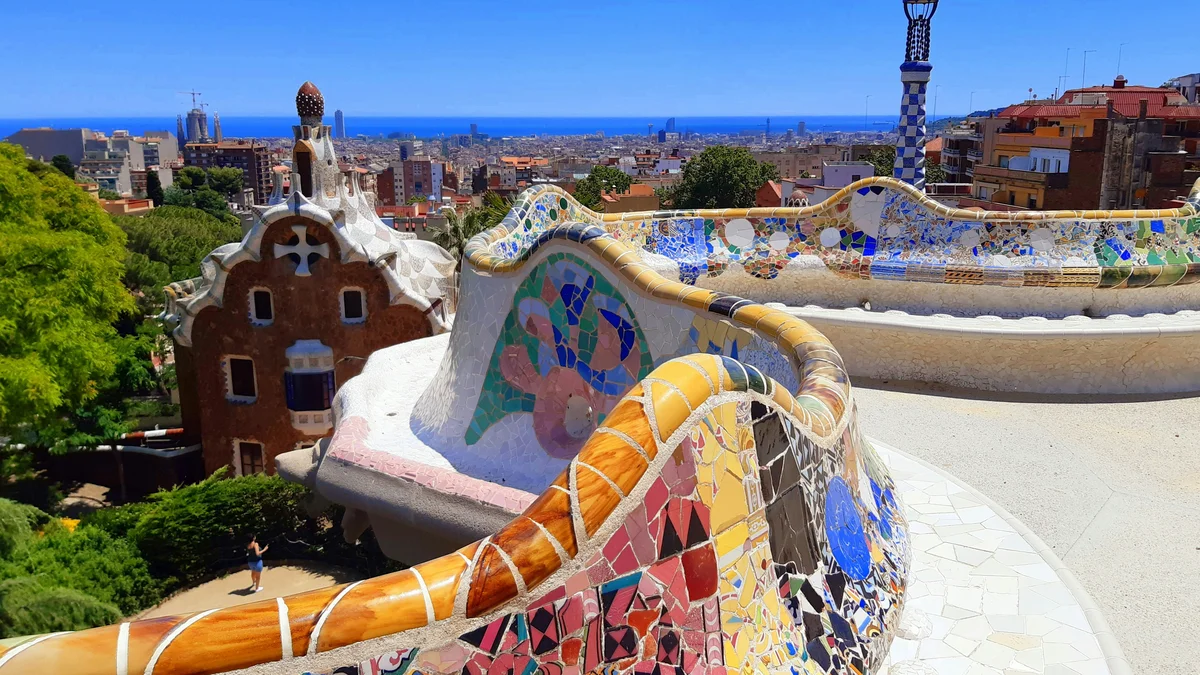
Park Güell is a public park in Barcelona designed by Antoni Gaudí between 1900 and 1914, originally conceived as a private, English-style garden housing estate that never fully materialized commercially. Its most photographed feature is a long, undulating mosaic bench, made of broken ceramic tile (trencadís) in Gaudí's signature style, overlooking sweeping views of the city and the sea. The park was declared a UNESCO World Heritage Site in 1984 as part of Gaudí's body of work.
Visitor guide
Park Guell is a public park on the southern slope of the Turo del Carmel in Barcelona, Spain, designed by the architect Antoni Gaudi for the industrialist Eusebi Guell. Built between 1900 and 1914, it is known for its mosaic-covered structures, its sea-serpent bench and its views over the city. It is part of the UNESCO World Heritage listing of Gaudi's works.
According to Wikipedia, Guell originally planned a high-end residential development for Barcelona's bourgeoisie on Muntanya Pelada, or Bare Mountain, inspired by the English garden city movement. The name 'Park' reflects that English influence. The plan called for sixty triangular plots, but only two houses were built, neither by Gaudi, because the site was considered too far from the city centre.
A show home built in 1904 failed to sell, and Guell persuaded Gaudi to buy it. Gaudi moved in with his father and niece in 1906. The house, designed by Francesc Berenguer i Mestres, became the Gaudi House Museum in 1963. The park opened to the public in 1926 and eventually became a municipal garden.
Two whimsical pavilions at the entrance form the Porter's Lodge, one of which now holds an exhibit from the Barcelona City History Museum. From here a stairway climbs toward the main terrace, bordered by a long, curving bench shaped like a sea serpent. Wikipedia credits the design of the bench to Josep Maria Jujol, who worked with Gaudi.
Gaudi's mosaic salamander, known as El Drac or the dragon, decorates the stairway and was restored in 2007. The park uses ceramic fragments throughout, giving its walls and benches the colourful surfaces associated with Catalan Modernisme.
The park's elevated pathways were originally designed for carriages. Their columns mimic tree trunks and slope with the hillside, and Gaudi used inverted catenary arches to carry loads. The layout works with the terrain rather than against it, which gives the park a naturalistic feel despite the man-made structures.
At the highest point, a calvary of three stone crosses known as the Turo de les Tres Creus offers views over Barcelona, including the Sagrada Familia, the Torre Glories, Montjuic and the Mediterranean. Wikipedia notes that the park includes references to Catalan political identity, Catholicism and Greek mythology.
UNESCO designated the park a World Heritage Site in 1984 as part of the Works of Antoni Gaudi. The listing cites a blend of Arts and Crafts, Symbolism, Expressionism and Rationalism. Since 2013, the main Monumental Zone has had controlled entry, while other parts of the park remain open in a more traditional municipal-garden style.
The site is built on a hillside with slopes and steps, so comfortable footwear is useful. A private guided visit helps explain Gaudi's ideas and the park's unusual history, and Voyzo can arrange this with a private vehicle and driver.
See every tour and attraction we cover in Barcelona.