TorontoOntario · 36 tours
 Niagara FallsOntario · 25 tours
 New York CityNew York · 30 tours
 Las VegasNevada · 8 tours
 San FranciscoCalifornia · 16 tours
 VancouverBritish Columbia · 17 tours
 DubaiUAE · 54 tours
 Abu DhabiUAE · 5 tours
 Buenos AiresArgentina · 23 tours
 AthensGreece · 31 tours
 AucklandNew Zealand · 38 tours
 CancunMexico · 54 tours
No destinations match “”. Try searching all tours instead — that search understands full questions, not just place names.
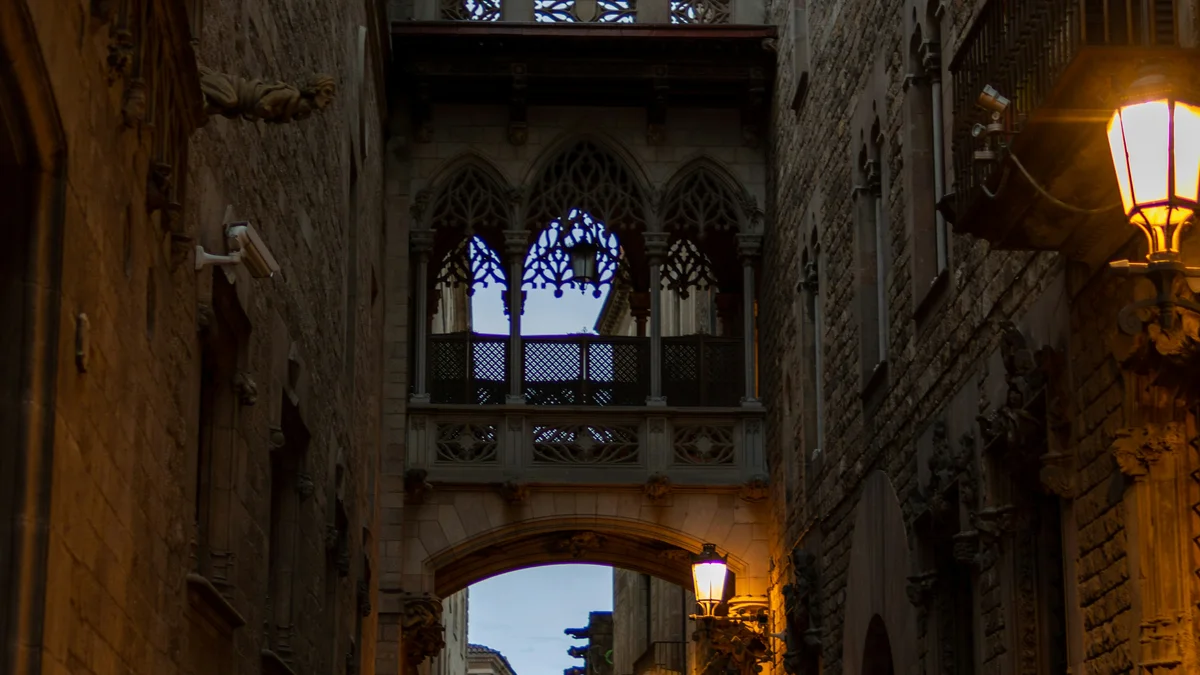
The Gothic Quarter (Barri Gòtic) is Barcelona's medieval old town, a dense tangle of narrow stone lanes built over the footprint of the original Roman settlement of Barcino. Remnants of Roman walls and columns still surface between Gothic-era churches and palaces, most notably around the 14th-century Barcelona Cathedral. The quarter's small squares and covered passageways, like the arched Pont del Bisbe bridge, make it one of the most atmospheric parts of the city to simply wander.
Visitor guide
The Gothic Quarter, or Barri Gotic, is the historic centre of Barcelona's old city, in the Ciutat Vella district of Catalonia, Spain. It is a labyrinth of narrow streets and small squares that contains remains of the Roman wall, medieval churches and civic buildings. Much of it is closed to ordinary traffic, which makes it a district for walking.
According to Wikipedia, the quarter runs from La Rambla to Via Laietana and from the Mediterranean seafront to the Ronda de Sant Pere. It contains the oldest parts of Barcelona, including remains of the Roman wall, and it holds El Call, the medieval Jewish quarter, where the former main synagogue stood. Streets open abruptly into squares such as Placa Sant Jaume, Placa del Rei and Placa de Sant Felip Neri.
The quarter sits on the area of Roman Barcino, and traces of this earlier city survive among later buildings. The Temple of Augustus is among the Roman remains mentioned in connection with the quarter.
The Cathedral of Santa Eulalia is the quarter's anchor. Its medieval structure is Gothic, but Wikipedia notes that its neo-Gothic facade was built between 1882 and 1913. Placa Sant Jaume is the civic centre, with the Palau de la Generalitat de Catalunya, the seat of Catalonia's government, facing the Casa de la Ciutat, or City Hall, whose neoclassical facade dates to 1831-1847.
Placa del Rei is dominated by the Palau Reial Major and by Casa Padellas, a building from around 1500 that was moved here in 1931 and now houses the headquarters of the Barcelona City History Museum. Elsewhere in the quarter, the Picasso Museum occupies palaces along Carrer Montcada, restored in 1959.
One of the most interesting points about the district is that many of its apparently medieval buildings are not medieval. Wikipedia explains that much of the fabric dates from the nineteenth and early twentieth centuries. A major restoration, timed to the 1929 International Exhibition, shaped the area into a tourist attraction, and neo-Gothic work continued into the 1960s.
The Pont del Bisbe, a Flamboyant-style bridge over Carrer del Bisbe linking the Palau de la Generalitat and the Cases dels Canonges, is a good example. It was built in 1928, according to Wikipedia, which credits the architect Joan Rubio. The bridge looks medieval, but it belongs to the same era of neo-Gothic rebuilding.
Despite its tourist popularity, the quarter is also a residential neighbourhood, with a population given as around 24,460 in 2023. It adjoins other parts of the old city, including the Basilica of La Merce, Placa Reial and the cafe Els Quatre Gats, which Wikipedia lists among nearby sites.
The streets are narrow and the layout is confusing, so a guide can add a lot. A private guided visit can separate Roman, medieval and revival-era layers, and Voyzo can arrange this with a private vehicle and driver to the edge of the pedestrian zone.
See every tour and attraction we cover in Barcelona.