TorontoOntario · 36 tours
 Niagara FallsOntario · 25 tours
 New York CityNew York · 30 tours
 Las VegasNevada · 8 tours
 San FranciscoCalifornia · 16 tours
 VancouverBritish Columbia · 17 tours
 DubaiUAE · 54 tours
 Abu DhabiUAE · 5 tours
 Buenos AiresArgentina · 23 tours
 AthensGreece · 31 tours
 AucklandNew Zealand · 38 tours
 CancunMexico · 54 tours
No destinations match “”. Try searching all tours instead — that search understands full questions, not just place names.
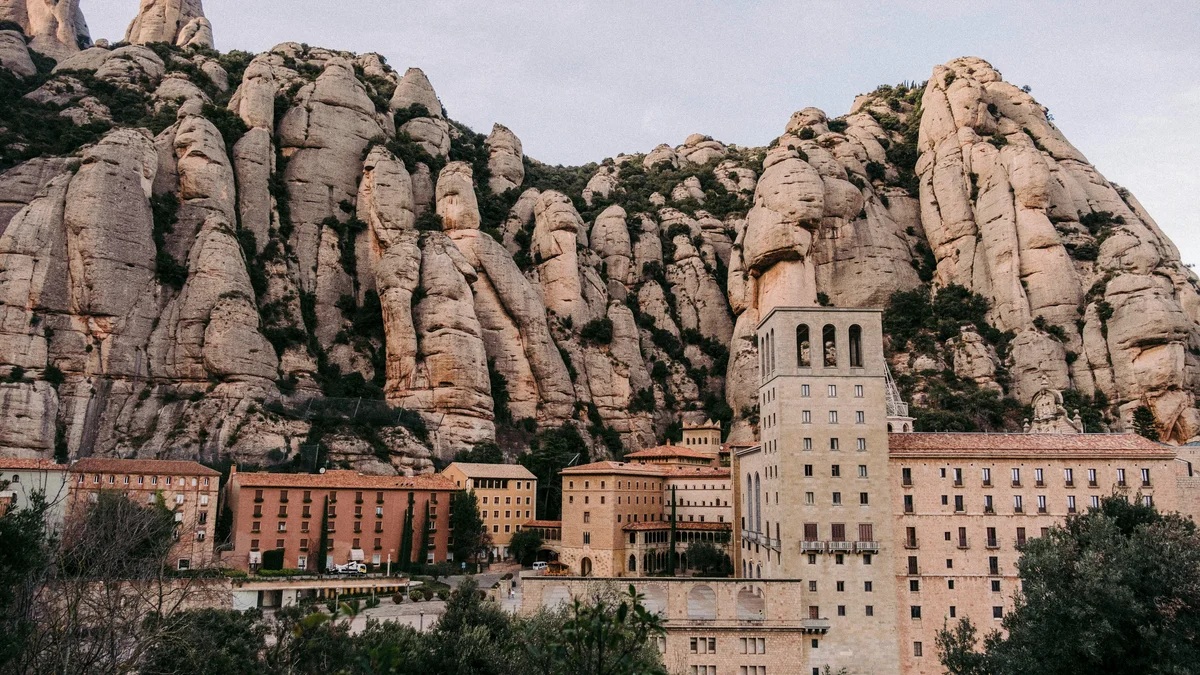
Montserrat Monastery is a Benedictine abbey perched dramatically on a jagged mountain range about an hour outside Barcelona, founded in the 11th century. It's home to the Virgin of Montserrat, a wooden statue known as La Moreneta ('the little dark-skinned one') and one of Catalonia's most venerated religious icons. The monastery can be reached by road or by a rack railway and cable car that climb the mountain, and the surrounding trails offer views across the Catalan countryside.
Visitor guide
Santa Maria de Montserrat is a Benedictine abbey on the mountain of Montserrat, in Catalonia, Spain, about 48 kilometres north-west of Barcelona. It is a spiritual centre for Catalans and is home to a statue of the Virgin known as La Moreneta. The abbey stands on a serrated mountain whose name is often rendered as 'serrated mountain'.
According to Wikipedia, the abbey was founded in 1025 by Abbot Oliba of Ripoll, on the site of an older hermitage of the same name. Wikipedia says it gained its own abbot in 1082, while the monastery's visitor site dates its becoming an independent abbey to 1409. A legend holds that the statue of the Virgin was found around 880, and a cult grew around the Moreneta, developing across four earlier ninth-century hermitages on the mountain.
Montserrat reaches 1,236 metres and is the highest point of the Catalan lowlands. Its summit, Sant Jeroni, can be reached on foot, and on clear days the island of Mallorca is said to be visible. Notable abbots include Giuliano della Rovere, who later became Pope Julius II and served from 1472 to 1483.
Construction of the basilica began in the sixteenth century, and reconstruction started in 1811 after destruction during the Peninsular War. Pope Leo XIII granted minor basilica status in 1881 and on 11 September 1881 proclaimed the Virgin patron saint of Catalonia. The basilica has a single nave measuring 68.32 metres long, 21.50 metres wide and 33.33 metres high.
The Plateresque Revival facade dates from 1901 and is the work of Francisco de Paula del Villar y Carmona, while a later facade by Francesc Folguera was built between 1942 and 1968. The Sala del Cambril, the chamber behind the altar where the Virgin is displayed, was built in 1876-1884 and designed by Villar with his assistant Antoni Gaudi. Pilgrims commonly come to see the statue.
The Escolania, the abbey's boys' choir, is described by Wikipedia as one of the oldest in Europe. The abbey's press published its first book in 1499 and is among the oldest still-operating presses. The cloister was designed by Josep Puig i Cadafalch in 1929.
The museum holds Catalan painters such as Rusinol, Casas, Miro and Dali, French Impressionists such as Monet and Renoir, objects from Egypt and the Holy Land, and older paintings attributed to artists including El Greco and Caravaggio.
The abbey was burned and looted in 1811 and 1812 and was closed from 1835 until 1844. Wikipedia reports that 22 Montserrat monks were among the clergy killed in Catalonia during the Spanish Civil War. During the Franco period, Montserrat became associated with Catalan identity: a 1947 Mass drew over 100,000 people, and prayers were said in Catalan despite government language policy. The abbey marked a thousand years of its existence in 2025.
The abbey can be reached by road, by train or by cable car, and a rack railway links it to Monistrol, according to Wikipedia. Two funiculars serve Santa Cova and the upper slopes. The surrounding mountain has paths, rock formations and viewpoints. A private guided visit helps explain the history and setting, and Voyzo can arrange this with a private vehicle and driver.
See every tour and attraction we cover in Barcelona.