TorontoOntario · 36 tours
 Niagara FallsOntario · 25 tours
 New York CityNew York · 30 tours
 Las VegasNevada · 8 tours
 San FranciscoCalifornia · 16 tours
 VancouverBritish Columbia · 17 tours
 DubaiUAE · 54 tours
 Abu DhabiUAE · 5 tours
 Buenos AiresArgentina · 23 tours
 AthensGreece · 31 tours
 AucklandNew Zealand · 38 tours
 CancunMexico · 54 tours
No destinations match “”. Try searching all tours instead — that search understands full questions, not just place names.
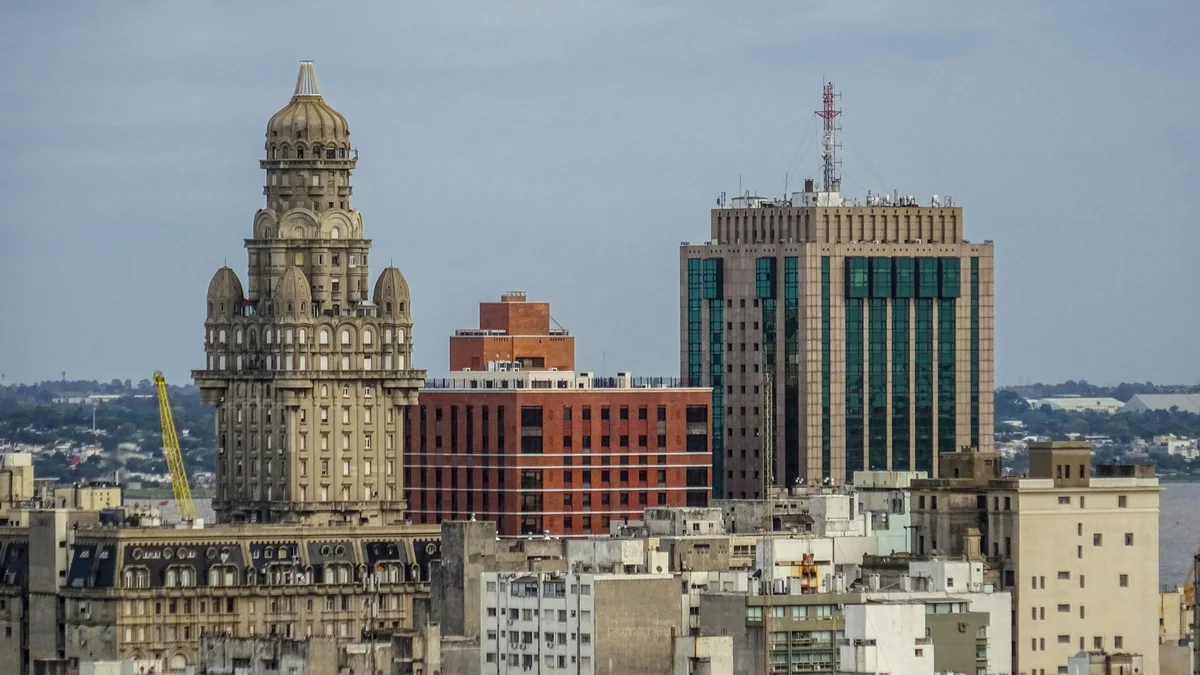
A landmark early-20th-century tower overlooking Plaza Independencia, completed in 1928 and briefly the tallest building in South America. Designed by Italian architect Mario Palanti (who also designed Buenos Aires' similar Palacio Barolo), it combines apartments, offices, and a distinctive spired silhouette that has become Montevideo's most recognizable skyline landmark.
Visitor guide
The Palacio Salvo is an eclectic skyscraper on Plaza Independencia in Montevideo, Uruguay, at the meeting point of the Old City and 18 de Julio Avenue. Designed by the Italian-born architect Mario Palanti for the Salvo brothers, it is a National Historical Monument of Uruguay and one of the most recognisable buildings in the city.
Wikipedia states that the building was commissioned by the brothers Angel, Jose and Lorenzo Salvo, and designed by Mario Palanti, an Italian immigrant who lived in Buenos Aires. The structural engineer was Lorenzo Gori Salvo. Construction ran from 1925 to 1928 according to the article, although other sources give 1922 as the start, so the exact date depends on the source. The plot had previously held La Giralda, a popular cafe where Gerardo Matos Rodriguez is said to have first played the tango La Cumparsita in 1917.
The building has 27 floors plus two basements and is 101 metres high, or 105 metres with its beacon. Wikipedia says that when it was completed it was the tallest reinforced-concrete structure in the world and, briefly, the tallest building in Latin America. Its style is described as eclectic, combining Renaissance references, Gothic reminiscences and Neoclassical touches. Many ornamental corner elements were removed in 1979 because they kept detaching and falling onto public areas.
The beacon on top has changed over time. The original plan called for a lighthouse with a large rotating lamp, but it is unclear when or why it was removed. A television antenna replaced it, and the antenna was removed in 2012. An LED beacon was inaugurated atop the dome in 2017.
Palanti also designed the Palacio Barolo in Buenos Aires, a few years earlier. Wikipedia says the Barolo is five metres shorter and has five fewer floors, and that both buildings draw inspiration from Dante Alighieri's Divine Comedy. Palanti reportedly hoped that the two lighthouses would form a bridge of light across the Rio de la Plata, though miscalculations meant the beams never met.
The Salvo was originally meant as a hotel, but that plan did not succeed, and it later became a mix of offices and private apartments, with some 370 residential units. The basement once held a theatre where performers including Josephine Baker performed. Today the building also hosts a tango museum with an exhibit about La Cumparsita. The English musician Damon Albarn wrote a song, The Tower of Montevideo, that was inspired by the building.
The Salvo is best appreciated from Plaza Independencia, from where the whole tower can be seen, and the plaza is a short walk from the Teatro Solis and the Puerta de la Ciudadela. Because it is an inhabited, privately owned building, access to interiors is limited and depends on organised visits. A private guide can place it in the context of the city's early twentieth-century boom.
See every tour and attraction we cover in Montevideo.