TorontoOntario · 36 tours
 Niagara FallsOntario · 25 tours
 New York CityNew York · 30 tours
 Las VegasNevada · 8 tours
 San FranciscoCalifornia · 16 tours
 VancouverBritish Columbia · 17 tours
 DubaiUAE · 54 tours
 Abu DhabiUAE · 5 tours
 Buenos AiresArgentina · 23 tours
 AthensGreece · 31 tours
 AucklandNew Zealand · 38 tours
 CancunMexico · 54 tours
No destinations match “”. Try searching all tours instead — that search understands full questions, not just place names.
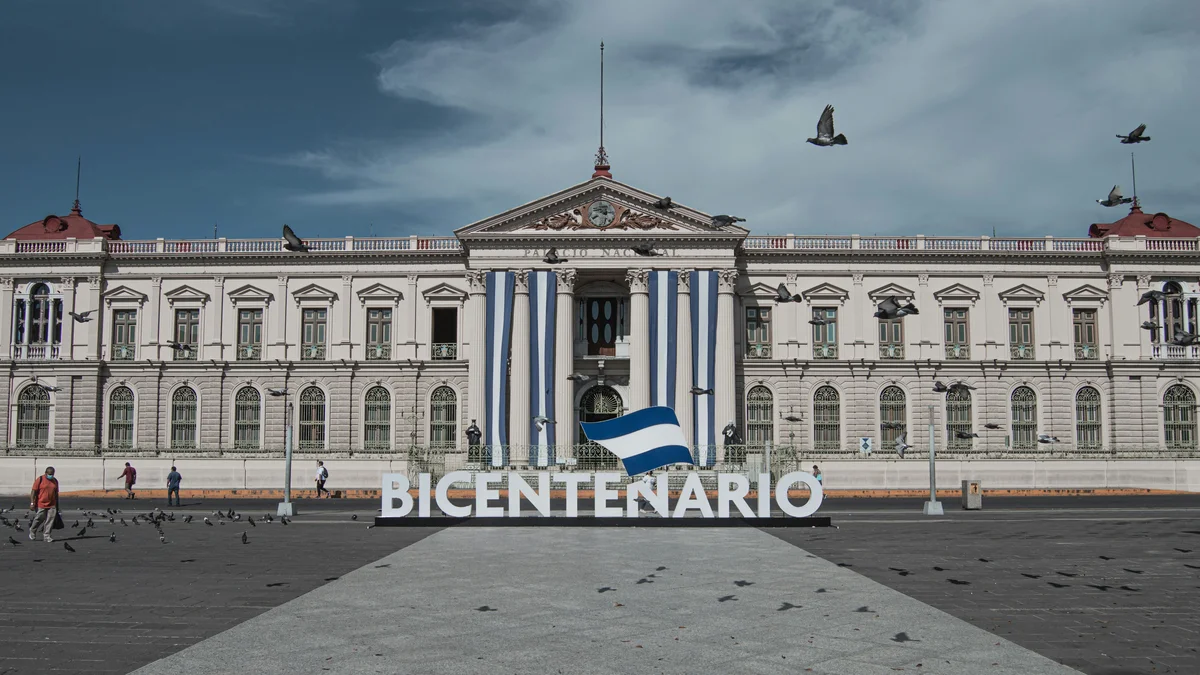
El Salvador's grand neoclassical former seat of government in downtown San Salvador, completed in 1911. The palace witnessed pivotal moments in the country's political history and today is open to the public as a museum, its interior courtyards and period rooms restored to their early-20th-century appearance.
Visitor guide
The National Palace, or Palacio Nacional, in San Salvador is a former seat of government and a national monument in El Salvador's capital. Built between 1905 and 1911, it combines neoclassical, Renaissance and Gothic Revival styles and was assembled with materials imported from several European countries. It stands on Plaza Barrios in the historic centre, opposite the Metropolitan Cathedral.
An earlier National Palace was built between 1866 and 1870. It was destroyed by fire in 1889, leaving the government in need of a new seat. The current palace replaced it after construction ran from 1905 to 1911.
According to the Ministry of Culture, engineer José Emilio Alcaine won the 1903 design competition, and he and engineer José María Peralta Lagos led construction, with the architect Pascasio González as master builder. President Pedro José Escalón is credited with starting construction and Fernando Figueroa with finishing it. To pay for completion, the government passed legislation that collected one colón for each quintal of coffee exported, linking the building to the coffee economy of the period.
Materials were imported from several European countries, including Germany, Italy and Belgium. The building has two floors and stands about 15 metres tall, with a listed area of 7,000 square metres, though the source labels that figure ambiguously.
The palace blends Neoclassical, Renaissance and Gothic Revival elements. It has four main rooms and 101 secondary rooms, and each main room has its own colour. The Red Room, or Salón Rojo, was used for receptions by the Foreign Ministry and for ceremonies in which ambassadors present their credentials. The Yellow Room served as an office for the President of the Republic. The Pink Room once housed the Supreme Court and later the Ministry of Defense.
The Blue Room, or Salón Azul, served as the meeting place of the legislature from 1906. Its classical design includes Ionic, Corinthian and Roman elements, and it is now called the Salvadoran Parliament in memory of its former use. It was declared a National Historic Landmark in 1974.
Government offices occupied the palace until 1974, and a renovation took place in the 1980s according to the infobox. The building is owned by the Government of El Salvador and is listed as a national monument. Details of current restoration or opening arrangements are not described in the source, so they should be checked locally before visiting.
Wikipedia also records a second name in its infobox, Palacio Nacional de los chapines de El Salvador, and notes that the building is currently listed with a restoration status. Its two-storey form, formal rooms and European-sourced finishes make it a useful example of how El Salvador's elites used imported materials and architectural styles to present the state in the early twentieth century.
Located on Plaza Barrios, the palace forms the eastern edge of the square alongside the Metropolitan Cathedral. A private guided walk through the historic centre can link the palace with the cathedral and nearby landmarks, explaining how coffee wealth, civic ambition and European craftsmanship shaped the capital's early twentieth-century public architecture.
See every tour and attraction we cover in San Salvador.