TorontoOntario · 36 tours
 Niagara FallsOntario · 25 tours
 New York CityNew York · 30 tours
 Las VegasNevada · 8 tours
 San FranciscoCalifornia · 16 tours
 VancouverBritish Columbia · 17 tours
 DubaiUAE · 54 tours
 Abu DhabiUAE · 5 tours
 Buenos AiresArgentina · 23 tours
 AthensGreece · 31 tours
 AucklandNew Zealand · 38 tours
 CancunMexico · 54 tours
No destinations match “”. Try searching all tours instead — that search understands full questions, not just place names.
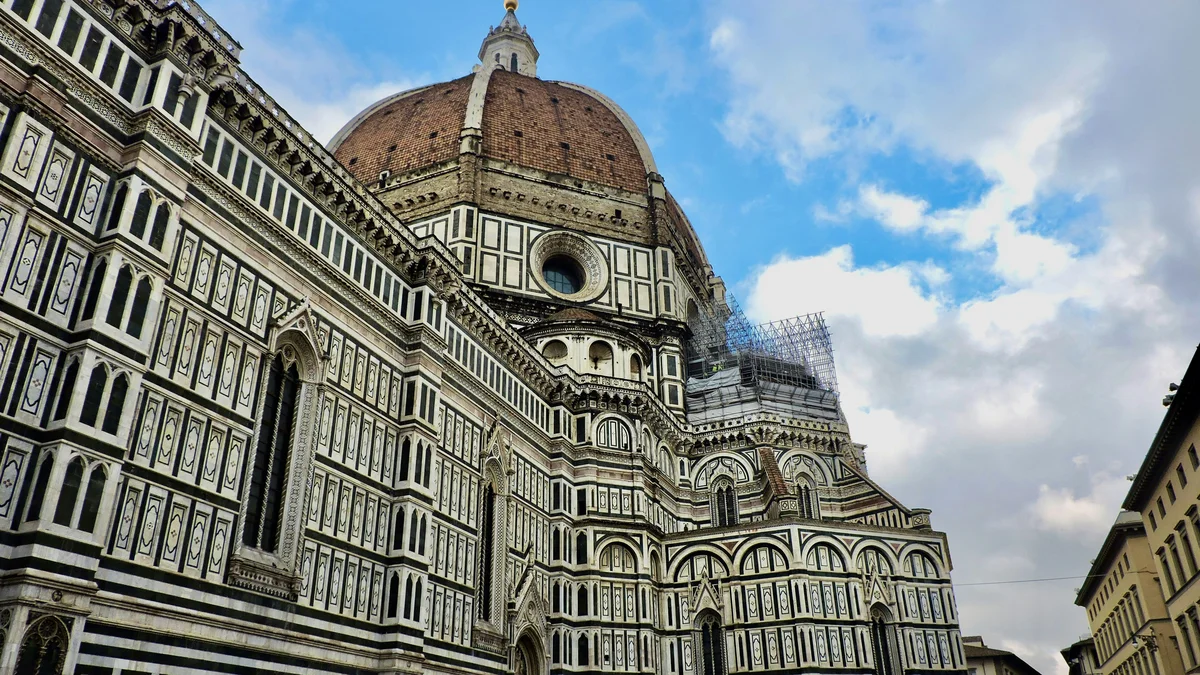
Florence's Gothic-Renaissance cathedral is topped by Brunelleschi's Dome, an engineering marvel completed in 1436 that remains the largest brick dome ever built. The cathedral complex also includes Giotto's Bell Tower and the octagonal Baptistery, famed for Ghiberti's bronze 'Gates of Paradise' doors, together forming the historic heart of the city.
Visitor guide
Florence Cathedral, formally the Cathedral of Saint Mary of the Flower or Santa Maria del Fiore, is the cathedral of the Catholic Archdiocese of Florence in Tuscany, Italy. It was begun in 1296 in the Gothic style to a design by Arnolfo di Cambio and completed by 1436 with a dome engineered by Filippo Brunelleschi. Its exterior is faced in polychrome marble panels of green, pink and white.
Santa Maria del Fiore was built on the site of the earlier cathedral dedicated to Saint Reparata, which was crumbling and too small for the growing city. The city council approved Arnolfo's design in 1294 and the first stone was laid on 9 September 1296. Wikipedia says the vast project was to last 140 years. After Arnolfo's death in 1302 work slowed for almost fifty years, then resumed under the wool merchants' guild, who in 1334 appointed Giotto to oversee construction. Giotto's main contribution was the campanile, which was finished after his death by Francesco Talenti. The nave was finished by 1380, leaving only the dome incomplete.
The design called for an octagonal dome higher and wider than any ever built, with no external buttresses. In 1418 the guild announced a competition, and Brunelleschi, supported by Cosimo de' Medici, beat Lorenzo Ghiberti, though Ghiberti was appointed to share the work. Construction of the dome began in 1420 and was finished in 1436. The dome starts about 52 metres above the floor and spans about 45.5 metres.
Brunelleschi studied the Pantheon in Rome for solutions, but there was not enough timber in Tuscany to build conventional scaffolding for such a dome. He therefore used a double shell of brick, raised without support from below, with stone and iron chains embedded in the inner dome to resist spreading. Sandstone and marble were reserved for the chains, ribs and lantern. The dome remains the largest masonry dome ever constructed, according to Wikipedia.
The original medieval facade was left unfinished and dismantled in 1587 and 1588. The present Gothic Revival facade is a 19th-century work by Emilio De Fabris. The Late Gothic interior is vast and relatively bare, and many decorations have been moved to the Museo dell'Opera del Duomo, including singing galleries by Luca della Robbia and Donatello. Notable works inside honour Florentine heroes, such as frescoes of the condottieri Sir John Hawkwood by Paolo Uccello and Niccolo da Tolentino by Andrea del Castagno, and a depiction of Dante.
Excavations between 1965 and 1974 revealed remains of Roman houses, an early Christian pavement and the ruins of the former cathedral of Santa Reparata. In the part of the crypt open to the public is the simple tomb of Brunelleschi.
The cathedral stands in the Piazza del Duomo with the Florence Baptistery and Giotto's Campanile, all part of the UNESCO World Heritage Site covering the historic centre of Florence. A private guided visit with a driver can help you set the cathedral, baptistery and bell tower in order, and a guide can explain the dome's construction while you view it from the square.
See every tour and attraction we cover in Florence.