TorontoOntario · 36 tours
 Niagara FallsOntario · 25 tours
 New York CityNew York · 30 tours
 Las VegasNevada · 8 tours
 San FranciscoCalifornia · 16 tours
 VancouverBritish Columbia · 17 tours
 DubaiUAE · 54 tours
 Abu DhabiUAE · 5 tours
 Buenos AiresArgentina · 23 tours
 AthensGreece · 31 tours
 AucklandNew Zealand · 38 tours
 CancunMexico · 54 tours
No destinations match “”. Try searching all tours instead — that search understands full questions, not just place names.
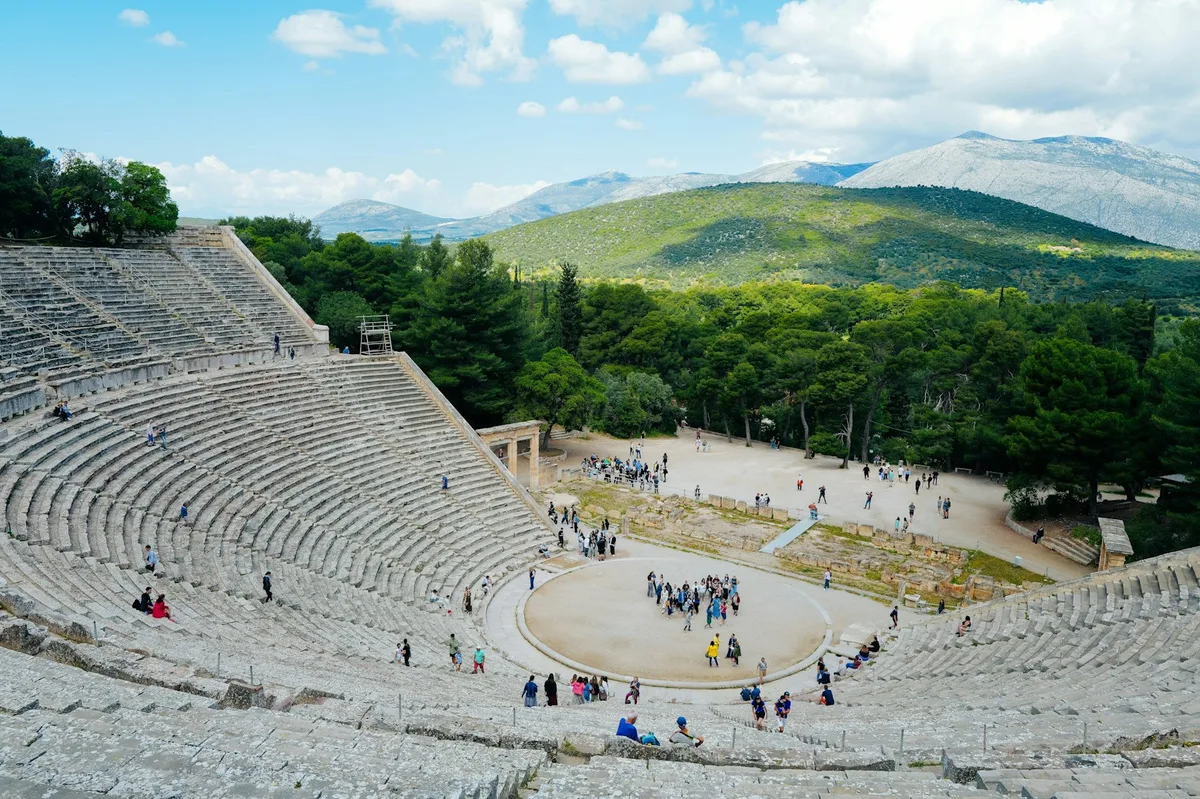
A 4th-century BC theatre in the Peloponnese famed for its near-perfect acoustics, still used for performances today and considered one of the best-preserved ancient Greek theatres.
Visitor guide
The Ancient Theatre of Epidaurus is a 4th-century BC theatre in the Peloponnese of Greece, part of the sanctuary of Asclepius, and is celebrated for its acoustics and its symmetry. It is still used today for dramatic performances, and the sanctuary and theatre were inscribed on the UNESCO World Heritage List in 1988.
The theatre was designed by Polykleitos the Younger in the 4th century BC. According to Wikipedia its original 34 rows of limestone seats were extended in Roman times by another 21 rows, and the theatre can seat up to about 14,000 people. Unlike Roman theatres, Greek theatres treat the landscape behind the stage building as an integral part of the design, so the view of the hills and sky was never meant to be blocked.
Tour guides often repeat that a spoken word can be understood by every spectator, even in the highest rows. Wikipedia notes that measurements made in place moderate this claim: most sounds can be heard throughout the theatre, but intelligibility is not guaranteed, especially for voices with poor projection. This may not have been a problem for Greek actors, who were considered skilled in projecting their voices.
Researchers attribute the effect to both the shape of the theatre and its limestone seating. The seat rows act as an acoustic filter that suppresses low-frequency sounds such as the murmur of a crowd and passes higher-frequency sounds from the stage. Studies include a 2007 paper in the Journal of the Acoustical Society of America on how the seat rows cause acoustic diffraction and a 2016 project that compared Epidaurus with the theatre at Argos and the Odeon of Herodes Atticus in Athens.
The theatre belonged to a sanctuary about eight kilometres from the town of Epidaurus that was the most celebrated healing centre of the Classical world. Its cult is attested from the 6th century BC, when the older hilltop sanctuary of Apollo Maleatas became too small. Patients slept in a large hall called the enkoimeteria and expected the god to advise their cure in dreams. The complex included a guest house of 160 rooms and nearby mineral springs.
The sanctuary declined after Sulla sacked it during the First Mithridatic War in the first half of the 1st century BC, and a visit by the emperor Hadrian in AD 124 revived it. The Goths raided it in AD 395, but it remained a Christian healing centre into the mid-5th century.
UNESCO listed the sanctuary and theatre at Epidaurus in 1988 under cultural criteria i, ii, iii, iv and vi, with a large core area and an even larger buffer zone. The modern town of Epidaurus has its own 4th-century BC theatre, holding about 2,000 spectators, which was excavated from 1990 and later renovated and opened to the public as part of a scheme mapping 140 ancient arenas across Greece.
The great theatre is used again today for performances, which gives visitors a living connection to the ancient setting. A private guided visit suits the site because a guide can explain the theatre, the sanctuary ruins and the story of healing at Asclepius's shrine, and can help visitors test the acoustics for themselves on the stage.
See every tour and attraction we cover in Greece.