TorontoOntario · 36 tours
 Niagara FallsOntario · 25 tours
 New York CityNew York · 30 tours
 Las VegasNevada · 8 tours
 San FranciscoCalifornia · 16 tours
 VancouverBritish Columbia · 17 tours
 DubaiUAE · 54 tours
 Abu DhabiUAE · 5 tours
 Buenos AiresArgentina · 23 tours
 AthensGreece · 31 tours
 AucklandNew Zealand · 38 tours
 CancunMexico · 54 tours
No destinations match “”. Try searching all tours instead — that search understands full questions, not just place names.
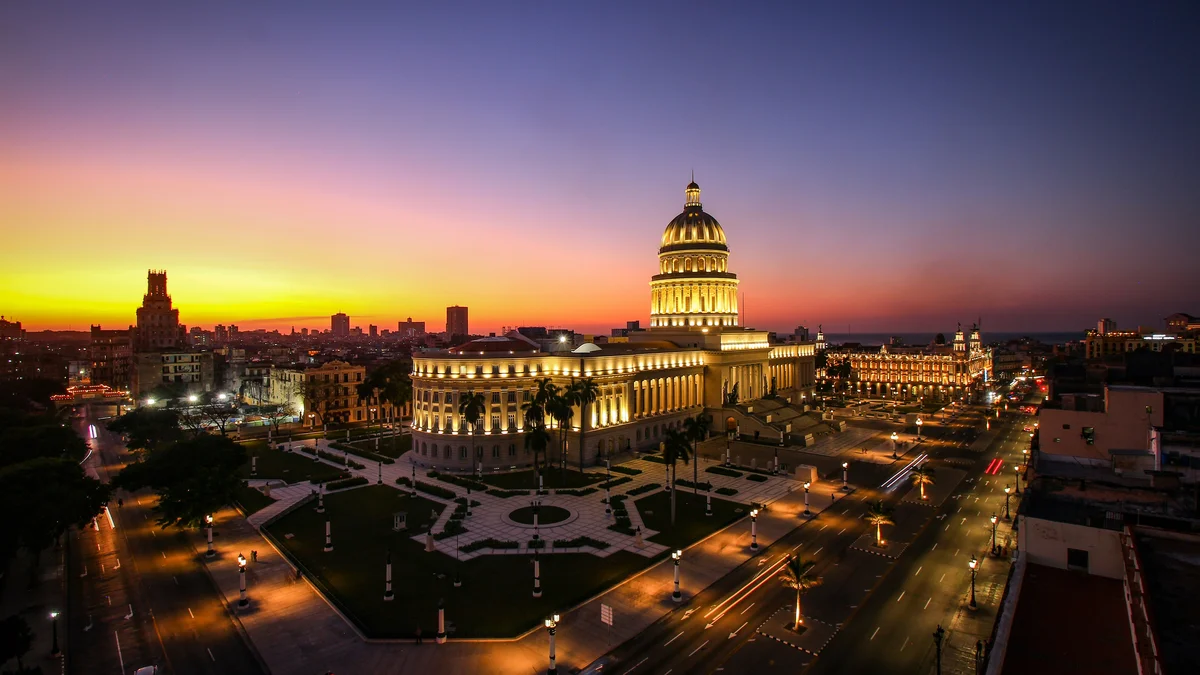
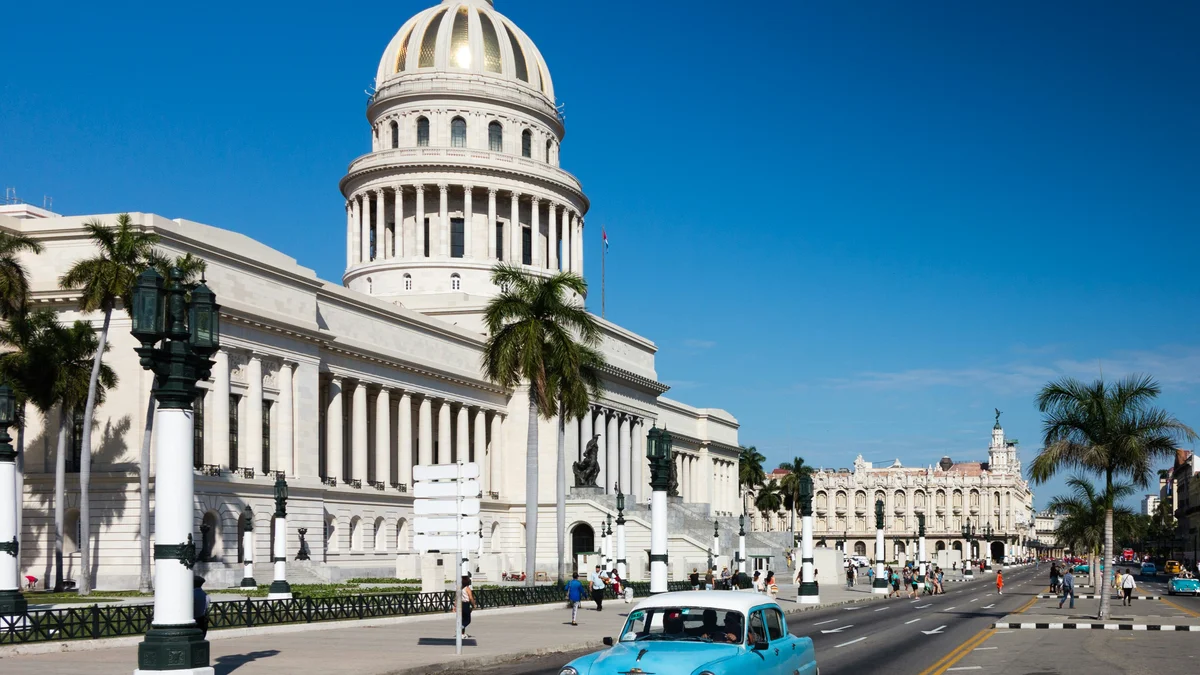
Havana's domed former Capitol building, completed in 1929 and modeled loosely on Washington DC's Capitol, was the seat of Cuba's Congress before the 1959 revolution, later housed the Academy of Sciences, and is now the seat of the National Assembly of People's Power. Its grand marble interior and the Statue of the Republic beneath the dome make it one of the city's most recognizable landmarks.
Visitor guide
El Capitolio is a grand neoclassical building in central Havana, completed in 1929 and long a symbol of the city. It was built as Cuba's legislative seat and, according to Spanish Wikipedia, has housed the National Assembly of People's Power since 2015.
Commissioned by President Gerardo Machado, the building was constructed between 1926 and 1929, with work beginning on 1 April 1926 and finishing on 20 May 1929. Eugenio Rayneri Piedra directed the design, and the American firm Purdy and Henderson supervised construction. According to Wikipedia, it measures 207 metres long and 91 metres wide and was the tallest building in Havana until the 1950s.
Its dome rises about 92 metres and was the highest point in the city until the FOCSA building was completed in 1956. Rayneri said its inspiration came from the Pantheon in Paris, by way of Bramante's Tempietto. The building is often compared with the United States Capitol, but Wikipedia says it is not a replica.
The Spanish article adds that the project was planned around the 1928 Sixth International Pan-American Conference, and that the French urbanist Jean-Claude Nicolas Forestier contributed the monumental setting, including the staircase, side loggias and gardens. The site had earlier been a swamp, a dump, a botanical garden and a railway station. It was inaugurated on 20 May 1929 at a cost of nearly 17 million pesos, shortly before the 1929 financial crash. The site covers about 43,000 square metres.
A monumental granite staircase of 55 steps (Spanish Wikipedia says 56) called La Escalinata leads to a portico with twelve granite Ionic columns, flanked by statues by Angelo Zanelli. Inside stands the Statue of the Republic, also by Zanelli, who made the Altare della Patria in Rome. Cast in bronze in three pieces and covered in gold leaf, it is described as the third-largest indoor statue in the world, though sources give different heights.
A replica 25-carat diamond embedded in the floor of the central hall marks Kilometre Zero for Cuba. The original, said to have belonged to Tsar Nicholas II, was stolen on 25 March 1946 and returned in 1947.
The Spanish article lists 58 varieties of marble, mahogany woodwork, bronze fittings and stained glass among the materials, and describes the dome as about 32 metres in diameter with sixteen ribs decorated in gold leaf. Below the main staircase is the Tomb of the Unknown Mambi, a crypt with a sarcophagus flanked by six bronze figures representing the republic's six provinces. The original diamond was replaced by a replica in 1973 for security reasons.
The Salon de los Pasos Perdidos, or Hall of Lost Steps, is named for its acoustic properties and has inlaid marble floors and gilded lamps. It leads to the two semicircular chambers that once housed the Senate and the Chamber of Deputies.
On 30 August 2019 city historian Eusebio Leal announced the end of a renovation with the unveiling of the dome.
After the revolution of 1959 the building lost its legislative role and housed the Academy of Sciences and a science ministry. It became part of the UNESCO-listed Old Havana in 1982, was declared a National Monument in 2010, and underwent a long restoration. It also hosted the 1940 Constituent Assembly that drafted the 1940 Constitution.
The Capitolio stands near Old Havana and the Parque Central, and is easy to include in a city drive. Because it is an active legislative building, interior access depends on events and arrangements, which should be checked ahead. A private guided visit can combine it with nearby sights such as the Gran Teatro and the cigar factories.
See every tour and attraction we cover in Havana.