TorontoOntario · 36 tours
 Niagara FallsOntario · 25 tours
 New York CityNew York · 30 tours
 Las VegasNevada · 8 tours
 San FranciscoCalifornia · 16 tours
 VancouverBritish Columbia · 17 tours
 DubaiUAE · 54 tours
 Abu DhabiUAE · 5 tours
 Buenos AiresArgentina · 23 tours
 AthensGreece · 31 tours
 AucklandNew Zealand · 38 tours
 CancunMexico · 54 tours
No destinations match “”. Try searching all tours instead — that search understands full questions, not just place names.
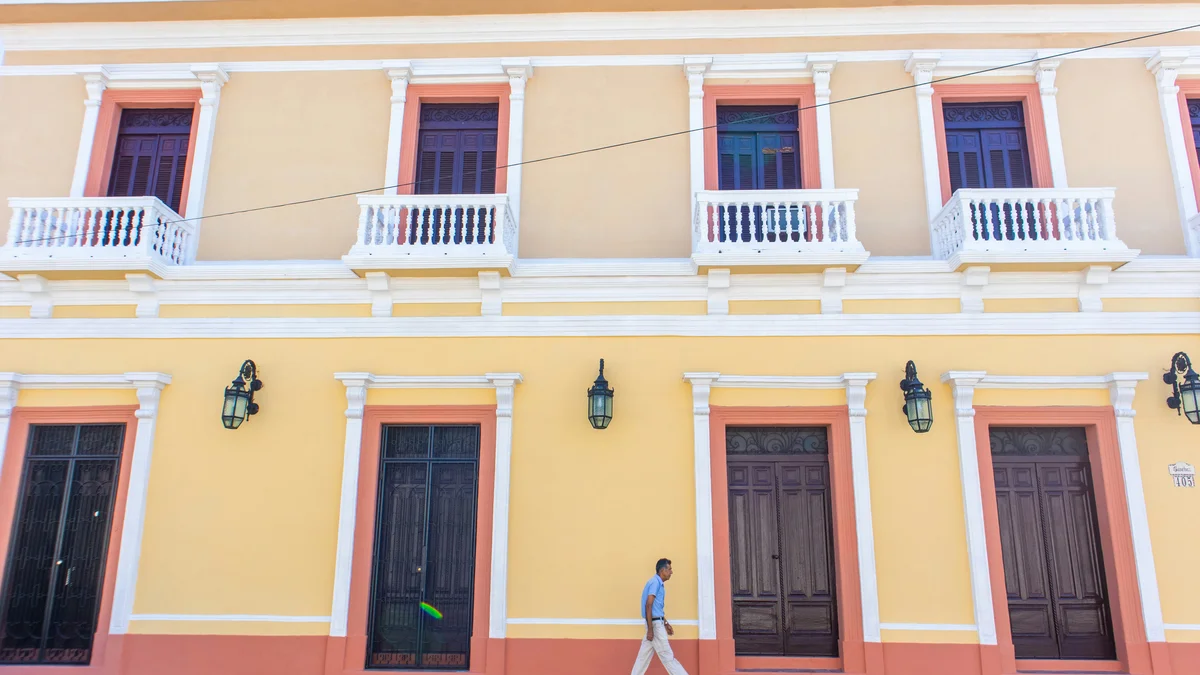
The Convento San Francisco is among the oldest surviving religious buildings in Central America, with a history stretching back to the 16th century, though like much of colonial Granada it was rebuilt after being burned during William Walker's occupation in the 1850s. Its museum wing holds a real collection of pre-Columbian basalt statues gathered from Zapatera Island in Lake Nicaragua, alongside exhibits on the region's indigenous history.
Visitor guide
The Convento y Museo San Francisco in Granada, Nicaragua, is a former Franciscan convent that now houses a museum of pre-Columbian art and regional history. Lonely Planet describes it as one of the oldest churches in Central America. Its best-known collection is a group of black basalt statues from Zapatera Island in Lake Nicaragua.
Sources agree that the convent has a long history but differ on dates. Spanish-language Wikipedia places the foundation in 1529 as a convent of the Immaculate Conception, with the Franciscan order taking charge in 1579, and notes that it was the seat of the Franciscan province of San Jorge de Nicaragua, established in 1575. Another source records original construction in 1585, and travel writers variously give 1529 or 1585, so the founding year is best treated as uncertain. Early building used wood poles, cane and clay tile, and a later reform in the mid-18th century rebuilt it in stone, according to one account.
Wikipedia's article on Granada says the Franciscans built the convent church between 1685 and the late 18th century.
The convent suffered repeated damage. Sources attribute attacks in the 17th century to pirates, with one account naming Henry Morgan in 1665 and another listing a different raider in 1685. Several sources agree that the church and convent were damaged in the 1856 fire ordered by William Walker's forces. One account says that only the outer walls, the entrance hall, part of the tower and the stairs remain of the original structure.
After the conflict, the state is reported to have confiscated the building in 1857, and it served as barracks, hospital and school, with Frommer's describing later uses as a university before becoming a museum. A restoration followed in the late 20th century, and Spanish Wikipedia reports that the museum centre opened in 2003 and that the convent was declared a national monument in 2020.
The museum's highlight is its collection of pre-Columbian basalt statues. Wikipedia describes them as carved from black basalt, generally 1 to 2.25 metres high, and depicting humans and animals, possibly deities or high-status individuals. They date to roughly AD 800 to 1350 and are attributed to the Chorotega. The statues come from Zapatera, the second largest island in Lake Nicaragua, where American diplomat Ephraim George Squier visited in 1849 and Swedish naturalist Carl Bovallius surveyed in 1883.
Almost all statues have been removed from Zapatera, partly through looting, and a sizeable collection is kept at the San Francisco convent museum, with others used as ornament in state buildings or held by private collectors. Granada's Wikipedia article says the museum also displays material from Ometepe, so provenance descriptions vary.
The museum also holds other exhibits on regional history, and the complex has courtyards that sources describe as holding artwork. Because the museum is a working institution, displays and access can change.
The convent is a short walk from the Parque Central and pairs naturally with the cathedral and La Merced. A private guided visit can connect the statues, the building's battered history and Granada's wider story.
See every tour and attraction we cover in Granada.