TorontoOntario · 36 tours
 Niagara FallsOntario · 25 tours
 New York CityNew York · 30 tours
 Las VegasNevada · 8 tours
 San FranciscoCalifornia · 16 tours
 VancouverBritish Columbia · 17 tours
 DubaiUAE · 54 tours
 Abu DhabiUAE · 5 tours
 Buenos AiresArgentina · 23 tours
 AthensGreece · 31 tours
 AucklandNew Zealand · 38 tours
 CancunMexico · 54 tours
No destinations match “”. Try searching all tours instead — that search understands full questions, not just place names.
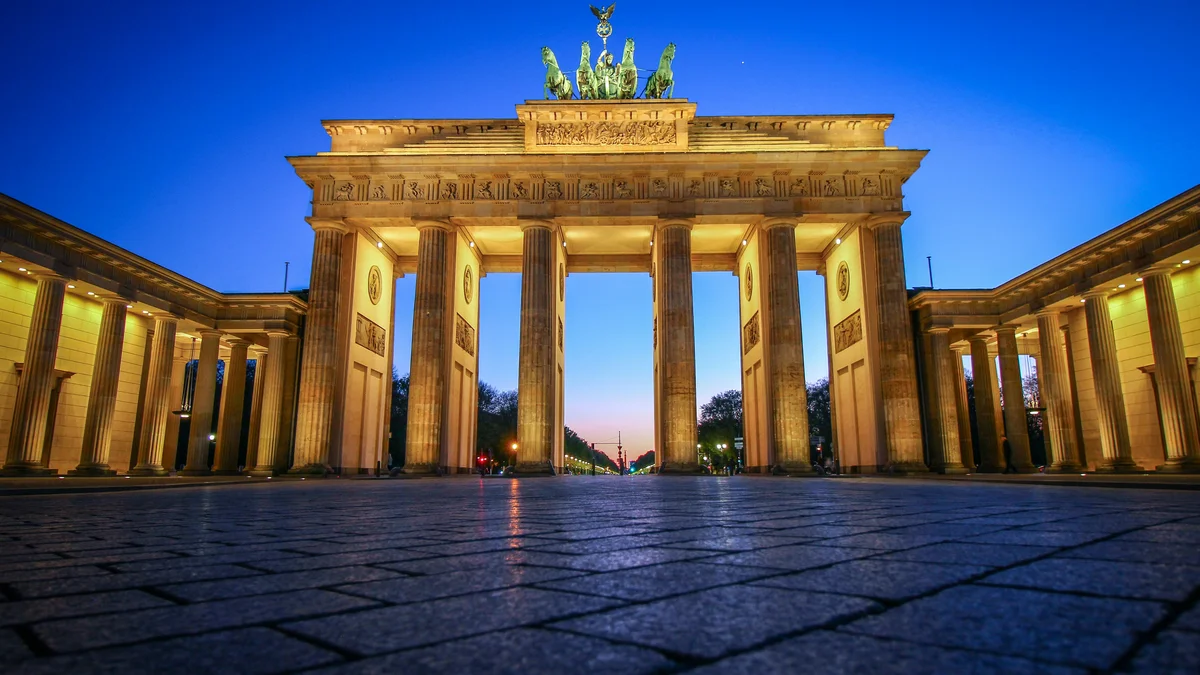
Built in 1791 as a neoclassical city gate, the Brandenburg Gate is Berlin's most recognizable landmark and a symbol of both the city's division and its reunification. It stood just behind the Berlin Wall for nearly three decades before crowds gathered here to celebrate the Wall's fall in 1989, and it remains the ceremonial heart of the reunified city.
Visitor guide
The Brandenburg Gate is an 18th-century neoclassical monument in the Mitte district of Berlin, Germany, and one of the country's best-known landmarks. It stands at the junction of Unter den Linden and Ebertstrasse, beside Pariser Platz, and is crowned by a bronze chariot sculpture known as the Quadriga.
The present gate replaced an earlier customs gate built around 1734. King Frederick William II of Prussia, on the throne from 1786, wanted Berlin to become a cultural centre rivalling Vienna, Paris and London, and in 1788 he appointed Carl Gotthard Langhans, an architect from Breslau, to design a new gate. It was built between 1788 and 1791 and was first called the Peace Gate. Wikipedia describes it as one of the first examples of Greek Revival architecture in Germany.
Its design is based on the Propylaea, the monumental entrance to the Acropolis in Athens. It has twelve fluted Doric columns, six on each side, forming five passageways, and the metopes carry reliefs from Greek mythology, many showing centaurs fighting men. Citizens were originally allowed to use only the outer two passages.
The sculpture on top, a four-horse chariot, is by Johann Gottfried Schadow and was initially intended to represent Eirene, the Greek goddess of peace. After Prussia's defeat at Jena-Auerstedt in 1806, Napoleon took the Quadriga to Paris. It was returned to Berlin in 1814, and Karl Friedrich Schinkel redesigned it so the goddess became Victoria, given a Prussian eagle and an Iron Cross.
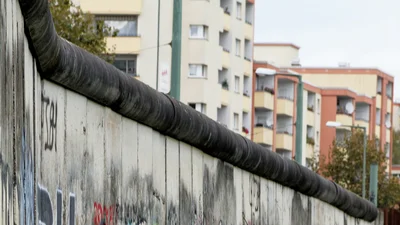
The gate survived the Second World War but was badly damaged, and the Quadriga was recreated from a 1942 plaster cast, with East and West Berlin collaborating on the restoration completed in December 1957. When the Berlin Wall went up on 13 August 1961, it ran along the gate's western side, closing it for the whole Cold War period. On 12 June 1987 US President Ronald Reagan spoke there, calling on Mikhail Gorbachev to tear down the Wall.
The gate became a symbol of freedom after the Wall fell in November 1989. The border crossing reopened on 22 December 1989 when Chancellor Helmut Kohl walked through. The reunification ceremony of October 1990 took place there, and after refurbishment in 2000 the gate was reopened on 3 October 2002 with a new lighting concept.
Pariser Platz is now largely a cobbled pedestrian zone, closed to vehicles, which hosts celebrations and public events and the finish of the Berlin Marathon. The Reichstag is one block to the north and Unter den Linden leads east toward Museum Island, so the gate makes a natural stop on a private guided tour of central Berlin.
See every tour and attraction we cover in Berlin.