TorontoOntario · 36 tours
 Niagara FallsOntario · 25 tours
 New York CityNew York · 30 tours
 Las VegasNevada · 8 tours
 San FranciscoCalifornia · 16 tours
 VancouverBritish Columbia · 17 tours
 DubaiUAE · 54 tours
 Abu DhabiUAE · 5 tours
 Buenos AiresArgentina · 23 tours
 AthensGreece · 31 tours
 AucklandNew Zealand · 38 tours
 CancunMexico · 54 tours
No destinations match “”. Try searching all tours instead — that search understands full questions, not just place names.
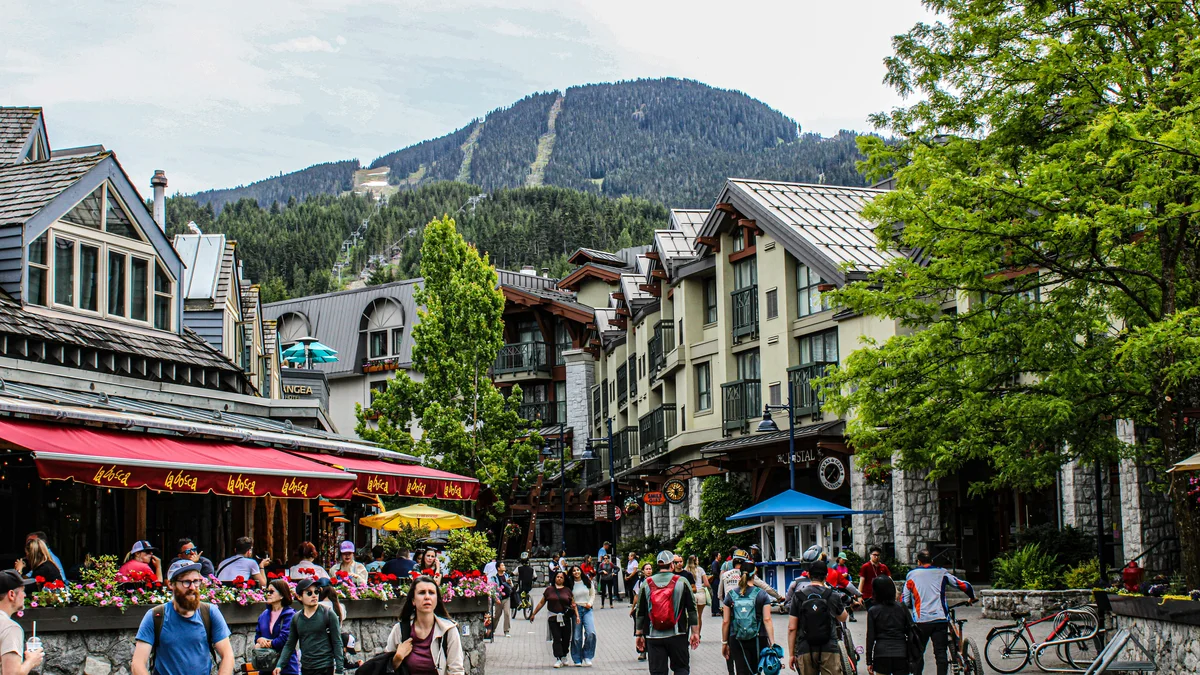
The pedestrian-only heart of the resort, built in the 1980s and expanded for the 2010 Winter Olympics, is packed with shops, restaurants, and cafes at the base of both mountains. Cobblestone walkways connect it to Whistler Olympic Plaza and the gondola bases, making it the natural starting point for exploring the wider valley.
Private Tours
Discover Whistler beyond the village core with a private local guide, visiting Lost Lake, the Squamish Lil'wat Cultural Centre, Green Lake Lookout, and Whistler Olympic Plaza.
 Private Tours
See Whistler without renting a car on this private, comfortable sightseeing tour to Green Lake Lookout, Lost Lake, Rainbow Park, and the Cheakamus River, with a local guide's commentary throughout.
Visitor guide
Whistler Village is the pedestrian-focused core of the resort in the Coast Mountains of British Columbia, where lifts for Whistler and Blackcomb mountains meet a car-free web of plazas, shops, restaurants and hotels. Its layout was planned in the late 1970s with a deliberate idea of how people should move through it.
The area is shared territory of the Lil'wat and Squamish Nations, who know it as Cwítima and Sḵwiḵw respectively. The resort takes its English name from the whistling call of the hoary marmot. Alex and Myrtle Philip founded Rainbow Lodge on Alta Lake in 1914, the year the railway arrived, and Whistler Mountain opened to the public in January 1966 according to the Resort Municipality of Whistler (some sources say 1965). Whistler became part of British Columbia's first resort municipality in 1975, which is why planning here was so tightly controlled.
The Whistler Museum says the original plans for a town centre followed a standard North American grid. In 1978, landscape architect Eldon Beck, who had worked on Vail, Colorado, was brought in for a few days and proposed a different approach. His Village Stroll was meant to mimic the meanders of a stream, with plazas as eddies where people could pause. Loading bays, underground parking and service entrances were tucked into back alleys, and the municipality attached strict covenants to the first 12 parcels offered to developers. Beck's reasoning, as the museum puts it, was that visitors came to relax and a little happy confusion was welcome.
The museum also notes that the site held a small garbage dump, though it was much smaller than local legend suggests. The village was built in phases beginning with Phase 1 in the late 1970s and early 1980s, and each completed stage stayed very close to the original plan.
For the 2010 Winter Olympics and Paralympics, Whistler was the Host Mountain Resort, described as the first community to hold that designation from the IOC. Events held in the Whistler area included alpine skiing, sliding sports and Nordic events. The village served as a hub.
The village is built for strolling. Most visitors begin at the Olympic Plaza and the Gondola Transit Exchange area, near the base of the lifts, and wander the Stroll past shops and restaurants. Lost Lake Park and the Valley Trail are reached on foot or by bike from here, and Scandinave Spa is a short drive away. Whistler's 2021 census population was 13,982 residents.
Parking is limited, and the village's own streets are pedestrian. Voyzo's private vehicle and driver can take you to the village door-to-door from Vancouver or the airport and wait for you, so you do not need to hunt for day parking. Check Resort Municipality of Whistler and Whistler Blackcomb for current events and operating information.
See every tour and attraction we cover in Whistler.