TorontoOntario · 36 tours
 Niagara FallsOntario · 25 tours
 New York CityNew York · 30 tours
 Las VegasNevada · 8 tours
 San FranciscoCalifornia · 16 tours
 VancouverBritish Columbia · 17 tours
 DubaiUAE · 54 tours
 Abu DhabiUAE · 5 tours
 Buenos AiresArgentina · 23 tours
 AthensGreece · 31 tours
 AucklandNew Zealand · 38 tours
 CancunMexico · 54 tours
No destinations match “”. Try searching all tours instead — that search understands full questions, not just place names.
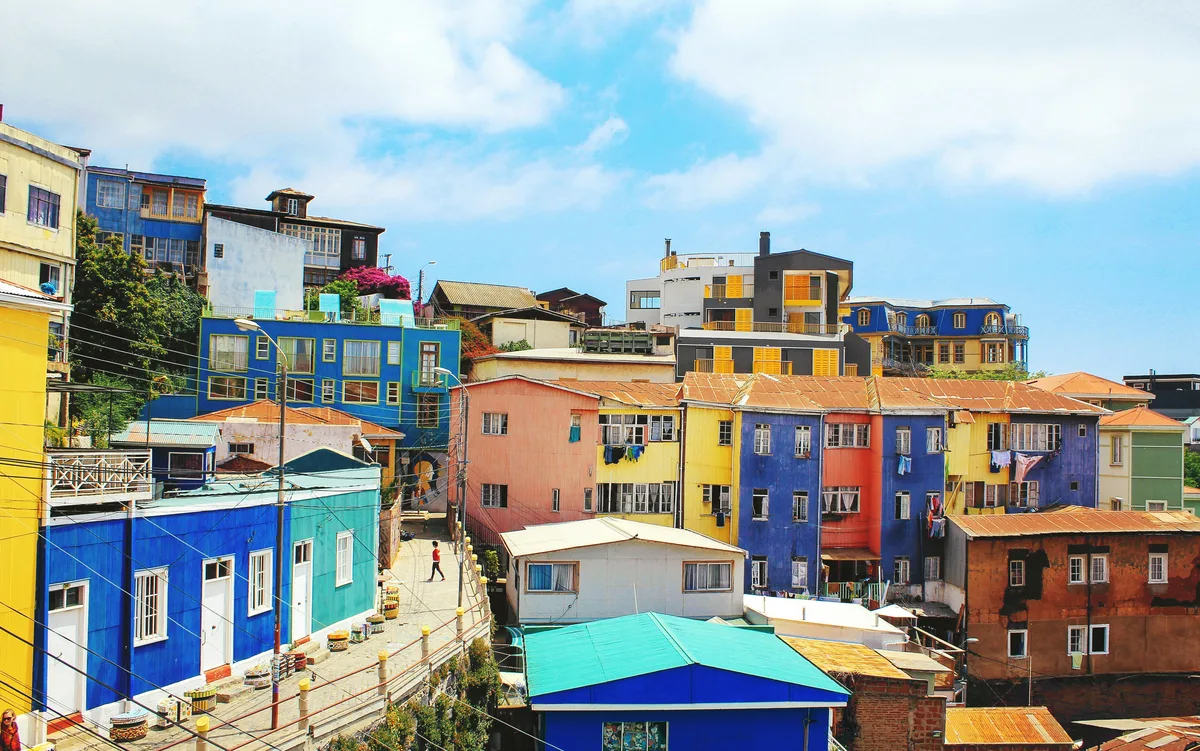
A UNESCO-listed port city built across steep hills above the Pacific, known for its funiculars (ascensores), maze of staircases, and murals covering entire building facades.
Visitor guide
Valparaiso is a port city on Chile's Pacific coast, about 120 kilometres northwest of Santiago, built on dozens of steep hillsides above a curving bay. Its historic quarter was inscribed as a UNESCO World Heritage Site in 2003, and Wikipedia nicknames it the Jewel of the Pacific.
Spanish explorers arrived in 1536, and the town was named after Valparaiso de Arriba in Cuenca, Spain. For most of the colonial era it remained a small village. After independence it became the main harbour for the Chilean navy and, as a stopover for ships rounding Cape Horn and supplying the California gold rush, grew rapidly. Immigrants came from Britain, Germany, France, Switzerland and Italy, and newspapers were printed in several languages.
The British community prospered between the 1820s and 1920s, settling on Cerro Alegre and Cerro Concepcion. Wikipedia lists several firsts claimed for the city, including Chile's first public library and the continent's first volunteer fire department, though such claims should be treated as the article's wording.
The city's character comes from its hills, with a labyrinth of cobbled alleys, staircases and houses stacked up the slopes. Wikipedia credits the World Heritage listing to its improvised urban design and unique architecture. Colourful facades, murals and the open-air museum on Cerro Bellavista are among the sights.
Funiculars called ascensores link the flat port district to the hills. Wikipedia counts sixteen historic examples, fifteen public and one private, many of them national monuments.
The opening of the Panama Canal in 1914 and the shift of shipping to other ports hurt the city, and many wealthy families left. A 1906 earthquake devastated Valparaiso, and the city lies near the Peru-Chile Trench, so earthquakes remain a fact of life. Between 2000 and 2015 it saw a recovery, attracting artists, tourists and cultural entrepreneurs to the hillside districts.
Wikipedia lists among the historic landmarks the Iglesia de la Matriz, Anibal Pinto Square, Sotomayor Square with the Chilean Navy building, and monuments to Admiral Lord Cochrane and Manuel Blanco Encalada. The Cemetery Number One and the Dissidents Cemetery, the first non-Catholic cemetery in Chile, occupy Panteon Hill.
Around the hills are several museums, including the National Maritime Museum, the Lord Cochrane Museum, the Municipal Museum of Fine Arts in the Palacio Baburizza, the Natural History Museum and Lukas' House-Museum. La Sebastiana, one of Pablo Neruda's homes, stands on a hill above the city.
The climate is a mild warm-summer Mediterranean one. Monthly average temperatures range from about 17 degrees Celsius in January to 11.4 in July, and the summer is essentially dry.
Valparaiso has a mild Mediterranean climate with fog from the Humboldt Current, so layers help. The best way to take in the hillsides is on foot with a local guide, using the funiculars and viewing platforms. A private guided visit with a dedicated vehicle and driver can link Valparaiso with Vina del Mar and the coast in a single day from Santiago.
See every tour and attraction we cover in Chile.