TorontoOntario · 36 tours
 Niagara FallsOntario · 25 tours
 New York CityNew York · 30 tours
 Las VegasNevada · 8 tours
 San FranciscoCalifornia · 16 tours
 VancouverBritish Columbia · 17 tours
 DubaiUAE · 54 tours
 Abu DhabiUAE · 5 tours
 Buenos AiresArgentina · 23 tours
 AthensGreece · 31 tours
 AucklandNew Zealand · 38 tours
 CancunMexico · 54 tours
No destinations match “”. Try searching all tours instead — that search understands full questions, not just place names.
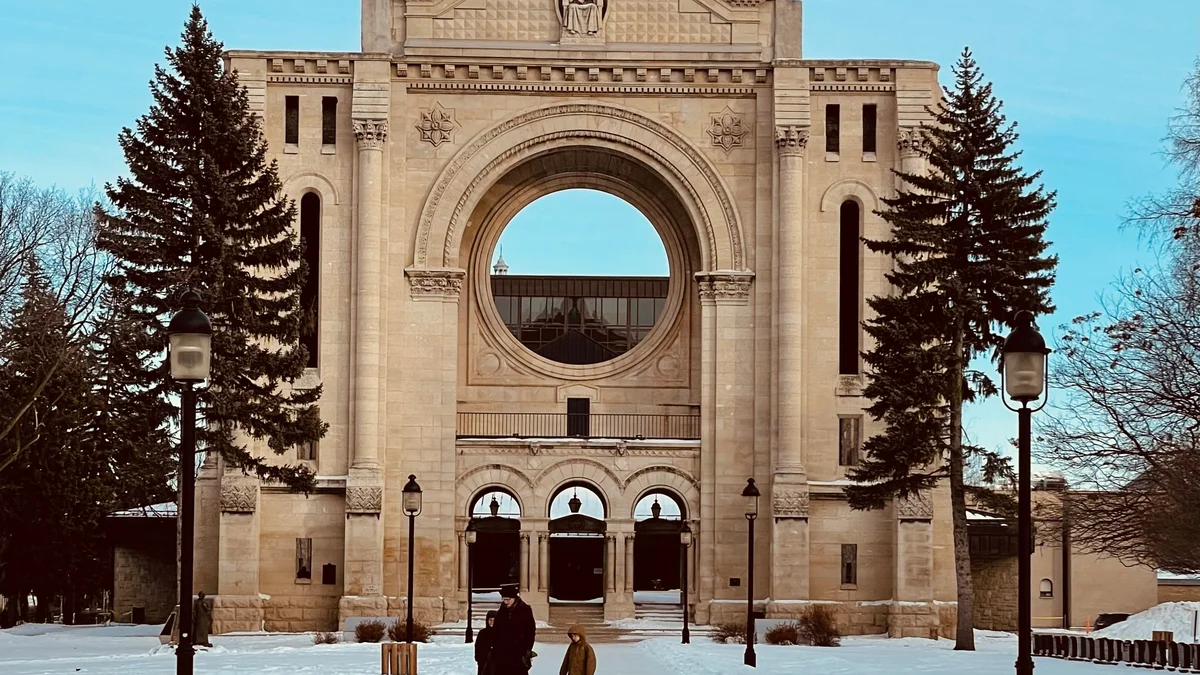
St. Boniface is Winnipeg's historic French quarter and the heart of the largest French-speaking community in Western Canada. It's home to the ruins of the 1908 Saint-Boniface Cathedral facade, the adjoining cemetery where Métis leader Louis Riel is buried, and the Saint-Boniface Museum, housed in a former convent that's among the oldest buildings in Winnipeg.
Visitor guide
Saint-Boniface is the French-speaking quarter of Winnipeg, sitting on the east bank of the Red River opposite The Forks. It began as a Catholic mission in 1818, joined the City of Winnipeg in 1971, and is still regarded as the centre of the Franco-Manitoban community and the largest francophone community in Western Canada. Its cathedral ruins, the grave of Louis Riel and a very old log-built museum make it one of the city's richest short visits.
The district's story starts on 1 November 1818, when Father Joseph-Norbert Provencher built a small log chapel dedicated to Saint Boniface on the site, according to Manitoba's heritage register. A college founded the same year is the ancestor of today's Université de Saint-Boniface. The Grey Nuns arrived in 1844 and went on to found the hospital that is now St. Boniface Hospital. The community became a town in 1883 and a city in 1908, with a population that Wikipedia puts at 817 in 1871 and 7,483 in 1911, before amalgamation with Winnipeg in 1971.
Language was central to its identity. After Manitoba's 1890 legislation removed French as an official language, Saint-Boniface became a focus of resistance in what is known as the Manitoba Schools Question, and its institutions have kept French-language life going ever since.
Louis Riel, the Métis leader who negotiated for Manitoba's entry into Confederation, was born in the Red River settlement in 1844 and is buried in the churchyard of Saint-Boniface Cathedral. Manitoba's heritage listing describes the grounds as the oldest Catholic cemetery in Western Canada, where early settlers, missionaries and other prominent figures also lie.
Five cathedrals have stood on the site. The Romanesque cathedral designed by the Montreal firm Marchand and Haskell had its cornerstone blessed in 1906 and is described in the provincial listing as the best example of French Romanesque architecture in Manitoba. Fire severely damaged it on 22 July 1968. Rather than rebuild a copy, Franco-Manitoban architect Étienne Gaboury designed a new cathedral, blessed in 1972, that incorporates the sacristy, facade and walls of the burned building. The empty stone facade with its open rose-window frame is the image most visitors remember.
The Musée de Saint-Boniface Museum occupies the former Grey Nuns' convent beside the cathedral. Some sources call it the oldest building in Winnipeg and one of the oldest oak-log structures in North America; treat that as a widely repeated claim and check the museum for its own wording. Its focus is Franco-Manitoban and Métis history, with a strong Riel thread.
Beyond the cathedral precinct, Boulevard Provencher is the neighbourhood's main street, lined with cafes and shops, and the Centre culturel franco-manitobain and the Centre du patrimoine, home to Franco-Manitoban archives, anchor the cultural life. Each February the Festival du Voyageur, held at Whittier Park and Fort Gibraltar, celebrates the fur-trade voyageur era. Esplanade Riel, the pedestrian bridge to The Forks, links the quarter to the downtown side of the river.
The Forks, Winnipeg's riverside meeting place, and the Canadian Museum for Human Rights are a short drive or walk across the river, so Saint-Boniface pairs naturally with a half-day of central Winnipeg.
See every tour and attraction we cover in Winnipeg.