TorontoOntario · 36 tours
 Niagara FallsOntario · 25 tours
 New York CityNew York · 30 tours
 Las VegasNevada · 8 tours
 San FranciscoCalifornia · 16 tours
 VancouverBritish Columbia · 17 tours
 DubaiUAE · 54 tours
 Abu DhabiUAE · 5 tours
 Buenos AiresArgentina · 23 tours
 AthensGreece · 31 tours
 AucklandNew Zealand · 38 tours
 CancunMexico · 54 tours
No destinations match “”. Try searching all tours instead — that search understands full questions, not just place names.
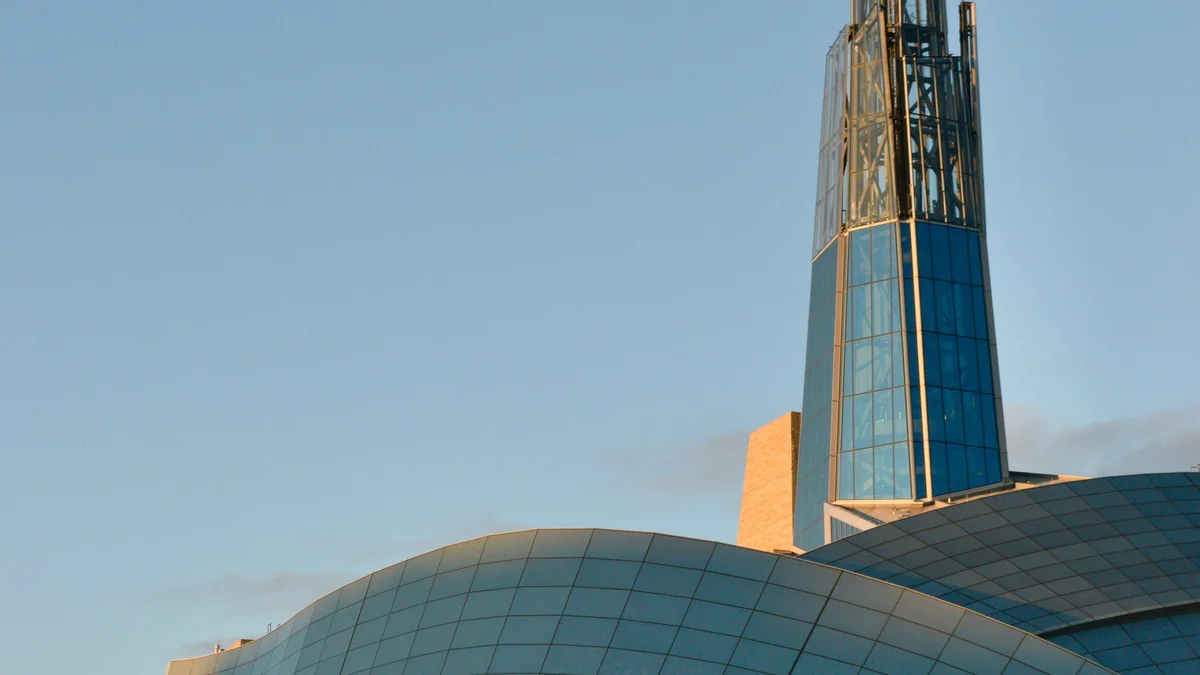
Opened in 2014 at The Forks, the Canadian Museum for Human Rights was the first national museum in Canada built outside the Ottawa region and the world's first museum dedicated solely to human rights. Its striking glass Tower of Hope, designed by architect Antoine Predock, has become one of Winnipeg's defining landmarks.
Visitor guide
The Canadian Museum for Human Rights stands at 85 Israel Asper Way in Winnipeg, just north of The Forks, and opened in September 2014. It is a national museum, the first in Canada located outside the National Capital Region, and its mandate is to explore human rights with a special but not exclusive reference to Canada.
Izzy Asper, the founder of Canwest Global Communications, conceived the museum in July 2000 and announced the project at The Forks on April 17, 2003. He died that October, and his daughter Gail Asper led the effort. Parliament made it a national museum by amending the Museums Act in March 2008, and the groundbreaking took place on December 19, 2008. Funding came from the federal, Manitoba and Winnipeg governments and from private donors. Wikipedia reports a final cost of about $351 million, and the federal government covers operating costs.
Antoine Predock of Albuquerque won an international competition that drew entries from 63 firms in 21 countries. His design wraps a stone mountain of Tyndall limestone, which the museum describes as 400 million years old, in the abstracted wings of a white dove. Its glass "cloud" used 1,335 of the building's 1,669 custom pieces of glass, with the other 334 in the tower. The route through the building rises from dark stone toward light: visitors climb the Hall of Hope, a sequence of backlit alabaster ramps, to the Israel Asper Tower of Hope, a 100-metre glass spire with views of downtown. The Garden of Contemplation, an interior space of still pools and black Mongolian basalt, offers a place to pause. Critics have been divided on the design, with some praising it as a landmark and others finding its symbolism overwrought.
At opening there were ten core galleries, including "What are human rights?", "Indigenous perspectives", "Canadian journeys", "Examining the Holocaust and other genocides", "Breaking the silence" and "Actions count". Exhibits have been developed over time, and the museum shows rotating and special exhibitions; check humanrights.ca for what is currently on. The museum's own site acknowledges that it sits on Treaty 1 territory, in the homeland of the Red River Métis.
The museum has not been free of controversy. Critics argued the site is an important Indigenous archaeological location and that excavations were insufficient. Ukrainian Canadian groups objected to the place of the Holodomor in the exhibits, and in later years there have been disputes over how the museum treats some other subjects and over its management. These debates are part of the story of a museum that deals with contested history.
The Forks is a few steps away, and the Exchange District is a short drive. A Voyzo private tour with a private vehicle and driver can drop guests at the accessible entrance and pick them up at the end of the visit.
See every tour and attraction we cover in Winnipeg.