TorontoOntario · 36 tours
 Niagara FallsOntario · 25 tours
 New York CityNew York · 30 tours
 Las VegasNevada · 8 tours
 San FranciscoCalifornia · 16 tours
 VancouverBritish Columbia · 17 tours
 DubaiUAE · 54 tours
 Abu DhabiUAE · 5 tours
 Buenos AiresArgentina · 23 tours
 AthensGreece · 31 tours
 AucklandNew Zealand · 38 tours
 CancunMexico · 54 tours
No destinations match “”. Try searching all tours instead — that search understands full questions, not just place names.
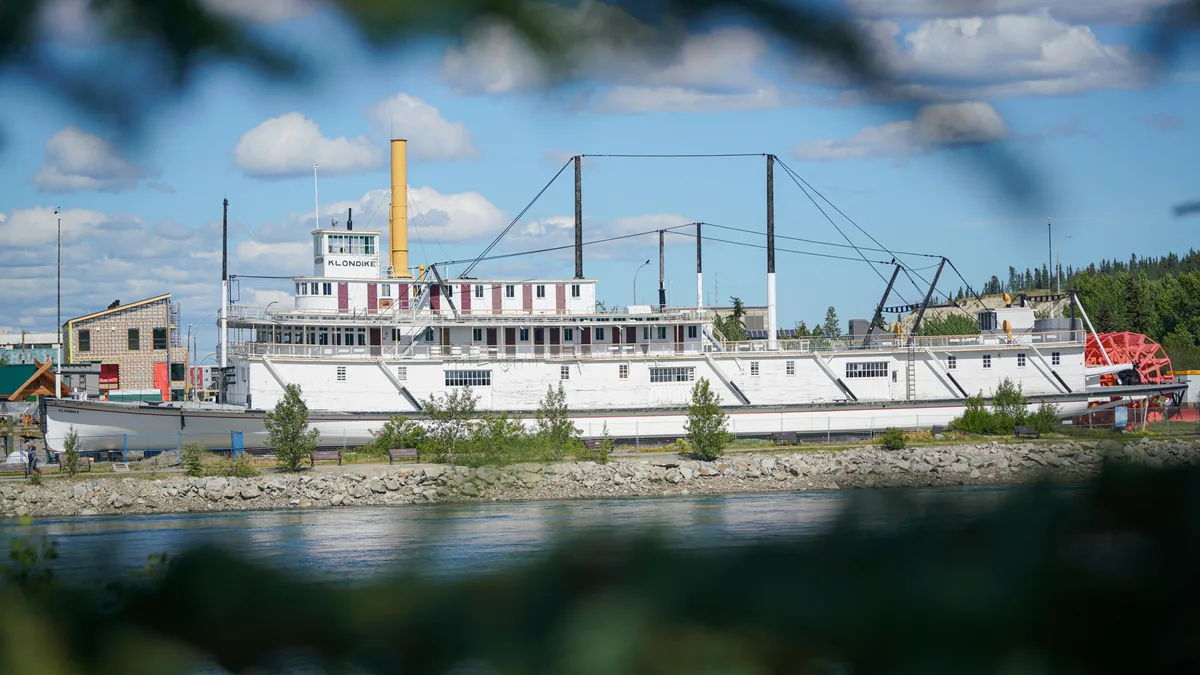
A restored Yukon River sternwheeler from the Klondike era, preserved on the riverbank in downtown Whitehorse.
Visitor guide
The S.S. Klondike is a sternwheeler preserved on the bank of the Yukon River on the edge of downtown Whitehorse, beside the Robert Campbell Bridge. Parks Canada describes it as one of Canada's few remaining steam-powered paddlewheelers, and it stands as the clearest surviving symbol of the riverboat era in the Yukon.
The vessel on display is the second to carry the name. The British Yukon Navigation Company, a White Pass and Yukon Route subsidiary, built the first Klondike in 1929, designed with notably greater cargo capacity than a typical sternwheeler while still drawing little water. In June 1936 it ran aground north of the Thirty Mile section of the river and was lost. Its boiler, engines and many fittings were salvaged for the replacement, Klondike II, launched in May 1937 as a near-replica.
Klondike II is about 64 metres (210 feet) long with a beam of about 12.5 metres, powered by two compound steam engines driving a stern paddlewheel. Its draft is shallow, around 0.6 metres light and 1 metre loaded, which suited the Yukon's shifting channels. It moved ore and freight between Whitehorse and Dawson City; Parks Canada says ore hauling ended in 1950 when the all-weather road to Mayo opened, and riverboat service ended in 1952 when that road was extended to Dawson. White Pass then converted the ship for cruise travel, and Prince Philip took a short trip aboard in 1954, but the cruises ended with a final day excursion on 26 August 1955.
The ship was donated to the Government of Canada by White Pass and Yukon Route in 1960 and was later restored to its 1937 configuration, opening to the public in 1981. Accounts describe the 1966 move to its present site as an operation using bulldozers and steel runners greased with soap flakes, with a crew of about a dozen over roughly three weeks. It was designated a National Historic Site of Canada on 24 June 1967. Parks Canada notes the site sits on the Traditional Territories of the Ta'an Kwäch'än Council and the Kwanlin Dün First Nation, and its interpretation covers how riverboats changed life on Yukon waterways, including the effects on Indigenous peoples.
Parks Canada has been carrying out a long-term rehabilitation of the vessel. For the 2026 season it reported the boat and buildings closed to visitors while the grounds stayed open, with self-guided visits through the Parks Canada Guided Tour App and interpretive panels, plus outdoor exhibits including the Atlin barge. Because this changes, check Parks Canada for current access, tours and hours before planning a stop.
The grounds and riverbank are a short, easy stop even when the ship's interior is not open. On a private tour with a driver, the site pairs naturally with the Yukon River waterfront and Miles Canyon, all within a short drive of each other.
The Yukon River waterfront trails, downtown Whitehorse and the Yukon Transportation Museum, where Parks Canada reports a restored lifeboat is on display, are close by. Miles Canyon lies a few kilometres upstream.
See every tour and attraction we cover in Whitehorse.