TorontoOntario · 36 tours
 Niagara FallsOntario · 25 tours
 New York CityNew York · 30 tours
 Las VegasNevada · 8 tours
 San FranciscoCalifornia · 16 tours
 VancouverBritish Columbia · 17 tours
 DubaiUAE · 54 tours
 Abu DhabiUAE · 5 tours
 Buenos AiresArgentina · 23 tours
 AthensGreece · 31 tours
 AucklandNew Zealand · 38 tours
 CancunMexico · 54 tours
No destinations match “”. Try searching all tours instead — that search understands full questions, not just place names.
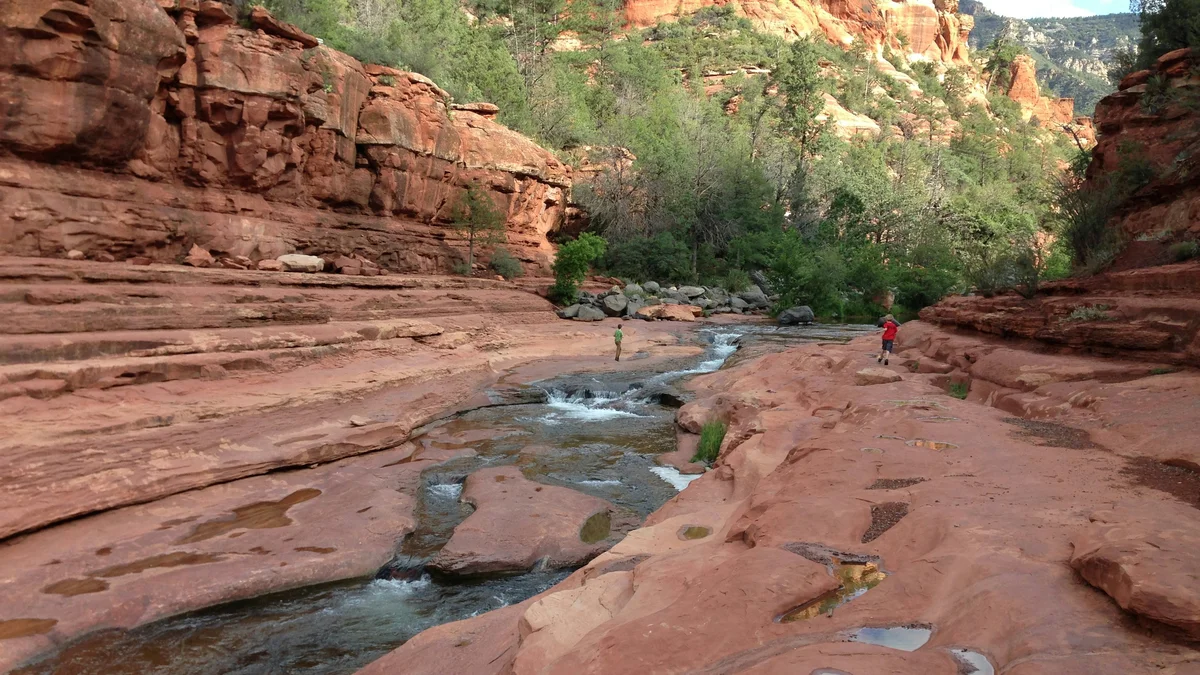
Slide Rock State Park, about 7 miles north of Sedona in Oak Creek Canyon, centers on a natural sandstone water slide formed by Oak Creek's flow over slickrock. Once a working homestead apple farm, it's now one of the most popular swimming spots in the canyon during the warmer months.
Visitor guide
Slide Rock State Park fills a narrow 43-acre bend of Oak Creek Canyon about 7 miles north of Sedona, Arizona, where the creek slides over a smooth sandstone bed beneath towering red cliffs. It is both a swimming spot and a preserved early-20th-century apple homestead, and it sits at roughly 4,930 feet in elevation on the Sedona side of the canyon's pine-and-sycamore corridor.
Frank L. Pendley arrived in the canyon in 1907 and gained title to the land through the Homestead Act in 1910. Earlier settlers had struggled to farm the steep canyon floor, but Pendley built an irrigation system that Arizona State Parks says is still in use today, and he planted his first apple orchard in 1912. He also kept livestock and grew garden produce on the property.
The canyon's isolation eased when a road through Oak Creek Canyon was completed in 1914; the state parks agency notes it was paved in 1938. Travelers began to stay overnight, and in 1933 Pendley built rustic tourist cabins, which helped establish tourism in the canyon. The surviving homestead buildings include a house dating to 1927 and an apple packing shed from 1932, along with the orchard itself. Few intact homesteads remain in Oak Creek Canyon, which is a large part of the park's historical value.
Arizona State Parks bought the property from the Arizona Parklands Foundation on July 10, 1985, and dedicated it as Slide Rock State Park in October 1987. The Pendley Homestead Historic District was added to the National Register of Historic Places on December 23, 1991. The park later became a Leave No Trace Gold Standard Site, according to the parks agency.
The park's name comes from the natural water slide formed where Oak Creek flows across a slick sandstone creek bed. Canyon walls here are cut into the pale, cross-bedded Coconino Sandstone and the red sandstones of the Schnebly Hill Formation, both Permian-age rock, and the canyon follows the line of the Oak Creek Fault. Geologic accounts differ on exactly which layer forms the creek bed at the swim area, so it is safest to say simply that the water runs over sandstone.
The land lies within the Coconino National Forest and is co-managed by Arizona State Parks and the U.S. Forest Service, which is why swim-area openings are coordinated with Forest Service closure orders for Oak Creek. Water levels and swim-area status change, so confirm them before you go.
Beyond the slide and swimming holes, the park keeps the homestead story visible. The historic cabins can be viewed from outside, the old apple orchard still stands, and an Apple Packing Shed open house with a ranger has been offered on weekends. Three short walks give a flavor of the property: the Pendley Homestead Trail (about 0.25 mile), the Slide Rock Route (about 0.3 mile), and the Clifftop Nature Trail (about 0.25 mile). Cottonwoods, sycamores and other riparian trees shade the creek.
Hollywood also found the canyon useful. Westerns shot in the area include Angel and the Badman (1946), Broken Arrow (1950), Gun Fury (1953) and Drum Beat (1954).
Oak Creek Canyon's switchbacking Highway 89A continues north toward Flagstaff, passing Call of the Canyon and the West Fork trail corridor, and Sedona's red-rock viewpoints lie to the south. On a private Voyzo tour, a driver can handle the busy canyon road and parking queue for you and drop your group at the entry station, so the day is spent at the creek rather than in traffic.
See every tour and attraction we cover in Sedona.