TorontoOntario · 36 tours
 Niagara FallsOntario · 25 tours
 New York CityNew York · 30 tours
 Las VegasNevada · 8 tours
 San FranciscoCalifornia · 16 tours
 VancouverBritish Columbia · 17 tours
 DubaiUAE · 54 tours
 Abu DhabiUAE · 5 tours
 Buenos AiresArgentina · 23 tours
 AthensGreece · 31 tours
 AucklandNew Zealand · 38 tours
 CancunMexico · 54 tours
No destinations match “”. Try searching all tours instead — that search understands full questions, not just place names.
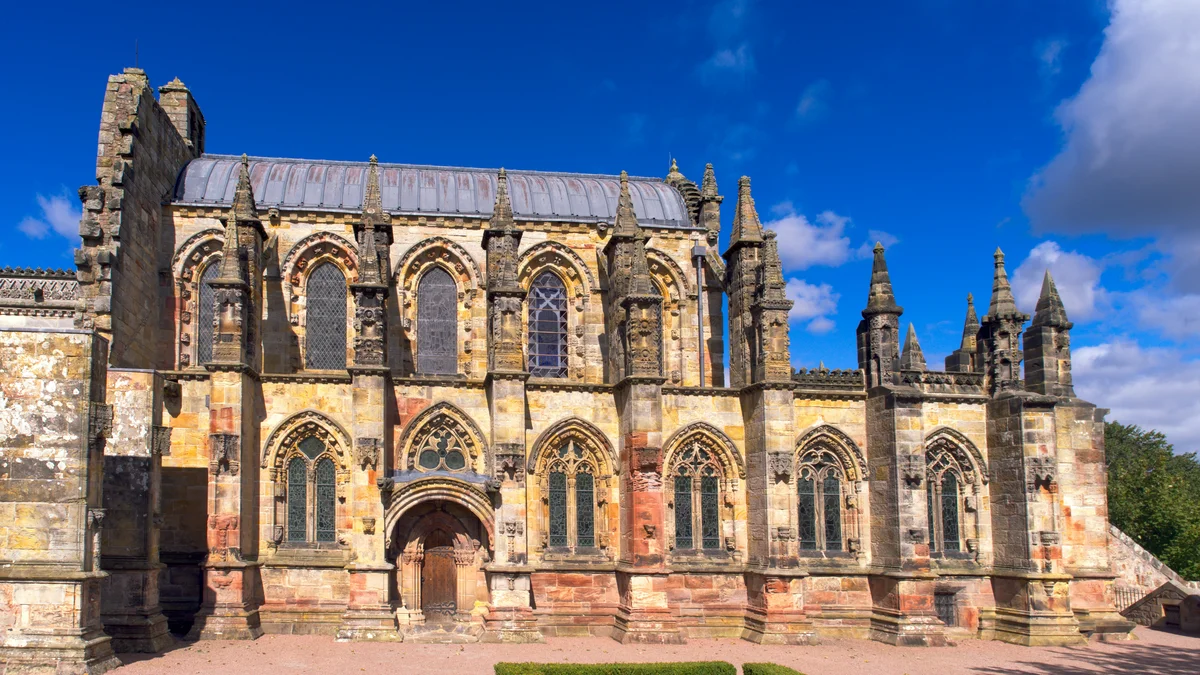
Rosslyn Chapel is a real 15th-century chapel in the village of Roslin, just outside Edinburgh, founded in 1446 by William Sinclair. It's renowned for its extraordinarily dense and intricate stone carvings covering nearly every interior surface, including the famous Apprentice Pillar, which has long attracted theories and legends about its symbolism. The chapel gained wider fame after its appearance in Dan Brown's novel The Da Vinci Code and its 2006 film adaptation, though it remains a genuine, still-active place of worship.
Visitor guide
Rosslyn Chapel, also called the Collegiate Chapel of Saint Matthew, is a fifteenth-century Episcopal chapel in the village of Roslin, Midlothian, near Edinburgh in Scotland. It stands on a small hill above Roslin Glen, holds Category A listed status and is known for its elaborate stone carving.
William Sinclair, 1st Earl of Caithness, of the Scoto-Norman Sinclair family, founded the chapel as a collegiate church dedicated to Saint Matthew the Evangelist. Wikipedia notes that construction is dated to a groundbreaking in 1456, although the foundation is often recorded as 1446, the year the chapel received its founding charter from Rome. The college was staffed by four to six ordained canons and two boy choristers, who performed the Liturgy of the Hours and Masses for the dead, including members of the Sinclair family.
The building was designed to be cruciform, but only the choir was completed, and the original plans have never been found. The Lady Chapel sits above an older vaulted lower chapel believed to belong to an earlier castle. Fourteen pillars form an arcade of pointed arches, and three pillars at the east end are named the Master Pillar, the Journeyman Pillar and the Apprentice Pillar. The Apprentice Pillar was originally called the Prince's Pillar in an 1778 account. The legend of a master mason and his apprentice is a later story and is not historically documented. A full-size plaster cast made in 1871 is held by the Victoria and Albert Museum.
The chapel contains 213 cube-shaped boxes with patterns, whose meaning is unknown, and many were replaced in the nineteenth century after erosion. Some researchers have proposed that the patterns correspond to musical notes, producing a tune called the Rosslyn Motet, but this is speculative. More than 110 Green Men, human faces surrounded by foliage, appear in and around the chapel. Some carvings resemble plants such as wheat, strawberries or lilies; others have been proposed as maize, but botanist Adrian Dyer considered them stylised patterns, and most scholars regard the resemblance as coincidental.
The Scottish Reformation in 1560 ended Catholic worship at the chapel, and its altars were destroyed in 1592. When Queen Victoria visited in 1842 it was ruined and overgrown. David Bryce carried out restoration work in 1862 for the 3rd Earl of Rosslyn, and the chapel was rededicated under the Scottish Episcopal Church. The Rosslyn Chapel Trust was established in 1995, and conservation work ran from 1997 to 2013.
From the 1980s, speculation linked the chapel to the Knights Templar, Freemasonry and the Holy Grail, and Dan Brown's novel The Da Vinci Code brought these ideas to a wide audience. Medieval historians such as Louise Yeoman say the Templar connection has no factual basis, and Robert L. D. Cooper notes the Masonic link is anachronistic because the third Masonic degree took shape around 1720, almost 300 years after the chapel's founding. Legends about what lies in the sealed crypt are unverified. Photography inside the chapel has been banned since 2008. A private guided visit pairs well with Roslin Glen and Edinburgh.
See every tour and attraction we cover in Edinburgh.