TorontoOntario · 36 tours
 Niagara FallsOntario · 25 tours
 New York CityNew York · 30 tours
 Las VegasNevada · 8 tours
 San FranciscoCalifornia · 16 tours
 VancouverBritish Columbia · 17 tours
 DubaiUAE · 54 tours
 Abu DhabiUAE · 5 tours
 Buenos AiresArgentina · 23 tours
 AthensGreece · 31 tours
 AucklandNew Zealand · 38 tours
 CancunMexico · 54 tours
No destinations match “”. Try searching all tours instead — that search understands full questions, not just place names.
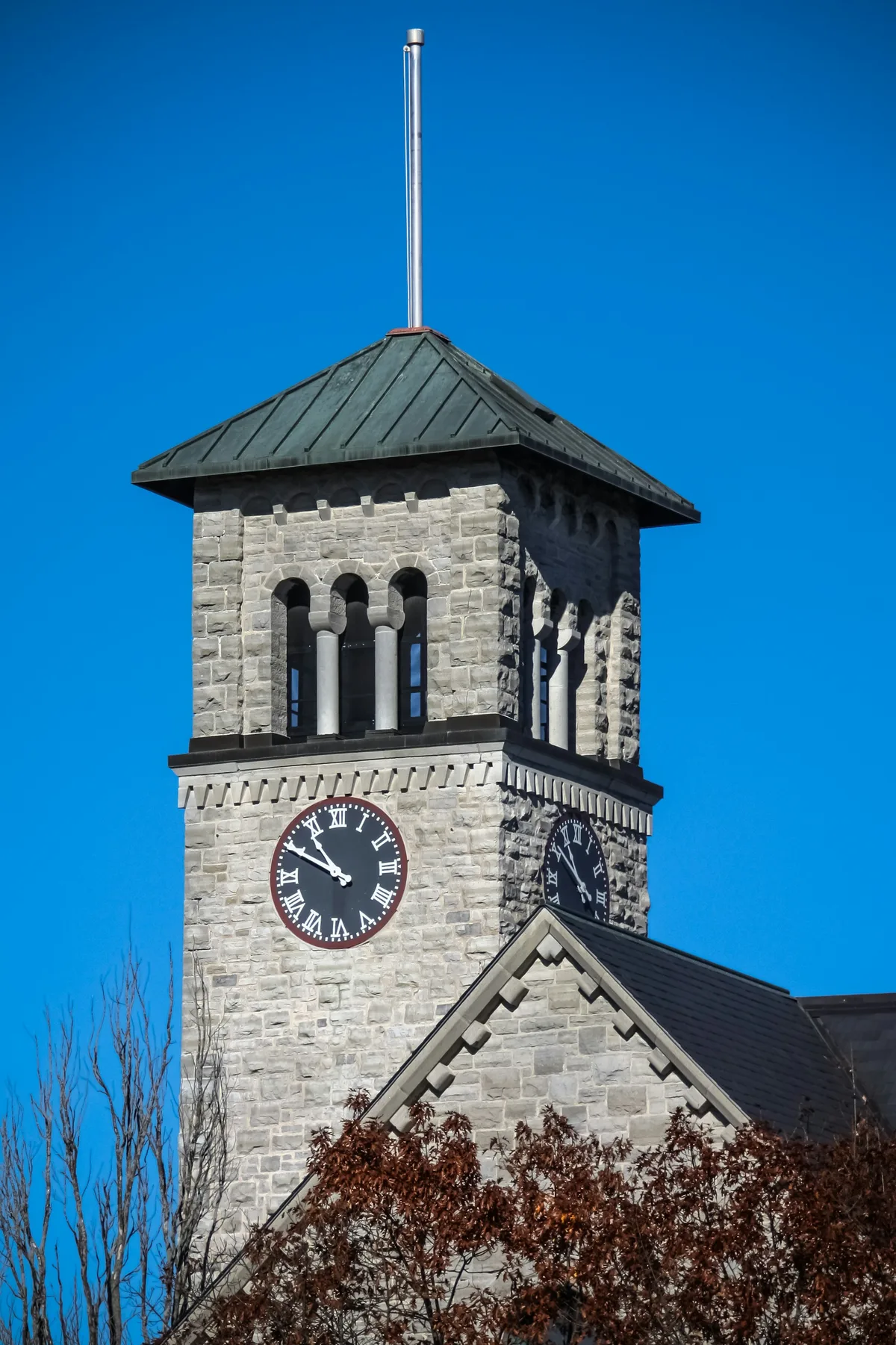
A limestone university campus in downtown Kingston founded in 1841, one of Canada's oldest universities and a recognizable part of the city's historic streetscape.
Visitor guide
Queen's University sits on a limestone-flanked campus beside Lake Ontario in the heart of Kingston, Ontario. It was established by royal charter from Queen Victoria on 16 October 1841 and is among the older universities in the country. The main campus, roughly 40 hectares, borders Lake Ontario and Kingston General Hospital, which makes it an easy and walkable stop on any Kingston itinerary.
Queen's was founded by Presbyterians in Upper Canada who wanted a college to train ministers and to teach science and literature, and it was modelled on Scottish universities such as Edinburgh and Glasgow. Classes began on 7 March 1842 in a small wood-frame house on the edge of town with two professors; sources give the first student count as 13 or 15. For its first eleven years the college had no permanent home and moved between rented houses before settling at Summerhill, a limestone residence that still stands at the heart of the main campus. A medical faculty was added in 1854.
The college nearly collapsed in 1867-68, when the government withdrew funding and a commercial bank failed, taking about two-thirds of the endowment with it. Principal William Snodgrass and others rescued it through a fundraising drive across Canada. Under Principal George Monro Grant, who led from 1877 to 1902, the college more than tripled in size. It received university status in 1881 and, in 1912, separated from the Presbyterian Church and took the name Queen's University at Kingston.
Queen's was the first university west of the Maritime provinces to admit women, in 1869. The record is not tidy, though: three women admitted to medical courses in 1880 were expelled in 1883 after hostility from male students and staff, and a separate Women's Medical College was founded so that they could finish their training.
The best-known landmark is Grant Hall, completed in 1905 and named for Principal Grant, with its clock tower and a reputation as the campus's most recognizable building. Summerhill, opened in 1839, is described as the oldest building on campus. University Avenue, the central artery of the main campus, is lined with many of the older limestone buildings.
The Agnes Etherington Art Centre stands on University Avenue opposite Grant Hall. It grew out of a house built for the Richardson family in 1879, which Agnes Etherington left to the university; accounts differ on whether this was a 1950s gift or a bequest, and the centre opened to the public in 1957. Wikipedia reports a collection of over 14,000 works. The Isabel Bader Centre for the Performing Arts opened in September 2014 and is home to the Department of Film and Media.
Wikipedia, citing 2022 figures, reports total enrolment of 33,842, of whom 26,052 were undergraduates and 5,733 postgraduates, and says over 131,000 alumni live in 156 countries. Queen's also owns Herstmonceux Castle in East Sussex, England, donated in 1993 by alumnus Alfred Bader, which houses Bader College. Nobel laureates linked to the university include Arthur B. McDonald (Physics, 2015) and David Card (Economics, 2021). The student radio station CFRC and the quarterly Queen's Quarterly, published since 1893, are among its long-running institutions.
Most campus buildings are in active academic use, so treat a visit as an outdoor walk around University Avenue, the lakeshore side of campus and the exteriors of the historic halls. Whether specific buildings, galleries or tours are open to the public varies with the academic calendar, so check the university and the Art Centre directly.
Kingston is compact, and Queen's is close to downtown, the waterfront and Fort Henry. Voyzo's private tours use a private vehicle and driver with door-to-door pickup, so the campus can be worked into a longer day alongside Kingston's fortifications and the Thousand Islands without parking or transit logistics.
See every tour and attraction we cover in 1000 Islands.