TorontoOntario · 36 tours
 Niagara FallsOntario · 25 tours
 New York CityNew York · 30 tours
 Las VegasNevada · 8 tours
 San FranciscoCalifornia · 16 tours
 VancouverBritish Columbia · 17 tours
 DubaiUAE · 54 tours
 Abu DhabiUAE · 5 tours
 Buenos AiresArgentina · 23 tours
 AthensGreece · 31 tours
 AucklandNew Zealand · 38 tours
 CancunMexico · 54 tours
No destinations match “”. Try searching all tours instead — that search understands full questions, not just place names.
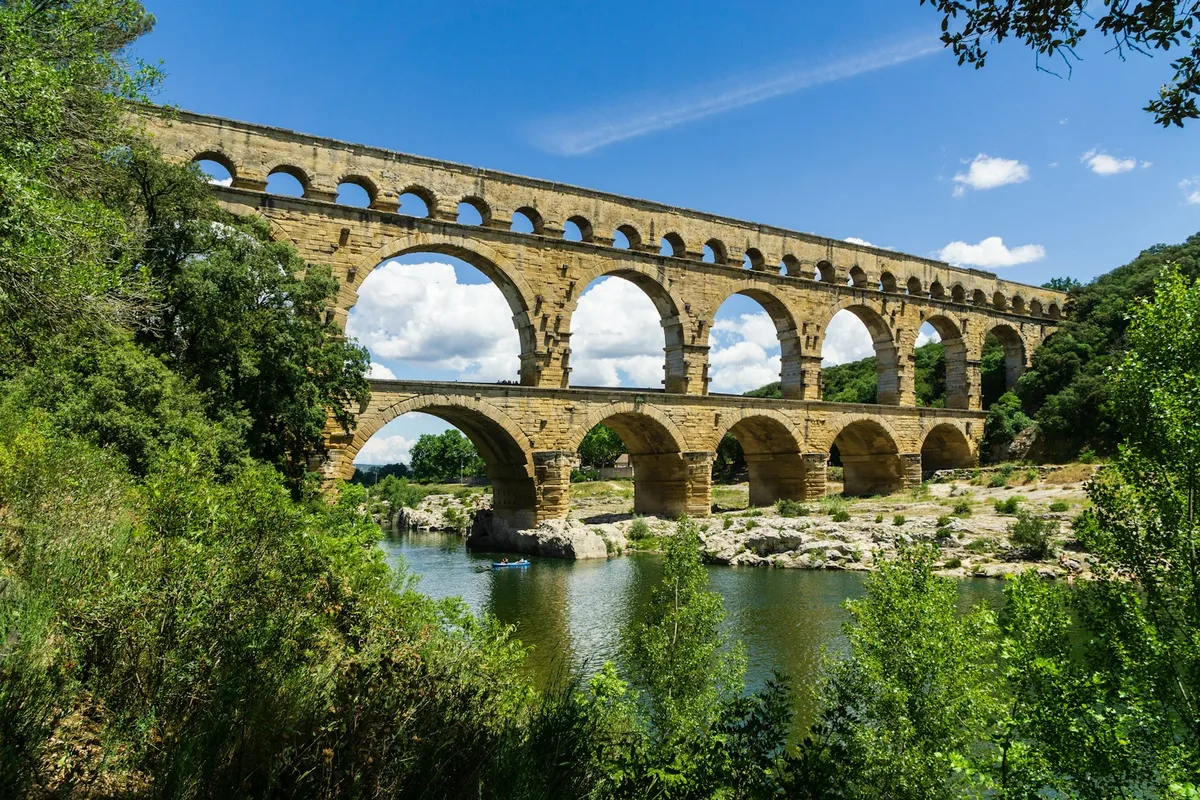
A Roman aqueduct bridge in Provence built in the 1st century AD to carry water nearly 50 kilometers to Nîmes, its three tiers of stone arches among the best-preserved Roman structures anywhere.
Visitor guide
The Pont du Gard is an ancient Roman aqueduct bridge in southern France, crossing the Gardon river near the town of Vers-Pont-du-Gard. Built in the first century AD, it carried water more than 50 kilometres to the Roman colony of Nemausus, now Nimes, and is one of the best-preserved Roman aqueduct bridges.
Nimes was awkwardly placed for water supply, so the Romans looked to springs near Uzes. The Nimes aqueduct carried water from the Fontaine d'Eure to a distribution basin in the city, where it fed fountains, baths and private homes. The straight-line distance is only about 20 kilometres, but the aqueduct winds around 50 kilometres to avoid the difficult hills known as the Garrigues de Nimes. Wikipedia estimates it supplied around 40,000 cubic metres of water a day, which took nearly 27 hours to flow from source to city.
The gradient was remarkably gentle, averaging about 1 in 3,000, and as shallow as 1 in 20,000 in places. To keep the bridge from becoming impossibly high, the engineers varied the slope along the route, which lowered the structure by about six metres.
The bridge has three tiers of arches built of shelly limestone and stands 48.8 metres high, which Wikipedia calls exceptionally high by Roman standards. The aqueduct may have remained in use as late as the 6th century, but poor maintenance after the 4th century let mineral deposits and debris clog the channel until the water stopped flowing.
After the empire collapsed, the Pont du Gard survived largely intact and gained a second life as a toll bridge, with local lords and bishops responsible for its upkeep. Some stones were looted, and serious damage was done in the 17th century. Interest grew from the 18th century and the site became an important tourist destination. A series of renovations culminated in 2000, with a new visitor centre and the removal of traffic and buildings from the bridge's immediate surroundings. It has attracted a succession of literary and artistic visitors.
Visitors today see the structure as a landscape monument as much as an engineering one: the long arcades of pale stone rise above the river, and the precision of the Roman surveying, with a fall of only a few millimetres over many metres in some stretches of the channel, is part of what earns the aqueduct its place among the most admired works of ancient engineering.
The Pont du Gard was added to the UNESCO World Heritage List in 1985 for its exceptional preservation, historical importance and architectural ingenuity. It is among France's most popular tourist attractions. The bridge is set in a natural landscape beside the Gardon river, and it sits conveniently between Avignon, Nimes and Uzes, so a private driver and guide can combine it with other Provence stops.
See every tour and attraction we cover in France.