TorontoOntario · 36 tours
 Niagara FallsOntario · 25 tours
 New York CityNew York · 30 tours
 Las VegasNevada · 8 tours
 San FranciscoCalifornia · 16 tours
 VancouverBritish Columbia · 17 tours
 DubaiUAE · 54 tours
 Abu DhabiUAE · 5 tours
 Buenos AiresArgentina · 23 tours
 AthensGreece · 31 tours
 AucklandNew Zealand · 38 tours
 CancunMexico · 54 tours
No destinations match “”. Try searching all tours instead — that search understands full questions, not just place names.
Mendoza's largest and most central plaza, laid out in the rebuilt city after the 1861 earthquake, with the Museo Municipal de Arte Moderno underground and a weekend arts-and-crafts market above — the natural starting point for exploring the Old Town on foot.
Visitor guide
Plaza Independencia is the central square of Mendoza, Argentina, inaugurated in 1863 after the city was rebuilt following the 1861 earthquake. Covering more than 55,000 square metres, it sits in the heart of the city and is the main square among the five that were laid out in the new city plan.
The 1861 earthquake devastated old Mendoza and killed at least 5,000 people, according to Wikipedia. During reconstruction, led by the engineer Julio Balloffet, planners made it a priority to create open spaces that could serve as refuge during future earthquakes. The new grid layout included five plazas, one central and four equidistant, and the present Plaza Independencia was the central one. Mendoza was rebuilt with larger squares and wider streets and sidewalks than any other Argentine city. The plaza is bounded by the streets Patricias Mendocinas, Chile, General Espejo and Rivadavia, and Spanish Wikipedia describes it as open around the clock.
In its early years the square was known as the Parque. Spanish Wikipedia says it had a balustrade and an artificial lake, which was its main attraction, along with a horse-drawn carousel for children.
Several landmarks surround the square. The Colegio Nacional Agustín Álvarez was built in 1911, the Plaza Hotel opened in 1922, and the Teatro Independencia opened in 1925, all on Calle Chile. The Provincial Legislature building, dating from 1889, stands at the corner of Patricias Mendocinas and Sarmiento.
Remodelling began in the early 1940s. In 1968, during the first term of mayor Víctor Fayad, a municipal mini-theatre and the Museo Municipal de Arte Moderno were inaugurated beneath the plaza and linked to the pedestrian Sarmiento street, and the Teatro Julio Quintanilla was remodelled. The plaza was later remodelled again under mayor Roberto Iglesias into its present appearance.
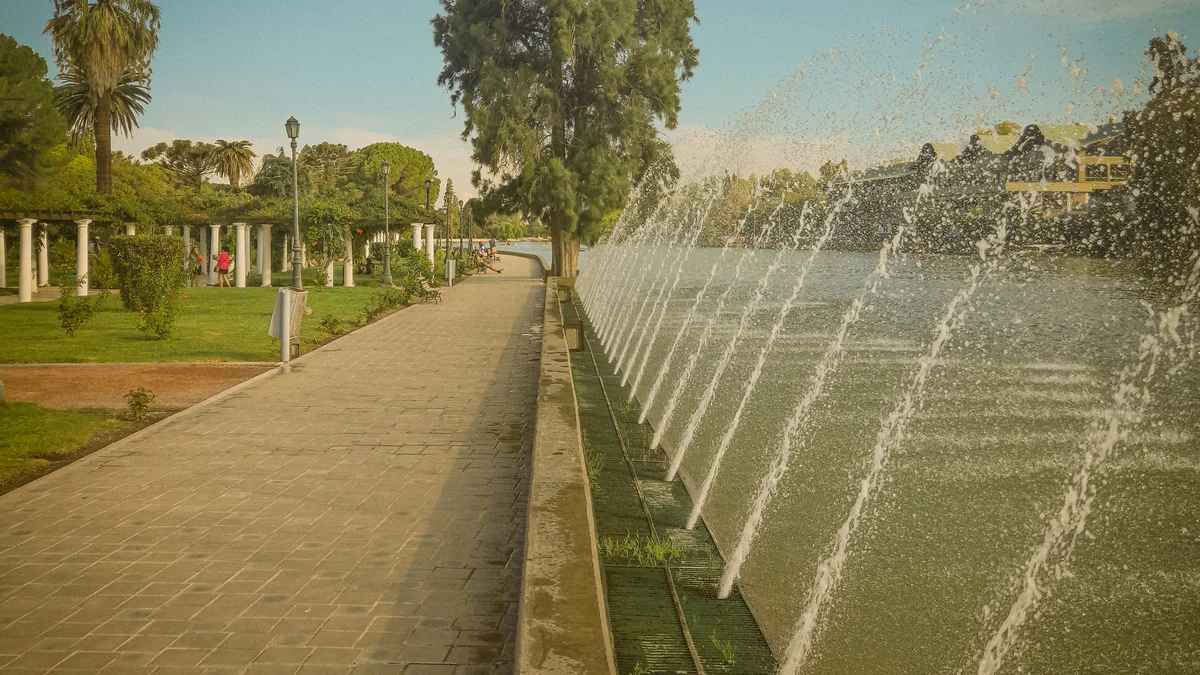
The plaza features a dancing-water fountain and a frieze titled La Libertad, esa gesta anónima, meaning Freedom, that anonymous feat. A travertine frieze had been planned in the 1940s and assigned to the sculptor Lorenzo Domínguez, but irregularities occurred and it was never built. A national competition in 1994 was won by Eliana Molinelli, who directed the project with Eneida Rosso and Laura Valdivieso. The work took about six months, has three parts with cast-iron plates in the middle depicting a flag falling into water, and was inaugurated on 25 May 1995. Spanish Wikipedia adds that since July 2021 the fountain has staged a water show with more than 900 nozzles and more than 350 coloured LED lights.
Spanish Wikipedia notes that a crafts fair is held on weekends and that street entertainers make the square a popular gathering place. It is a good starting point for exploring central Mendoza on foot, alongside the city's tree-lined streets and acequias. A private guided visit can explain how the earthquake shaped the city plan while linking the square to other sites such as the parks and wine country around Mendoza.
See every tour and attraction we cover in Mendoza.