TorontoOntario · 36 tours
 Niagara FallsOntario · 25 tours
 New York CityNew York · 30 tours
 Las VegasNevada · 8 tours
 San FranciscoCalifornia · 16 tours
 VancouverBritish Columbia · 17 tours
 DubaiUAE · 54 tours
 Abu DhabiUAE · 5 tours
 Buenos AiresArgentina · 23 tours
 AthensGreece · 31 tours
 AucklandNew Zealand · 38 tours
 CancunMexico · 54 tours
No destinations match “”. Try searching all tours instead — that search understands full questions, not just place names.
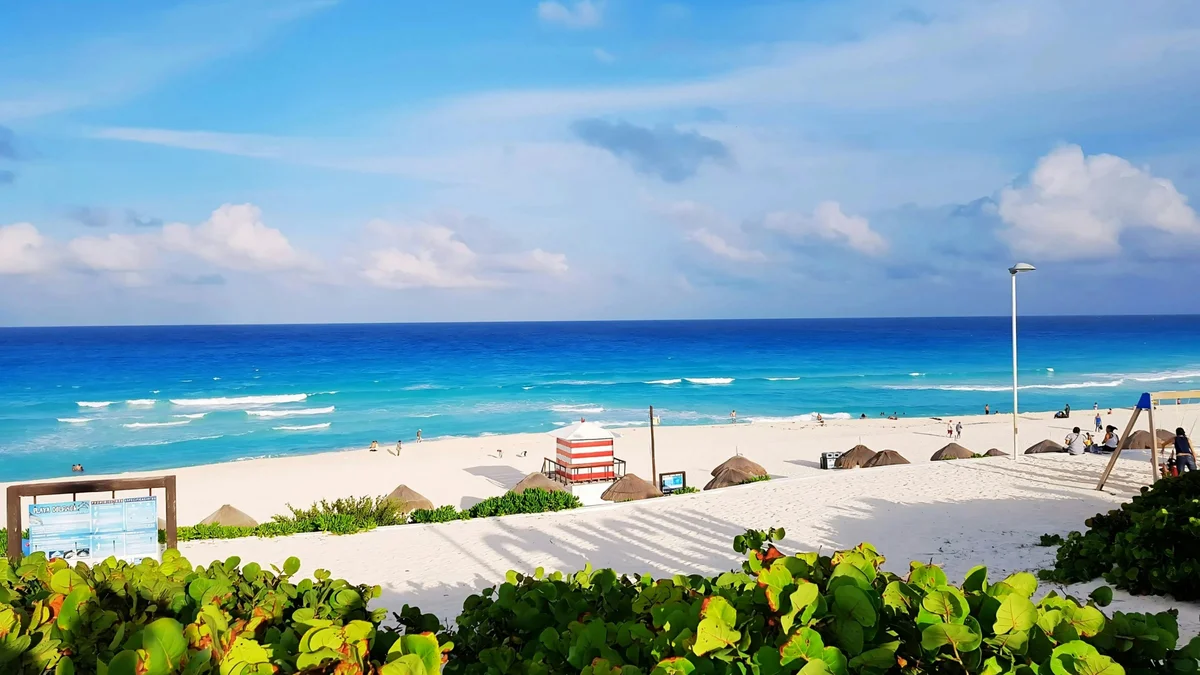
Playa Delfines is a real, public beach sitting at the highest point of Cancún's Hotel Zone, where the wide stretch of white sand and turquoise Caribbean water meets a dramatic bluff. It's home to the genuine giant 'Cancún' letter sign, one of the most photographed spots in the city, and unlike most Hotel Zone beaches it isn't fronted by a resort, so access is open to everyone. Strong currents here mean it's better known for its views and photo ops than for swimming.
Visitor guide
Playa Delfines is a public beach at the southern end of Cancun's Hotel Zone in Quintana Roo, Mexico, also known as El Mirador. Its name translates as Dolphin Beach, and it is known as an open stretch of white sand facing the Caribbean without a large resort building on it.
Travel guides say the name Playa Delfines refers to pods of dolphins once seen regularly here, and the alternative name El Mirador comes from a hilltop viewing deck overlooking the ocean and the Hotel Zone skyline, which carries a large colorful Cancun sign. Sources place the beach along Boulevard Kukulcan, with one guide giving roughly the 18-kilometer mark, near the Punta Nizuc end of the Hotel Zone.
According to Wikipedia, Cancun is a planned city created to foster tourism. In 1967 the Mexican government allocated a two-million-dollar fund, administered by the Bank of Mexico, to study new recreational zones, and the study was entrusted to INFRATUR, an agency that later became FONATUR, the national tourism development fund. Resort development began on 23 January 1970, when the island had only three residents, and the tourism project took shape as an Integrally Planned Center from 1974. Because investors were reluctant to back an unknown area, the federal government financed the first nine hotels.
The Hotel Zone juts into the Caribbean Sea and is the city's main source of tourism income. Wikipedia notes that it forms part of the Mesoamerican Barrier Reef System region. From 1970 to 1980 the population grew by an average of 62.3 percent a year, and the city reached 888,797 residents in the 2020 census.
Lonely Planet describes Playa Delfines as the only beach in the Hotel Zone without a large all-inclusive hotel on it, which is why it draws residents and independent travelers. The beach is described as having rows of palapas, a small playground, restrooms and an outdoor gym, with public parking nearby. City bus routes R1 and R2 run along Kukulcan Avenue through the Hotel Zone, and Wikipedia says service on that corridor runs about every five minutes between Tulum Avenue and the Westin Resort. Passengers can ask the driver to stop at El Mirador.
Because the beach is open to the sea, wave and current conditions vary, and visitors are generally advised to check the posted flags and follow lifeguard guidance. Tourism sources describe strong surf here, with a red flag often posted, and surfing is a popular activity.
The Hotel Zone's beaches are shaped by hurricanes. Wikipedia records that Hurricane Gilbert made a devastating direct hit in September 1988, that Hurricane Wilma made landfall on 21 October 2005 as a Category 4 storm with its eye passing just west of Cancun, and that Hurricane Dean in 2007, which came ashore about 190 miles to the south, still stripped sand from roughly 7.5 miles of beach between Punta Cancun and Punta Nizuc. Beach width and profile therefore change over the years, and a single description of the shoreline can date quickly.
Cancun has a tropical wet and dry climate with an annual mean of 27.1 degrees Celsius and roughly 1,340 millimeters of rain a year, according to Wikipedia. The rainy season runs from late August through November, the dry season from November through April, and hurricane season from June through November. Sea temperatures range from about 26 degrees Celsius in winter to 29 degrees in summer. One guide suggests November to April as the most comfortable window, and notes that the summer months overlap with periods of sargassum, a seaweed that washes up on Caribbean beaches in some years.
The beach is mainly a place to relax and take in the Caribbean views. A private tour with a driver can include it as a stop along the Hotel Zone, together with nearby sights such as the Museo Maya de Cancun, without needing to coordinate parking or buses.
See every tour and attraction we cover in Cancun.