TorontoOntario · 36 tours
 Niagara FallsOntario · 25 tours
 New York CityNew York · 30 tours
 Las VegasNevada · 8 tours
 San FranciscoCalifornia · 16 tours
 VancouverBritish Columbia · 17 tours
 DubaiUAE · 54 tours
 Abu DhabiUAE · 5 tours
 Buenos AiresArgentina · 23 tours
 AthensGreece · 31 tours
 AucklandNew Zealand · 38 tours
 CancunMexico · 54 tours
No destinations match “”. Try searching all tours instead — that search understands full questions, not just place names.
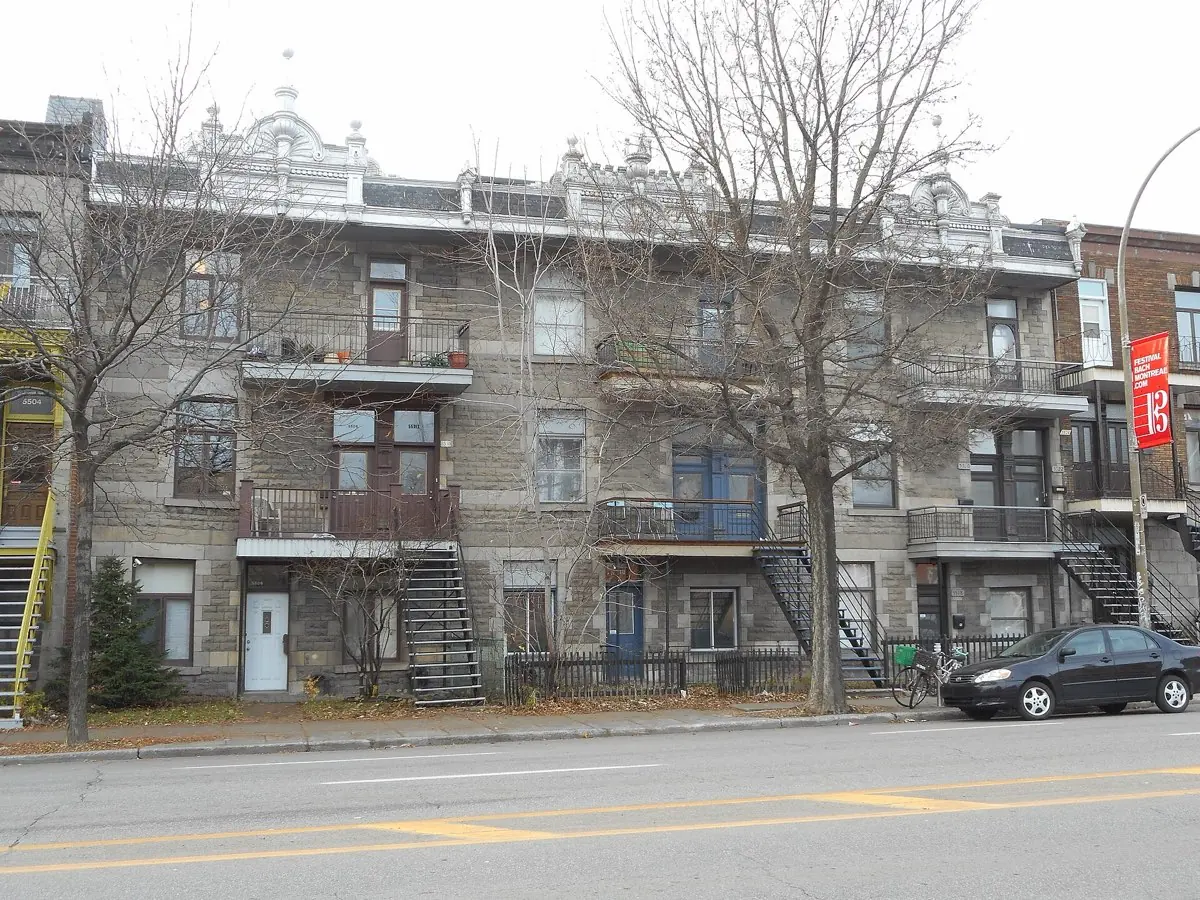
A colourful residential district known for spiral staircases and vibrant street murals.
Visitor guide
Le Plateau-Mont-Royal is a densely populated borough on the east side of Mount Royal, and the neighbourhood most people picture when they think of Montreal's coloured doors, outdoor staircases and café terraces. Wikipedia counts 105,813 residents in about 8.1 square kilometres in the 2021 census. It includes the Plateau proper, Mile End and Milton Park.
Development spread out from the Faubourg Saint-Laurent area after about 1745, and in 1792 Montreal's official limits were pushed roughly two kilometres beyond the old fortifications, with Mount Royal and Duluth Street forming the new edges. The Plateau then grew as a patchwork of separate villages: Coteau-Saint-Louis was founded in 1846, Saint-Jean-Baptiste took shape around 1861 and Saint-Louis-du-Mile-End followed in 1878. They were folded into Montreal one by one between the 1880s and 1910. By the early 1900s the Plateau was a working-class district of tradespeople and factory workers. The Université de Montréal moved to the mountain's north slope in 1943, which drew wealthier residents to the area. Population peaked at 176,090 in 1966, fell through the 1980s and 1990s, and has grown again since 2011. The present borough was created on 1 January 2002.
Jewish merchants ran shops along Saint-Laurent Boulevard, and Schwartz's Deli, there since 1928, remains a symbol of that era. The boulevard was renamed in 1905 and was long the informal dividing line between the French-speaking east and English-speaking west. Greek, Portuguese and Vietnamese communities have also shaped the district, and Little Portugal is part of it. The Plateau's many French-born residents earned it the nicknames Le Petit-Paris and La Petite-France, and in 1997 Utne Reader rated it one of North America's 15 hippest neighbourhoods.
The housing is mostly plexes: duplexes and triplexes with brick or stone fronts and outdoor staircases, often curving. Why the stairs are outside is partly debated. A commonly told explanation is that building rules required small setbacks from the street, so builders put stairs outside to save interior space, and the popular claim that they avoided property tax is repeated often but is harder to confirm. Whatever the reason, they became iconic; Atlas Obscura reports they topped a 2012 Pointe-à-Callière survey of Montreal symbols. Moving Day on 1 July is famously awkward with them.
Mont-Royal Avenue and Saint-Denis Street have independent shops, cafés and restaurants, and Saint-Laurent Boulevard is lined with restaurants, clubs and delis. Wikipedia describes the borough as a major arts centre. Institutions listed there include the National Theatre School of Canada, the Quebec Conservatory of Music in Montreal, Les Grands Ballets Canadiens and theatres such as Le Rideau vert, Théâtre de Quat'Sous, La Licorne and Théâtre d'Aujourd'hui. Novelists Michel Tremblay and Mordecai Richler both grew up in the area and set stories in the Plateau of the 1950s and 1960s; a library in Mile End carries Richler's name.
Saint-Louis Square is known for its Victorian houses. It occupies the site of a reservoir installed around 1850 to supply the Côte-à-Baron slope below Sherbrooke Street. Jeanne-Mance Park and Mount Royal Park are also nearby.
Parc La Fontaine covers roughly 34 to 40 hectares depending on the source (the City of Montreal says 40) and is the borough's main green space. The land was part of the old Logan farm, which the federal government bought in 1845 and used as a military site; from 1874 the city leased part of it to create a park. The city leased part of it and opened the park in 1874 as Logan Park, with its first major landscaping in 1888. It was renamed in 1901 to honour Louis-Hippolyte Lafontaine, the first French-speaking prime minister of the Province of Canada, rather than for any fountain.
Around 1900 the city dug two basins at different levels joined by a waterfall, and a lit fountain was added in 1929. In the 1930s Claude Robillard of the Municipal Parks Service led a redesign. The open-air Théâtre de Verdure opened in 1956, closed in 2014 because its facilities had deteriorated, and reopened in June 2022 with a modernized design seating over 2,500. Monuments include a Félix Leclerc statue (1990) and memorials to Dollard des Ormeaux (1920) and Lafontaine (1930). A small urban zoo, the Garden of Wonders, operated here from 1957 to 1989. The city lists skating and sledding in winter.
Mile End, with its bakeries and cafés, lies just north, and Jean-Talon Market and Little Italy are a short drive away. Voyzo runs this as a private tour with your own driver and vehicle and door-to-door pickup, so you can see several Plateau streets without parking, and cross between the Plateau and Mile End easily.
See every tour and attraction we cover in Montreal.