TorontoOntario · 36 tours
 Niagara FallsOntario · 25 tours
 New York CityNew York · 30 tours
 Las VegasNevada · 8 tours
 San FranciscoCalifornia · 16 tours
 VancouverBritish Columbia · 17 tours
 DubaiUAE · 54 tours
 Abu DhabiUAE · 5 tours
 Buenos AiresArgentina · 23 tours
 AthensGreece · 31 tours
 AucklandNew Zealand · 38 tours
 CancunMexico · 54 tours
No destinations match “”. Try searching all tours instead — that search understands full questions, not just place names.
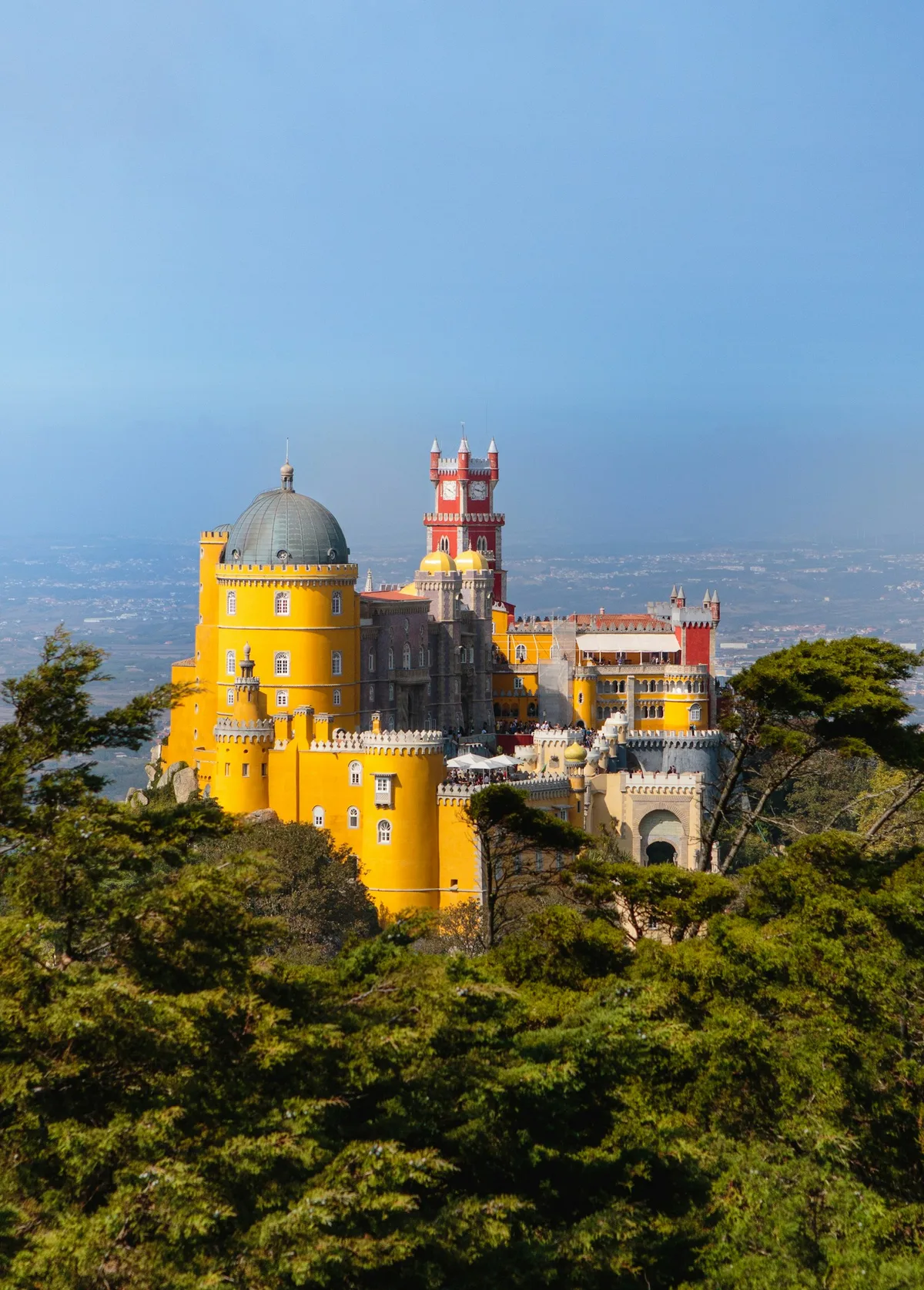
A 19th-century Romanticist palace on a hilltop above Sintra, its red, yellow, and violet-tiled towers visible from miles away — one of the Seven Wonders of Portugal.
Visitor guide
Pena Palace (Palácio da Pena) is a Romanticist palace on a hilltop in the Sintra Mountains, in the municipality of Sintra, Portugal. It is a national monument, part of the UNESCO-listed Cultural Landscape of Sintra, and one of the Seven Wonders of Portugal, and on a clear day it can be seen from Lisbon.
The hilltop's history begins in the Middle Ages with a chapel dedicated to Our Lady of Pena, which tradition says was founded after an apparition of the Virgin Mary. In 1493 King John II and Queen Leonor made a pilgrimage there to fulfil a vow, and Manuel I later ordered a monastery built and gave it to the Order of Saint Jerome. For centuries it was a quiet place of meditation housing at most eighteen monks.
Lightning damaged the monastery in the 18th century, and the 1755 Lisbon earthquake reduced it to ruins. According to Wikipedia, the chapel, with its marble and alabaster work attributed to Nicolau Chanterene, survived without significant damage.
In 1838 Ferdinand II, king consort of Queen Maria II, acquired the old monastery, the surrounding lands and the nearby Castle of the Moors, intending to turn the ruins into a summer residence for the royal family. The rebuilding was entrusted to Wilhelm Ludwig von Eschwege, a German lieutenant-general and mining engineer who was an amateur architect. Construction took place between 1842 and 1854, with the clock tower completed in 1843.
The king and queen shaped the decoration and symbolism, and Ferdinand designed an ornate window for the main facade inspired by one at the Convent of the Order of Christ in Tomar. The result mixes styles freely, with Neo-Gothic, Neo-Manueline, Neo-Islamic and Neo-Renaissance elements, and some features echo other Portuguese landmarks such as Belém Tower.
The palace stands almost entirely on rock. It includes the restored old convent and its cloister, the Arches Yard with a wall of Moorish arches in front of the chapel, and a palatial zone with a cylindrical bastion. The Queen's Terrace is noted for one of the best overall views of the palace. Interiors were adapted for royal summer stays and feature stucco work, trompe-l'oeil painted walls and 19th-century tile revetments, in rooms such as the chapel, the royal dining room and the kitchen.
Over the years the red and yellow facades faded until the palace looked entirely grey for a long time, but by the end of the 20th century it had been repainted in its original colours.
After Ferdinand's death the palace passed to his second wife, Elisa Hensler, Countess of Edla, who sold it to King Luís, and the Portuguese state bought it in 1889. After the 1910 republican revolution it was classified as a national monument and became a museum; Wikipedia says Queen Amélia, Portugal's last queen, spent her last night there before going into exile. The palace and the wider Cultural Landscape of Sintra were added to the UNESCO list in 1995.
Surrounding the palace is the Pena Park, a forested area of about 85 hectares of uneven terrain created by Ferdinand with help from Barons von Eschwege and von Kessler. Trees from distant regions were planted, including sequoia, Lawson's cypress, magnolia, western redcedar, Chinese ginkgo and Japanese cryptomeria, and ferns from Australia and New Zealand grow in the Queen's Fern Garden. A network of paths links the palace with features such as the Valley of the Lakes. Hilltop roads are steep and winding, so a private tour with a local driver is a practical way to reach Sintra.
See every tour and attraction we cover in Portugal.