TorontoOntario · 36 tours
 Niagara FallsOntario · 25 tours
 New York CityNew York · 30 tours
 Las VegasNevada · 8 tours
 San FranciscoCalifornia · 16 tours
 VancouverBritish Columbia · 17 tours
 DubaiUAE · 54 tours
 Abu DhabiUAE · 5 tours
 Buenos AiresArgentina · 23 tours
 AthensGreece · 31 tours
 AucklandNew Zealand · 38 tours
 CancunMexico · 54 tours
No destinations match “”. Try searching all tours instead — that search understands full questions, not just place names.
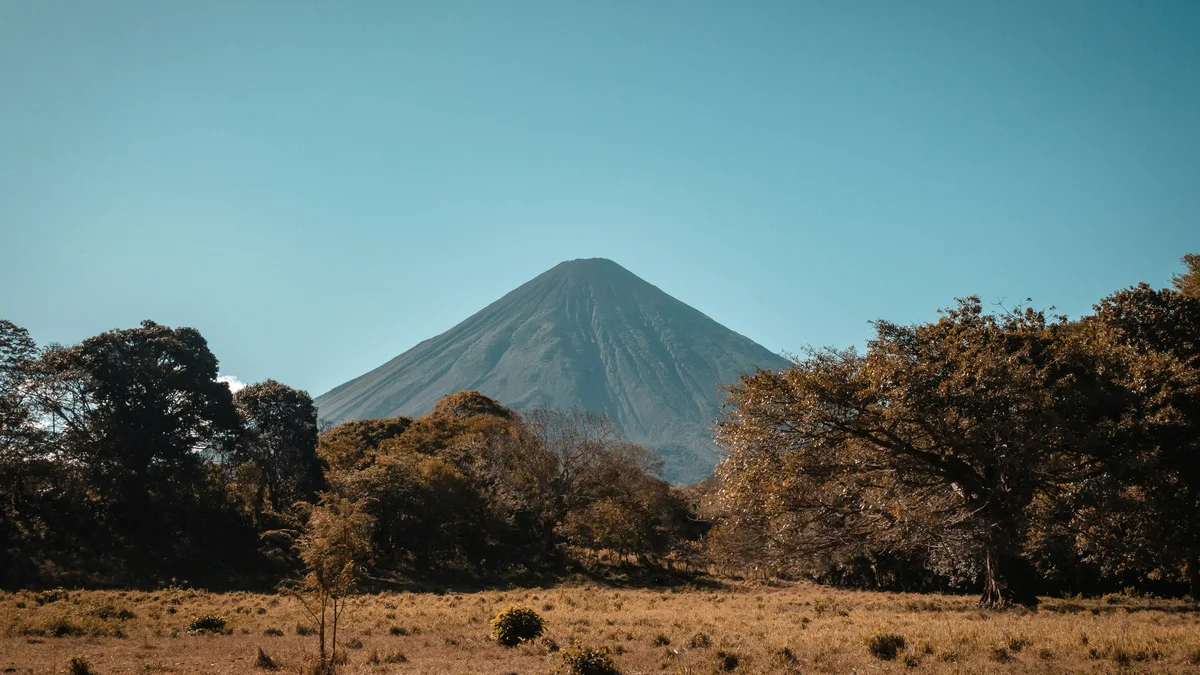
Formed by two volcanoes, Concepción and Maderas, rising directly out of Lake Nicaragua, Ometepe is the largest volcanic island inside a freshwater lake anywhere in the world. It's reached by public ferry from the mainland town of San Jorge and is known for petroglyphs left by pre-Columbian communities, the natural spring pool at Ojo de Agua, and the black-sand beach at Playa Santo Domingo, which sits on the narrow isthmus connecting the island's two volcanoes.
Visitor guide
Ometepe is an island in Lake Nicaragua, in the Rivas Department of Nicaragua, formed by two volcanoes joined by a low isthmus. It is the largest island in the lake and covers about 276 square kilometres. Its name comes from the Nawat words ome and tepetl, meaning two mountains.
Concepción occupies the northwest half of the island. It is an active volcano with a symmetrical cone reaching 1,610 metres, the island's highest point. Maderas forms the southeast half, rises 1,394 metres and is considered extinct or possibly dormant, with a lagoon in its crater that Wikipedia says farmer Casimiro Murillo discovered on 15 April 1930. The slopes of Maderas are planted with coffee and tobacco, the rest is rainforest, and much of the area is now a nature reserve.
Concepción's eruptions since 1880 include activity beginning on 8 December 1880 that lasted about a year, followed by eruptions in 1883, 1889, 1902, 1907 and 1924. A magnitude 6.2 earthquake in 2005 cracked island roads, and the volcano erupted violently in 2010, though damage was limited. Volcanic ash has made the soil very fertile, and the International Union of Geological Sciences included the island in its 2022 list of 100 geological heritage sites.
Settlement may have begun in the Dinarte phase, roughly 2000 to 500 BC, though the evidence is questioned. Later, Chorotega and Nicarao peoples carved basalt statues, and the Nicarao, who were Nahua speakers, are associated with the Ometepe period, AD 1350 to 1550. That era featured shoe-shaped urn burials and a basalt tool industry, and the island served as a trade node between Mesoamerica and the Isthmo-Colombian Area.
The Ometepe Petroglyph Project surveyed 15 kilometres of the Maderas half from 1995 to 1999, mapping 73 sites with nearly 1,700 petroglyph panels on about 1,400 boulders. Common motifs include spirals, meander patterns and stylised turtles, and two linked spirals may represent the island's two volcanoes.
After the Spanish conquest, pirates entering through the San Juan River raided the lake, and residents retreated to the volcano slopes. Spanish conquistadors settled the island at the end of the 16th century. Today the island has large populations of white-faced capuchin monkeys and mantled howler monkeys, and a biological field school on the Maderas side hosts researchers.
Altagracia lies on the northeastern side and Moyogalpa on the northwestern side, with a harbour; these towns anchor the two municipalities that divide the island. Most visitors arrive by ferry from San Jorge in Rivas to Moyogalpa, and the economy rests on livestock, agriculture and tourism, with plantains as the main crop. Wikipedia notes the island is known for more religious and folk festivals than anywhere else in Nicaragua, and that most visitors come between mid-November and mid-May.
A private guided day can focus on the island's pre-Columbian heritage, volcano viewpoints and local life, with timing adapted to conditions.
See every tour and attraction we cover in Nicaragua.