TorontoOntario · 36 tours
 Niagara FallsOntario · 25 tours
 New York CityNew York · 30 tours
 Las VegasNevada · 8 tours
 San FranciscoCalifornia · 16 tours
 VancouverBritish Columbia · 17 tours
 DubaiUAE · 54 tours
 Abu DhabiUAE · 5 tours
 Buenos AiresArgentina · 23 tours
 AthensGreece · 31 tours
 AucklandNew Zealand · 38 tours
 CancunMexico · 54 tours
No destinations match “”. Try searching all tours instead — that search understands full questions, not just place names.
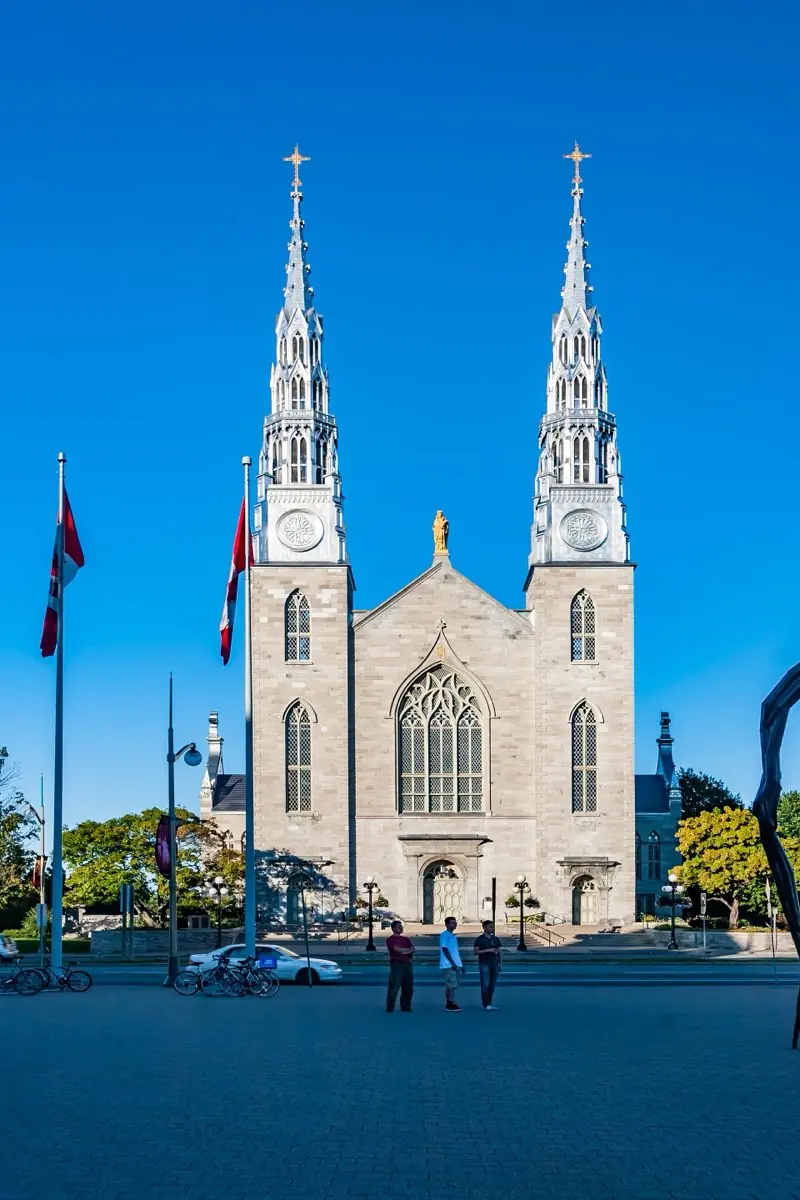
Ottawa's oldest and largest church, with an ornate blue-and-gold vaulted interior.
Visitor guide
Notre-Dame Cathedral Basilica is the seat of the Archbishop of Ottawa and a National Historic Site of Canada, designated in 1990. Its twin spires and gilded Madonna are visible from Parliament Hill. Sources describe it as the oldest and largest church in Ottawa, but treat that as a local claim.
A small wooden church, St. Jacques, was built on the site in 1832. Accounts differ on its fate: one says it was moved across the street in 1841 and later lost to fire, while another says it was demolished to make way for a larger building. Parks Canada says the building project began in 1839 when Bytown was a frontier lumber town, and historicplaces.ca dates the start of construction to 1841. The original neoclassical design came from the local builder Antoine Robillard and Father John Francis Cannon, and was modeled on St. Patrick's Church in Quebec City. In 1844 the Oblates of Mary Immaculate took over the parish, and the partially built structure was transformed into Gothic Revival under the Oblate priests Pierre-Adrien Telmon and Damase Dandurand.
Sources differ on when work finished: Wikipedia gives 1846 for the main structure, Parks Canada dates the construction period 1842 to 1897, and historicplaces.ca says construction was not fully finished until 1885. The church was blessed in 1846, before it had steeples. It became the cathedral of the Diocese of Bytown in 1847, with the Oblate Joseph-Bruno Guigues as first bishop, and Pope Leo XIII designated it a minor basilica in 1879. Parks Canada says the steeples were added in 1858, though other sources date Dandurand's Gothic spires to 1866, so treat the exact year as approximate.
Guigues, born in France in 1805, came to Canada in 1844 as visitor of the Oblates and was named bishop of Bytown in 1847 and consecrated in the Bytown cathedral in 1848, according to the Dictionary of Canadian Biography. When he arrived, that biography says, the cathedral was still unfinished. He also opened a college and seminary in Bytown in 1848, and the Oblates ran the Ottawa college that grew into the University of Ottawa until 1965. By the time of his death in 1874 the diocese counted 67 churches and 48 chapels. A life-size statue of him stands on the cathedral grounds.
Parks Canada recognized the basilica in 1990 as an outstanding Canadian example of Gothic Revival, and its statement of significance says the design blends neoclassicism, Quebec church traditions and French Gothic Revival. The mixture of styles is visible from the street: the lower doorways keep classical round arches, while the upper windows are pointed Gothic. Parks Canada lists a long east-west rectangular plan, strong vertical lines, buttresses, a twin-towered front with a large west window, a tall nave with clerestory and side aisles, and a curved apse among its defining features. A Gothic Revival apse designed by the Montreal priest-architect Victor Bourgeau was added in 1862 to 1863, and interior improvements by Georges Bouillon followed after 1875. The gilded figure of the Virgin and Child at the peak of the roof is also named as a character-defining element.
The exterior is restrained, but the interior is far more ornate, painted and gilded and filled with carved wood and plaster figures, altarpieces and stained glass. Louis-Philippe Hébert, a leading Canadian sculptor, made about 30 wooden sculptures for the choir. Parks Canada also credits the Quebec artists Pariseau and Rochon for figures. Some of the original stained glass was replaced between 1956 and 1961 by 17 windows by Guido Nincheri, a series Parks Canada lists as a defining element.
The church's first organ was inaugurated in 1850, and the case was carved by Flavien Rochon in 1871. Casavant's sons rebuilt the instrument in 1892 as a 52-stop organ with an electro-pneumatic action, and Guilbault-Thérien replaced the console and added stops in 1999. Composer Amédée Tremblay was organist from 1894 to 1920. Parks Canada lists the organ in its original location as part of the building's heritage value.
The building closed for renovations at the start of 1999 and reopened on December 18 of that year. Wikipedia reports that the Sisters of Charity of Ottawa hosted the parish in their Mother House chapel meanwhile, and that funding came from donors, a Canada Millennium program, the Ontario government and the Friends of the Cathedral. Wikipedia also records that Governor General Georges Vanier and Prime Minister Sir Wilfrid Laurier were given state funerals here.
The basilica sits within a religious precinct: Parks Canada places the Archbishop's Palace to the south and the former College of Bytown and the Grey Nuns' Mother House to the north, and lists views to and from the building across Sussex Drive as part of its significance. It is an active place of worship with services in both French and English, so visits may be restricted during services and special events. Check the basilica's own site for current visiting arrangements, and be respectful of worshippers.
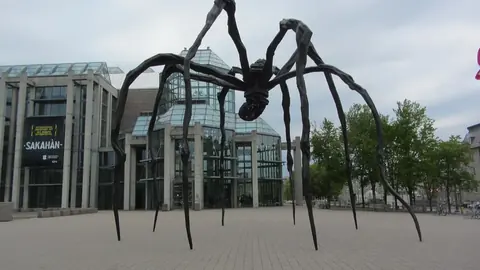
The basilica faces the National Gallery of Canada across Sussex Drive and is just a block from the ByWard Market, so the three combine into an easy walking loop. A Voyzo private driver can drop you at the gallery end and collect you at the market end, door to door, without needing to find parking near Sussex Drive.
See every tour and attraction we cover in Ottawa.