TorontoOntario · 36 tours
 Niagara FallsOntario · 25 tours
 New York CityNew York · 30 tours
 Las VegasNevada · 8 tours
 San FranciscoCalifornia · 16 tours
 VancouverBritish Columbia · 17 tours
 DubaiUAE · 54 tours
 Abu DhabiUAE · 5 tours
 Buenos AiresArgentina · 23 tours
 AthensGreece · 31 tours
 AucklandNew Zealand · 38 tours
 CancunMexico · 54 tours
No destinations match “”. Try searching all tours instead — that search understands full questions, not just place names.
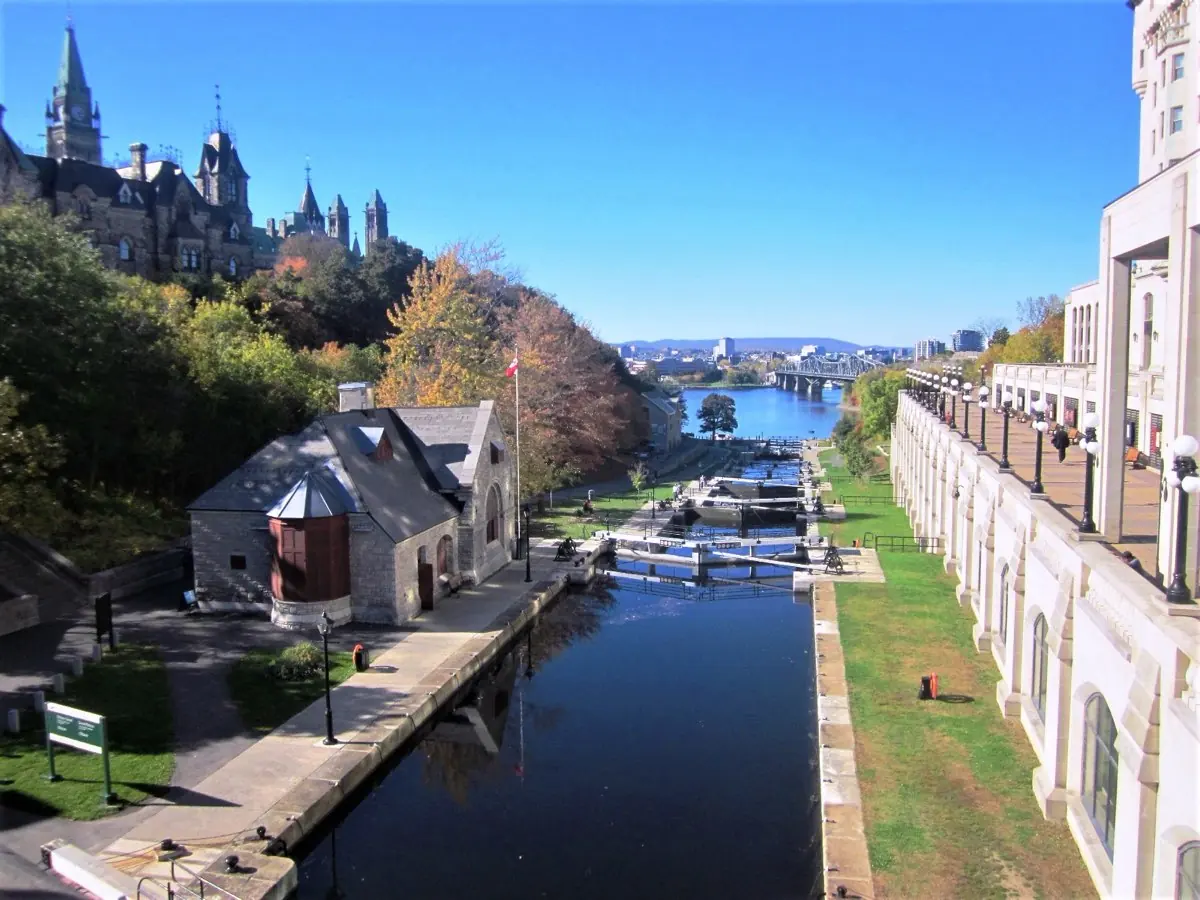
A UNESCO World Heritage waterway through downtown Ottawa, the world's largest skating rink in winter.
Visitor guide
The Rideau Canal is a 202-kilometre waterway linking the Ottawa River at Ottawa with Lake Ontario at Kingston, and it still carries boats along its original 1830s route. Parks Canada calls it the best-preserved slackwater canal in North America, and it is a UNESCO World Heritage Site. In Ottawa it runs right past Parliament Hill, which is why it doubles as the capital's front-row summer promenade and its winter skating rink.
The canal was planned after the War of 1812 as a military supply route between Montreal and Kingston that would avoid the St. Lawrence River, which ran close to the American border. Lieutenant-Colonel John By of the Royal Engineers supervised construction from 1826 to 1832, using a workforce largely of Irish, Scottish and French-Canadian labourers, and many died, mostly of disease. The first full steamboat passage arrived in Bytown, now Ottawa, on 29 May 1832. The final cost was about 822,804 pounds, and the overruns led to By being recalled to London. The canal was never used for the military purpose it was built for; commercial traffic dominated until railways and an improved St. Lawrence route reduced freight, and today it is mainly a recreational waterway.
The canal uses a slackwater system, which means dams raise river and lake levels so that much of the route is navigable water rather than a dug channel. Locks lift boats about 83 metres from the Ottawa River to the summit at the Rideau Lakes and lower them about 50 metres toward Kingston. Counts of locks and lockstations vary by source and by how the Tay Canal entrance is counted, so check Parks Canada if you need an exact number; Parks Canada describes 22 lockstations. The canal became a National Historic Site in 1925 and a UNESCO World Heritage Site in 2007. Parks Canada describes it as the only canal from the 19th-century canal-building era in North America that still operates along its original route with most of its original structures intact.
The Ottawa Locks, a flight of stepped locks beside the Parliament buildings and the Château Laurier, are the dramatic northern end where the canal drops down to the river. Further south you pass Dow's Lake, Hog's Back Falls and its lockstation, and the long ribbon of parkway used by cyclists and runners. The Commissariat Building, built in 1827, is often described as the oldest surviving stone building in Ottawa. Boaters and paddlers can lock through in the navigation season, which Parks Canada operates roughly from May to October, and visitors on foot can simply watch the lockmasters work the gates by hand.
In winter, a stretch of the canal freezes into the Rideau Canal Skateway, which the National Capital Commission says winds over 7.8 kilometres through the capital. It officially opened on 18 January 1971, and runs from near Carleton University to the locks downtown, including Dow's Lake. Guinness has recognised it as the world's largest naturally frozen skating rink; some outlets call it the longest, and the larger-than-all-others framing is the better supported. The NCC says the average season is about 50 days, with a record of 95 days in 1971 to 1972, and in recent years it has opened later and for fewer days. The Skateway is a centrepiece of the Winterlude festival.
Check Parks Canada for current navigation dates, lock operations and bridge or lock closures, and the National Capital Commission for Skateway ice conditions, since both depend on weather and maintenance. The pathways on both banks can be walked year-round.
The Ottawa Locks sit between Parliament Hill, the Château Laurier and the Bytown Museum, and the ByWard Market is a short walk away. A Voyzo private driver can drop you near the locks and meet you farther along the canal, which is handy if you want to walk one section only.
See every tour and attraction we cover in Ottawa.