TorontoOntario · 36 tours
 Niagara FallsOntario · 25 tours
 New York CityNew York · 30 tours
 Las VegasNevada · 8 tours
 San FranciscoCalifornia · 16 tours
 VancouverBritish Columbia · 17 tours
 DubaiUAE · 54 tours
 Abu DhabiUAE · 5 tours
 Buenos AiresArgentina · 23 tours
 AthensGreece · 31 tours
 AucklandNew Zealand · 38 tours
 CancunMexico · 54 tours
No destinations match “”. Try searching all tours instead — that search understands full questions, not just place names.
Canada's oldest museum, founded in 1860, with collections spanning Old Masters, Quebec art, and international contemporary work across several connected pavilions on Sherbrooke Street.
Visitor guide
The Montreal Museum of Fine Arts (Musée des beaux-arts de Montréal, MMFA) is an encyclopedic art museum on Sherbrooke Street West in the Golden Square Mile. Founded in 1860, it describes itself as the first art museum in Canada, a claim Wikipedia repeats. The museum says its collection holds close to 47,000 works from antiquity to the present, spread over five pavilions.
The museum began as the Art Association of Montreal, formed in April 1860, with early activity limited to exhibitions and drawing classes. A gift from Benaiah Gibb in 1877 of 72 paintings and four bronzes, with a building site and funds, came on condition that a gallery be built within three years. The Art Gallery on Phillips Square opened on 26 May 1879, and Wikipedia describes it as the first building in Canada constructed specifically to house an art collection. It was enlarged in 1893 and demolished in 1912; an office tower now stands there. The association was renamed the Montreal Museum of Fine Arts in 1950, according to the museum's own timeline, and in 1972 its status changed from a private institution to a mixed non-profit corporation.
For the move to Sherbrooke Street West, a building committee of prominent Montreal businessmen, including James Ross, Richard B. Angus and Vincent Meredith, oversaw a project on the former Holton House site. A limited competition chose Edward and William Sutherland Maxwell, whose Beaux-Arts design was built from 1910 to 1912. Prince Arthur, Duke of Connaught, inaugurated it on 9 December 1912 before about 3,000 people.
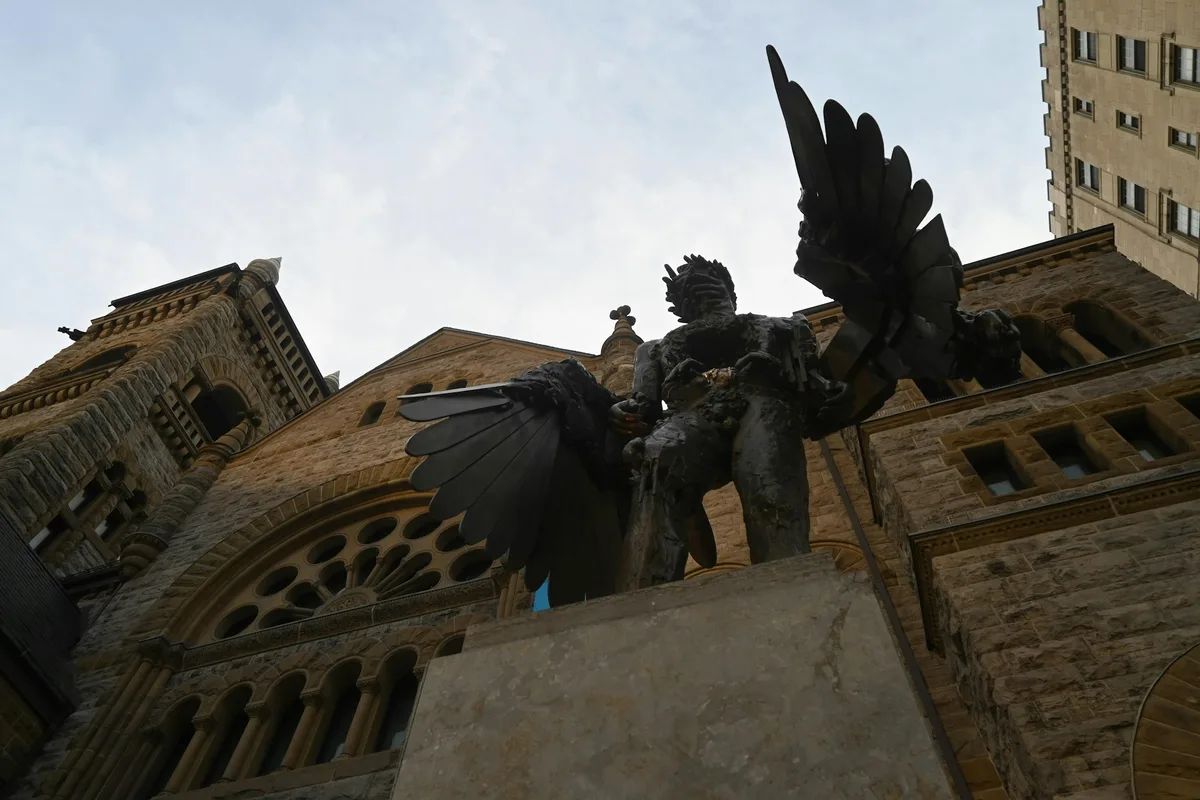
The 1912 building is now the Michal and Renata Hornstein Pavilion. The Liliane and David M. Stewart Pavilion opened in 1976; Wikipedia credits architect Fred Lebensold with its modernist concrete design and notes it was controversial at the time. The Jean-Noël Desmarais Pavilion, by Moshe Safdie, opened in 1991 on the south side of Sherbrooke Street, funded by governments and donors including the Desmarais family, and its design incorporated the facade of the 1905 New Sherbrooke Apartments. The Claire and Marc Bourgie Pavilion is a converted Romanesque Revival church built in 1893-94 as Erskine and American United Church, designated a National Historic Site of Canada in 1998; it was announced in 2007 and opened in 2011, according to the museum's timeline. It houses Quebec and Canadian art and the Bourgie Hall concert venue, known for Tiffany stained glass. The Pavilion for Peace was inaugurated in 2016, according to the museum's timeline with international art and won a Governor General's Medal in Architecture in 2018. Underground passages link the older pavilions.
The museum's stated mission is to acquire, conserve, study and present important works from around the world and every era. It covers European old masters, Canadian and Quebec art, decorative arts and design, and international art. Wikipedia traces its broad encyclopedic mandate to volunteer curator Frederick Cleveland Morgan, who from 1917 until his death in 1962 built a decorative arts department of more than 7,000 pieces. Other notable gifts include 60 paintings and a trust fund from John W. Tempest in 1892, over 300 objects from the Strathcona family in 1927, 3,000 Japanese incense boxes from Joseph Arthur Simard in 1959, and more than 5,000 objects from Liliane M. Stewart. The Hornsteins have donated Old Master works and large holdings of drawings by the Swiss painter Ferdinand Hodler. In the Desmarais Pavilion, ten galleries called Arts of One World hold more than 1,200 objects from the 4th millennium BCE to today.
Wikipedia says the museum has Inuit art galleries, has collected Inuit and Indigenous works since the 1950s, and hired its first curator of Indigenous arts in 2023. It also reports that the original Art Association reading room was the precursor of the museum's library, described as Canada's oldest art library. Major temporary exhibitions are a regular feature, often in the Desmarais Pavilion, and Wikipedia reports about 1.3 million visitors in 2017.
In 1972, the museum suffered a major art theft; Wikipedia calls it the largest in Canadian history, and most of the stolen paintings were never recovered. The museum has also returned looted or Nazi-confiscated works, including a Vasari painting in 1964 and a van Honthorst painting in 2013, and it publishes a list of works with incomplete provenance for the years 1933-1945.
Admission policies, discounts and exhibitions change, so check the museum's official site for current tickets, hours, and access rather than relying on older guidebooks. Allow several hours if you want more than one pavilion.
The Golden Square Mile's mansions, the Canadian Centre for Architecture, Crescent Street and McGill University are all close. Voyzo runs this as a private tour with your own driver and vehicle and door-to-door pickup, so you can be dropped at the pavilion entrance on Sherbrooke Street and combine the visit with a drive through the surrounding district.
See every tour and attraction we cover in Montreal.