TorontoOntario · 36 tours
 Niagara FallsOntario · 25 tours
 New York CityNew York · 30 tours
 Las VegasNevada · 8 tours
 San FranciscoCalifornia · 16 tours
 VancouverBritish Columbia · 17 tours
 DubaiUAE · 54 tours
 Abu DhabiUAE · 5 tours
 Buenos AiresArgentina · 23 tours
 AthensGreece · 31 tours
 AucklandNew Zealand · 38 tours
 CancunMexico · 54 tours
No destinations match “”. Try searching all tours instead — that search understands full questions, not just place names.
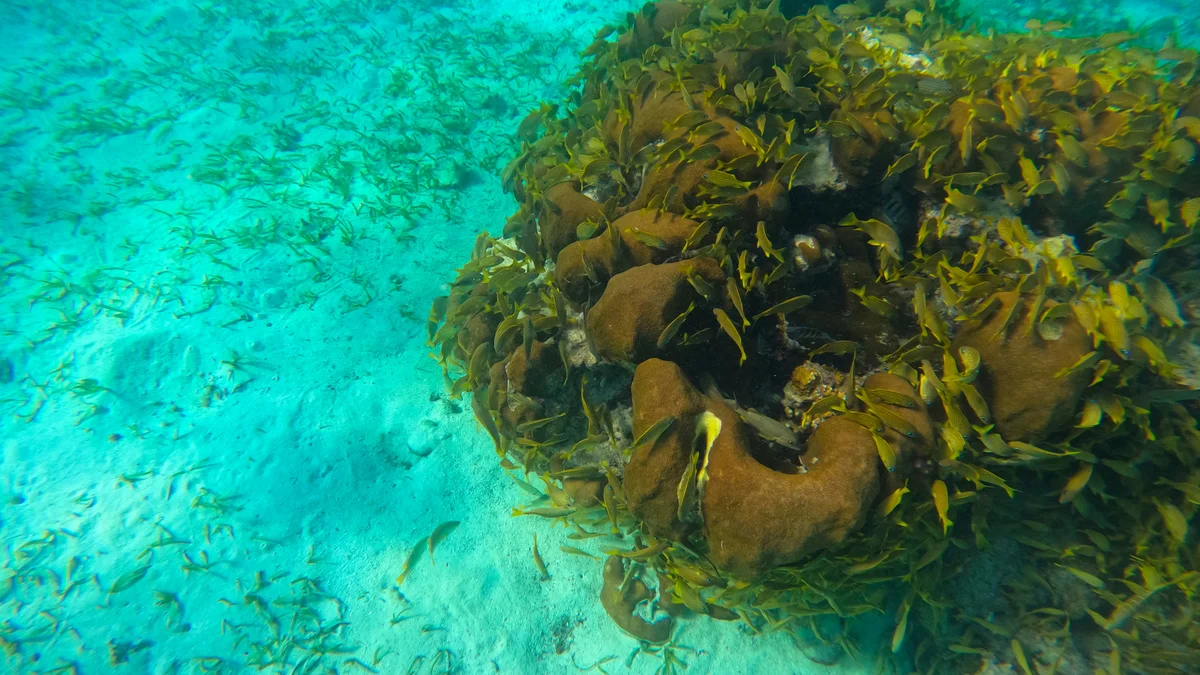
A shallow patch reef near the northern tip of Ambergris Caye, made up of scattered coral heads in water often just a few feet deep — shallow enough that even inexperienced snorkelers can get a close look at the coral and reef fish without diving. Its name refers to its position near the maritime border with Mexico, not any connection to the country itself.
Visitor guide
Mexico Rocks is a shallow patch reef complex off the far northern tip of Ambergris Caye in Belize, within the Belize Barrier Reef system. It is known for its clusters of boulder star coral in shallow water and is a common snorkeling stop for boat trips from San Pedro.
Wikipedia describes Mexico Rocks as about 100 Holocene patch reefs clustered on a Pleistocene limestone ridge, built up over roughly 420 years under static sea level conditions. The reefs grew in water about 2.5 to 5 metres deep, though snorkel guides give varying depth estimates depending on the spot. The framework is composed mainly of boulder star coral, Montastraea annularis, and Wikipedia notes that reefs dominated by this coral are rare in Belize, with the only others at Glover's Reef. Staghorn coral also grows on the ridge's windward and leeward flanks, and about thirty hard coral species have been identified.
Sources consulted do not explain the origin of the name.
The site is described as abundant in fish and invertebrates. Wikipedia lists Atlantic blue tang, yellowtail snapper, southern stingrays, nurse sharks and green moray eels, along with spiny lobster, conch, arrow crab, banded shrimp and many sponge species. Snorkelers also report sea fans, sea rods, star corals and fire coral, as well as parrotfish, wrasses, triggerfish and angelfish. Hawksbill turtles and spotted eagle rays are mentioned as occasional sightings. Visitor reports describe the reef as mixed in condition, with some damaged areas alongside large healthy heads of massive and brain coral and gorgonians.
Mexico Rocks was recommended for designation as a marine preserve in 1978, and in 2015 it was approved as part of the Hol Chan Marine Reserve, which was expanded with government and stakeholder support. A 2004 study by Burke and colleagues examined coral mortality, recovery and reef degradation at the site between 1995 and 1997, showing that the reef has been the subject of scientific attention. It is regarded as an important ecotourism attraction for Ambergris Caye.
The Belize Barrier Reef is a UNESCO World Heritage Site and, according to Wikipedia, runs about 300 kilometres within Belize as part of the longer Mesoamerican Barrier Reef System. In the north the reef lies close to shore, which is why a patch reef like Mexico Rocks can sit inside the reef in comparatively sheltered water. Other sites in the area include Hol Chan Marine Reserve and Shark Ray Alley to the south and Bacalar Chico National Park and Marine Reserve near the border.
Most visitors reach Mexico Rocks by boat from San Pedro, often on half-day trips that combine it with nearby spots. Because the site lies well inside the reef it is considered a good beginner snorkeling spot, but wind can make the water choppy. Conditions vary by day, and licensed guides generally lead trips.
See every tour and attraction we cover in San Pedro, Belize.