TorontoOntario · 36 tours
 Niagara FallsOntario · 25 tours
 New York CityNew York · 30 tours
 Las VegasNevada · 8 tours
 San FranciscoCalifornia · 16 tours
 VancouverBritish Columbia · 17 tours
 DubaiUAE · 54 tours
 Abu DhabiUAE · 5 tours
 Buenos AiresArgentina · 23 tours
 AthensGreece · 31 tours
 AucklandNew Zealand · 38 tours
 CancunMexico · 54 tours
No destinations match “”. Try searching all tours instead — that search understands full questions, not just place names.
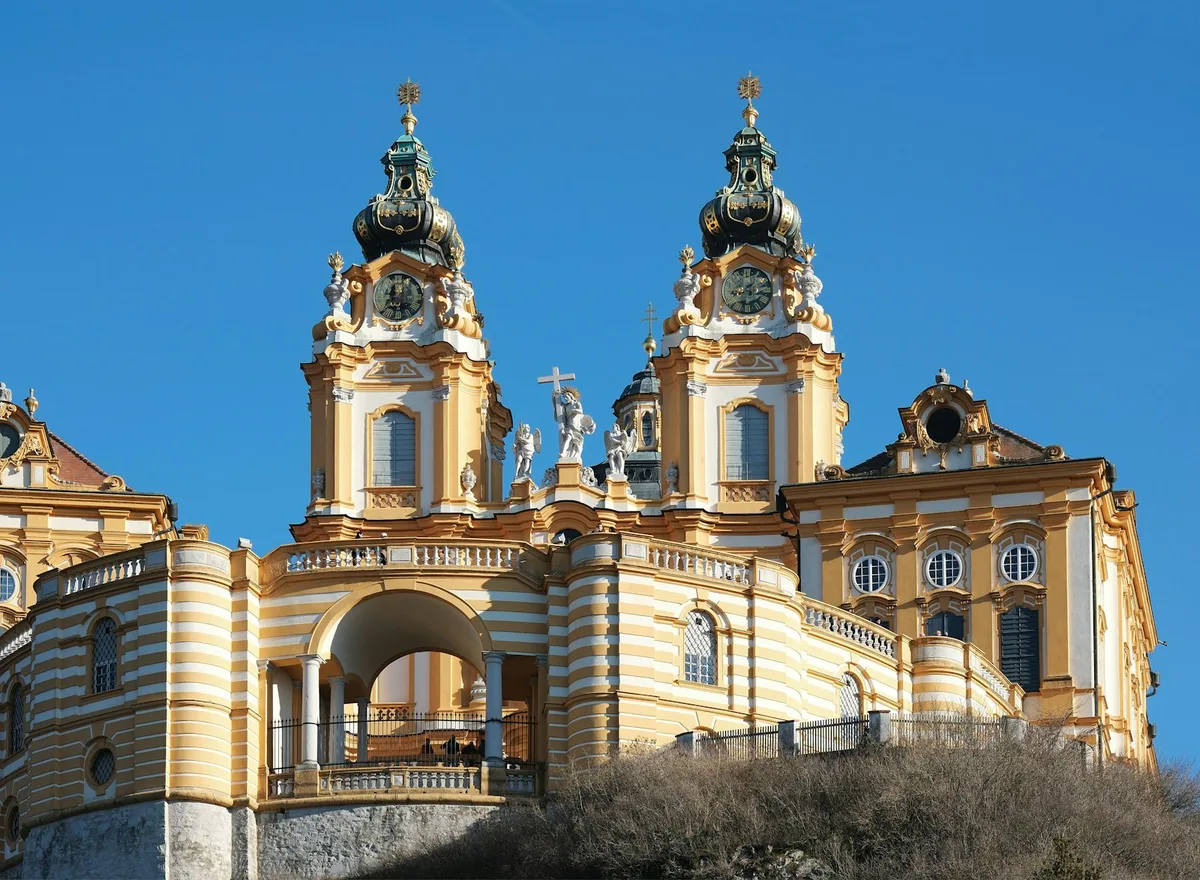
A baroque Benedictine monastery perched above the Danube at the entrance to the Wachau Valley, with a famous library and abbey church topped by twin yellow towers.
Visitor guide
Melk Abbey (Stift Melk) is a Benedictine abbey in Lower Austria, standing on a rocky outcrop above the town of Melk and the Danube at the edge of the Wachau valley. Its Baroque buildings, twin-towered church and renowned library make it one of the best-known monasteries in Austria.
According to Wikipedia, the abbey was founded in 1089 when Leopold II, Margrave of Austria, gave one of his castles to Benedictine monks from Lambach Abbey. A monastic school, forerunner of today's Stiftsgymnasium, was founded in the twelfth century, and the library became renowned for its extensive manuscript collection and production, many of them containing musical compositions. In the fifteenth century the abbey became the centre of the Melk Reform movement, which reinvigorated monastic life in Austria and southern Germany.
The abbey holds the tomb of Saint Coloman of Stockerau and the remains of several members of the House of Babenberg, Austria's first ruling dynasty. It has belonged to the Austrian Congregation since 1625.
The present Baroque complex was built between 1702 and 1736 to designs by Jakob Prandtauer. The abbey church is noted for frescoes and altarpieces by Johann Michael Rottmayr and altarpieces by Paul Troger. The church's twin towers and great dome form the facade seen from the river and appear on a ten-euro Austrian commemorative coin minted in 2007. The Marble Hall is among the most visited rooms.
In the later eighteenth century Melk became a centre of Enlightenment thought and social exchange, and Wikipedia notes there was even a Masonic lodge there, since several monks were Freemasons. Because of its fame and academic standing, the abbey escaped dissolution under Emperor Joseph II, who dissolved many Austrian monasteries between 1780 and 1790.
The Stiftsbibliothek holds many rare medieval manuscripts and a large inventory of Baroque literature. In July 2019 researcher Christine Glaßner of the Austrian Academy of Sciences found in the archives a strip of parchment containing 60 partial lines of the poem Der Rosendorn, which had been recycled into a book binding. It has been dated to around 1300, nearly 200 years earlier than the poem was previously thought to have been written.
The first recorded fire at the abbey and library was in 1297; accounts differ on how much of the library was lost. The abbey also suffered severe damage during the Turkish invasion of 1683. Its Baroque buildings caught fire in 1974, damaging interiors and art, and a restoration lasted from 1978 to 1995. The abbey survived the Napoleonic Wars and the period after the Anschluss of 1938, when the school and much of the abbey were confiscated by the state; the school was returned after World War II and now serves nearly 900 pupils.
Umberto Eco named a medieval character in The Name of the Rose Adso of Melk in tribute to the abbey, and Patrick Leigh Fermor treats Melk as a peak of discovery in A Time of Gifts. The abbey forms part of the Wachau Cultural Landscape World Heritage Site and is a natural pairing with a day exploring the valley by private vehicle.
See every tour and attraction we cover in Austria.