TorontoOntario · 36 tours
 Niagara FallsOntario · 25 tours
 New York CityNew York · 30 tours
 Las VegasNevada · 8 tours
 San FranciscoCalifornia · 16 tours
 VancouverBritish Columbia · 17 tours
 DubaiUAE · 54 tours
 Abu DhabiUAE · 5 tours
 Buenos AiresArgentina · 23 tours
 AthensGreece · 31 tours
 AucklandNew Zealand · 38 tours
 CancunMexico · 54 tours
No destinations match “”. Try searching all tours instead — that search understands full questions, not just place names.
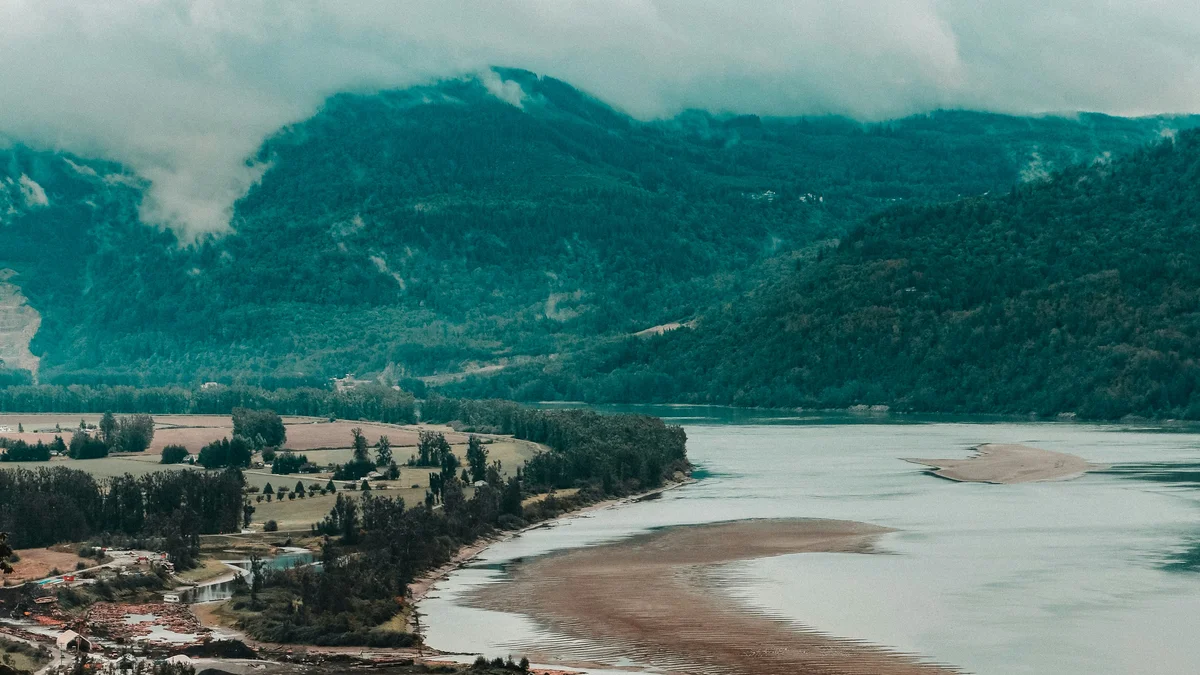
British Columbia's longest river, running through the heart of the Fraser Valley on its way to the Pacific. The stretch near Chilliwack is renowned among anglers for its white sturgeon, some of the largest freshwater fish in North America.
Visitor guide
The Fraser River is British Columbia's longest river, and at Chilliwack it forms the city's northern boundary as it crosses the broad, flat Fraser Valley on its way to the Pacific. It is a working river, a salmon highway and a floodplain that shaped how the valley was settled.
Wikipedia gives the river's length as about 1,375 km, rising near Mount Robson Provincial Park in the Rockies and reaching the Strait of Georgia south of Vancouver. Its basin covers about 220,000 square kilometres, and the main stem has never been dammed, according to the Canadian Heritage Rivers System, which designated the river in 1998. After squeezing through the Fraser Canyon, including the 35 m gap at Hell's Gate, it spreads out near Hope and flows past Chilliwack, Abbotsford and Mission. The Harrison and Sumas rivers join it in the Chilliwack area.
Wikipedia says the river carries roughly 20 million tons of sediment to the sea each year, and presents that heavy load as one reason a dam would silt up quickly. At its mouth the delta is a Ramsar wetland (designated in 1982) and a key stop for migrating shorebirds.
The river's Halq'eméylem name is Stó:lō, a word the Halkomelem-speaking peoples of the Lower Mainland also use for themselves; the Tsilhqot'in name means 'sturgeon river'. Alexander Mackenzie explored the upper reaches in 1793, and Simon Fraser traced the river in 1808 for the North West Company, proving it was not the Columbia. In 1828 Hudson's Bay Company governor George Simpson judged the canyon too dangerous to count the river as navigable, warning that running it would be near-certain death.
The Stó:lō, whose name means 'people of the river', have lived along the Fraser for at least 10,000 years, with permanent structures in the Chilliwack area dating back about 5,000 years. Wikipedia says as many as 40,000 people may have lived in Stó:lō territory at first European contact. Chilliwack's name comes from the Halq'eméylem Tcil'Qe'uk, meaning 'valley of many streams'. Fort Langley was founded in the late 1820s (sources give 1827 or 1828), and the gold rush of 1858 brought thousands of prospectors; many stayed to farm.
In the 1800s steamboats carried goods and passengers between Chilliwack and New Westminster. After the Canadian Pacific Railway was built in 1885, residents crossed the river at Minto Landing to catch a train at Harrison Mills. The Township of Chilliwhack was incorporated in 1873, and the early town centre moved south to Five Corners in 1881 because of limited space and flood threats.
Floods defined the valley. Wikipedia records major floods in 1894, 1935, 1948 and 2021 for the Chilliwack area; the 1948 flood saw failing dykes inundate about 200 square kilometres and roughly 16,000 people evacuated. In the 1894 flood the water mark at Mission reached about 7.85 metres, against about 7.5 metres in 1948. Today dykes protect fertile farmland, and about two-thirds of Chilliwack is in the Agricultural Land Reserve; Wikipedia lists 939 farms on about 17,300 hectares in the city.
The river is Canada's largest salmon producer per Wikipedia. Chinook, coho, chum, pink and sockeye all run here, plus steelhead; counts of 'salmon species' differ by source depending on whether steelhead and cutthroat are included. White sturgeon live in the river and can reach about six metres, with the Heritage Rivers site citing lifespans up to around 100 years and other sources suggesting longer, so treat the upper age as uncertain. Catch-and-release sturgeon fishing is a draw, with licensing and rules set by the province.
Dykes and riverside parks give easy viewing, but river banks and currents are dangerous and water levels change quickly in freshet season. Check local authorities for access and fishing regulations.
Fort Langley, Harrison Hot Springs and Cultus Lake are within a short drive. On a Voyzo private tour, your driver can link river viewpoints with those stops and pick you up door-to-door.
See every tour and attraction we cover in Fraser Valley.