TorontoOntario · 36 tours
 Niagara FallsOntario · 25 tours
 New York CityNew York · 30 tours
 Las VegasNevada · 8 tours
 San FranciscoCalifornia · 16 tours
 VancouverBritish Columbia · 17 tours
 DubaiUAE · 54 tours
 Abu DhabiUAE · 5 tours
 Buenos AiresArgentina · 23 tours
 AthensGreece · 31 tours
 AucklandNew Zealand · 38 tours
 CancunMexico · 54 tours
No destinations match “”. Try searching all tours instead — that search understands full questions, not just place names.
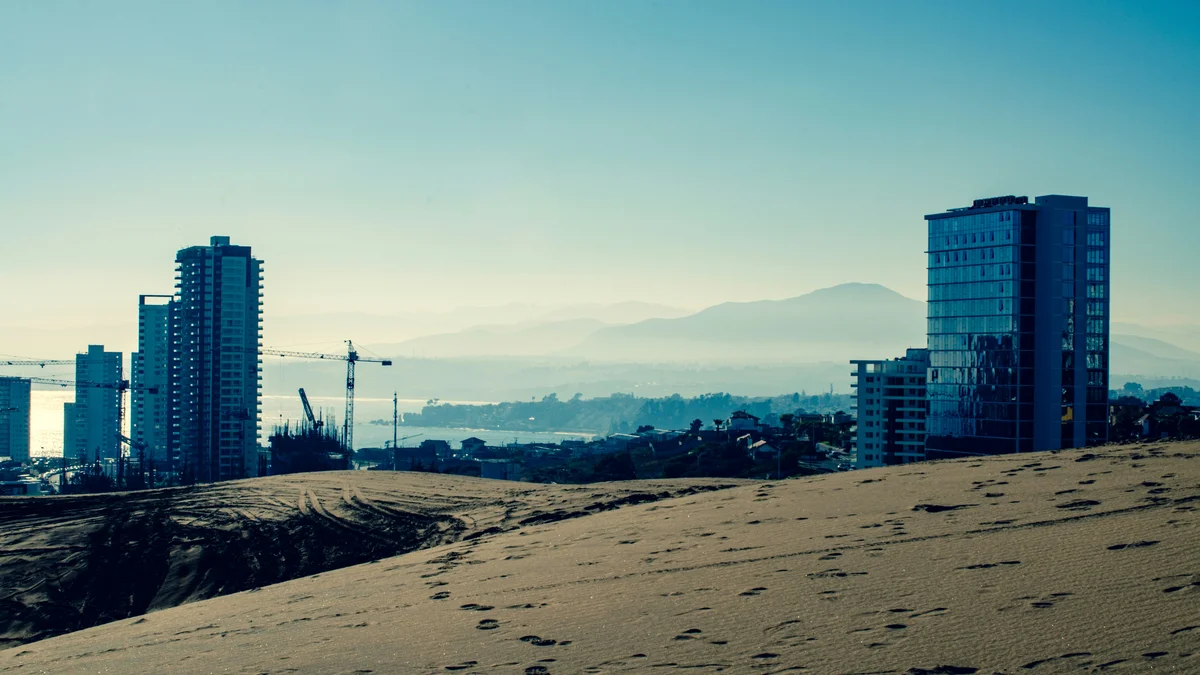
A dramatic stretch of coastline just north of Viña del Mar where towering golden sand dunes meet the Pacific Ocean directly, a real and striking contrast between desert and sea. The dunes are a popular stop for photos and sandboarding, and the town of Concón itself is known locally for its seafood restaurants.
Visitor guide
The Concon dunes, officially the Campo Dunar de la Punta de Concon, are a coastal dune field between the commune of Concon and the locality of Renaca in Chile's Valparaiso Region. Spanish-language Wikipedia says they are used as a tourist attraction, with sandboarding a common activity.
The dune field dates to the Quaternary period and sits on a marine terrace more than 30 metres above sea level, although one section of the article gives 80 metres. Its sand came from the streams of Vina del Mar and Renaca, which carried large quantities of sediment during an interglacial period, rather than from the beach. A cliff separates the dunes from the sea, so geomorphologists call them hanging dunes, and Spanish Wikipedia describes them as a fossil dune and a fragile one. Wind-blown Pleistocene sediments lie over marine sediments of the Caleta Horcon Formation, which the article dates to the Upper Pliocene.
Two dune systems are distinguished: older Pleistocene dunes inland, stabilised by sclerophyll forest vegetation that includes molle, maiten, huingan, peumo and boldo, and more recent Holocene dunes near the sea cliff, aligned across the prevailing southwest wind and alternating with depressions.
Low shrubs and annual herbs of the coastal scrub of Chile's Norte Chico cover the dunes, with flowers distributed unevenly by dune level, and Alstroemeria hookeri subsp. recumbens is named as an example. The reptile Liolaemus kuhlmanni uses the dunes for breeding, feeding and shelter, and the area is visited by migratory shorebirds. Sea lions and Humboldt penguins rest at nearby sites. The article also says the ecosystem includes species found only at this location, such as small invertebrates.
The dune field covers about 45 hectares according to Spanish Wikipedia. On 5 August 1993 it was declared a Santuario de la Naturaleza by Decree 481 of the Ministry of Education. In April 1994 a new decree reduced the protected area to 12 of the 45 hectares, which allowed owners of the unprotected land to plan apartment buildings. After community concern, protection was extended to 21.8 hectares in 2006 or 2007, and in December 2012 the Ministry of the Environment extended it to 30.1 hectares. Other sources give different figures, such as 20 of 50 hectares in English Wikipedia, so the exact protected area depends on the source and date.
Most of the sanctuary land belongs to a real estate company rather than the state. The dunes have been the subject of repeated disputes over construction and public access, and conservation groups including Duna Viva and Patrimonio Vivo Costa do outreach and cleanups. Because the dunes are fossil, damage from vehicle traffic is hard to reverse, so travellers should respect signs and rules about access.
Concon is a city and commune known for beaches, seafood restaurants and nightlife, with its three main beaches named Playa Negra, Amarilla and Boca. Wikipedia notes the Aconcagua River reaches the sea at the north of the town. It was first mentioned by Pedro de Valdivia in 1541 and became an independent municipality again in 1995.
A private guided visit with a dedicated vehicle and driver can combine the dunes with Vina del Mar and Valparaiso.
See every tour and attraction we cover in Valparaiso.