TorontoOntario · 36 tours
 Niagara FallsOntario · 25 tours
 New York CityNew York · 30 tours
 Las VegasNevada · 8 tours
 San FranciscoCalifornia · 16 tours
 VancouverBritish Columbia · 17 tours
 DubaiUAE · 54 tours
 Abu DhabiUAE · 5 tours
 Buenos AiresArgentina · 23 tours
 AthensGreece · 31 tours
 AucklandNew Zealand · 38 tours
 CancunMexico · 54 tours
No destinations match “”. Try searching all tours instead — that search understands full questions, not just place names.
An eccentric, one-of-a-kind museum built from architectural salvage, part playground and part art installation.
Visitor guide
City Museum is a sprawling, artist-built playground in a former International Shoe Company factory and warehouse in downtown St. Louis. It opened on October 25, 1997, and is made largely from architectural salvage rather than traditional exhibits. It is better described as a climb-through sculpture than a conventional museum.
Sculptors Bob and Gail Cassilly bought the mostly vacant building in 1993, and work began almost immediately. The construction stayed secret until visitors first glimpsed the work in progress on New Year's Eve 1996, and the giant whale in the lobby was completed in 1997. Within two years of opening, the museum drew around 300,000 visitors a year, and Wikipedia reports more than 700,000 in 2010. Ownership later passed to American Milling, and the museum was sold in 2019 to Premier Parks, according to Wikipedia. The building sits in the Washington Avenue loft district.
Bob Cassilly (1949 to 2011) was born in Webster Groves, Missouri, began apprenticing with sculptor Rudolph Torrini at about 14, and earned an art degree at Fontbonne University. Before City Museum he was known for animal sculptures: Wikipedia lists hippos in two of New York's parks, turtles in Forest Park, the Mysterious Monarch butterfly at Faust Park, a 67-and-a-half-foot giraffe at the Dallas Zoo, and sea lion fountains and a 45-foot squid for the Saint Louis Zoo. He remained City Museum's artistic director until his death in 2011.
Much of the museum is assembled from materials cities leave behind: the museum's own site lists rebar, concrete, iron, limestone and plaster. Wikipedia documents specific reclaimed pieces, including a refrigeration coil donated by Anheuser-Busch that serves as a giant Slinky, an 1870s vault from the First National Bank of St. Louis, a statue of St. George from a former Chicago church, and a 1924 Wurlitzer pipe organ said to come from New York's Rivoli Theater and added to the caves in 2007. The second-floor Vault Room has two 3,000-pound doors and about 1,000 safe deposit boxes.
Highlights include the Enchanted Caves, hand-sculpted by Cassilly and his crew and opened in 2003, which run through the center of the building up to the tenth floor; ceiling tunnels on the first floor hide behind aircraft Kevlar cut to resemble icicles. MonstroCity, completed in 2002, combines two Sabreliner 40 aircraft fuselages, a fire engine, a castle turret and giant Slinkies, and beneath it sits the Cabin Inn, an early-19th-century log cabin that Wikipedia says was once home to a son of Daniel Boone.
The multistory slides descend through the Shoe Shafts, built from structures International Shoe once used to send shoes down to the loading dock on spiral chutes. The first three-story slide opened in 2003 and a ten-story slide followed around 2008. The second floor has a Shoelace Factory with machines from the 1890s, while the third floor holds the Skateless Park, a circus school, Beatnik Bob's and a pencil more than 76 feet long that Wikipedia says was made in 2007 for Sri Chinmoy's 76th birthday and installed in 2009. Art City on the fourth floor offers art projects.
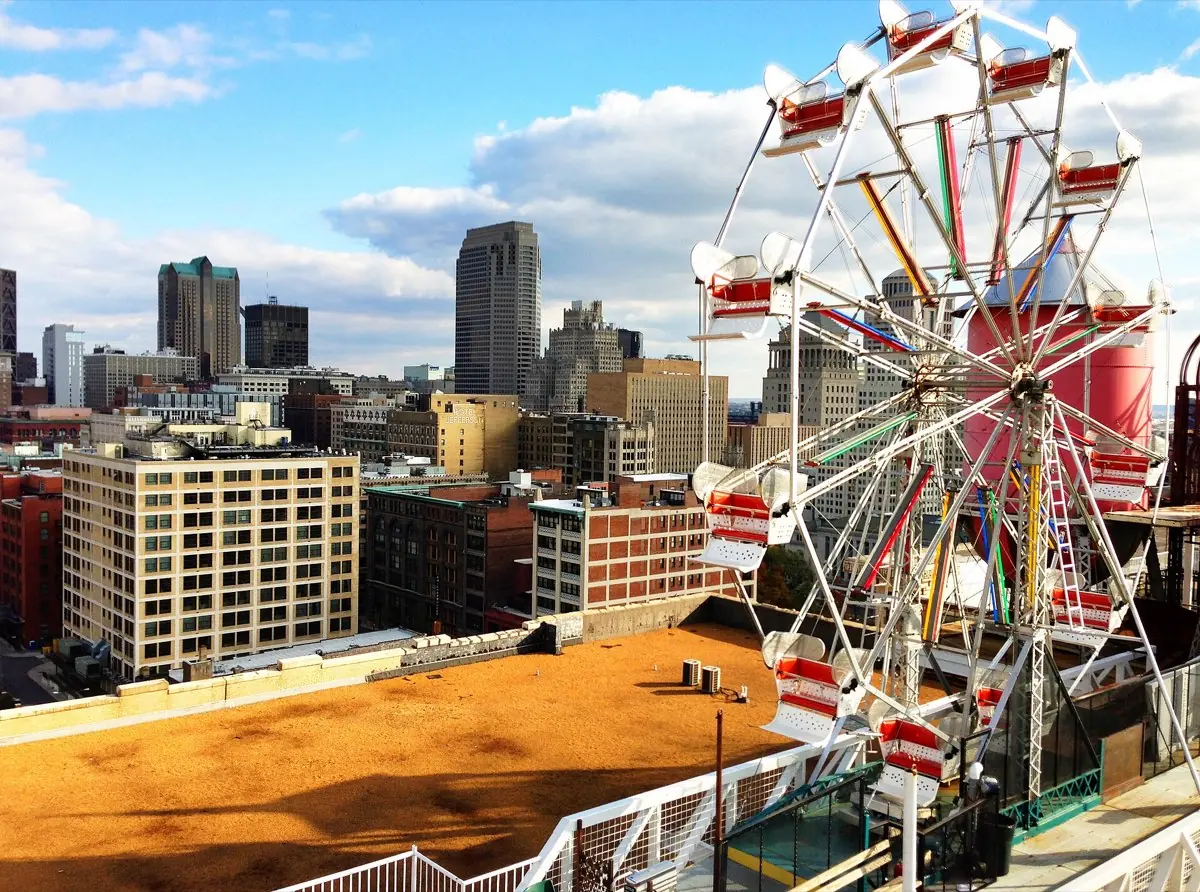
The roof has a small Ferris wheel installed in 2006 and a 24-foot praying mantis sculpture atop a dome salvaged from the St. Louis Science Center. Other features reported include a bowhead whale sculpture in the lobby. The exhibits and climbing areas change as the artists keep building, so treat the lists above as a snapshot. The museum itself describes a mix of indoor, outdoor and underground spaces, and the Project for Public Spaces has named it one of its great public spaces.
Voyzo's private tours include door-to-door pickup with your own driver, which suits families with children and gear. Check the museum directly for current hours, age guidance, accessibility and which areas are open.
See every tour and attraction we cover in St. Louis.