TorontoOntario · 36 tours
 Niagara FallsOntario · 25 tours
 New York CityNew York · 30 tours
 Las VegasNevada · 8 tours
 San FranciscoCalifornia · 16 tours
 VancouverBritish Columbia · 17 tours
 DubaiUAE · 54 tours
 Abu DhabiUAE · 5 tours
 Buenos AiresArgentina · 23 tours
 AthensGreece · 31 tours
 AucklandNew Zealand · 38 tours
 CancunMexico · 54 tours
No destinations match “”. Try searching all tours instead — that search understands full questions, not just place names.
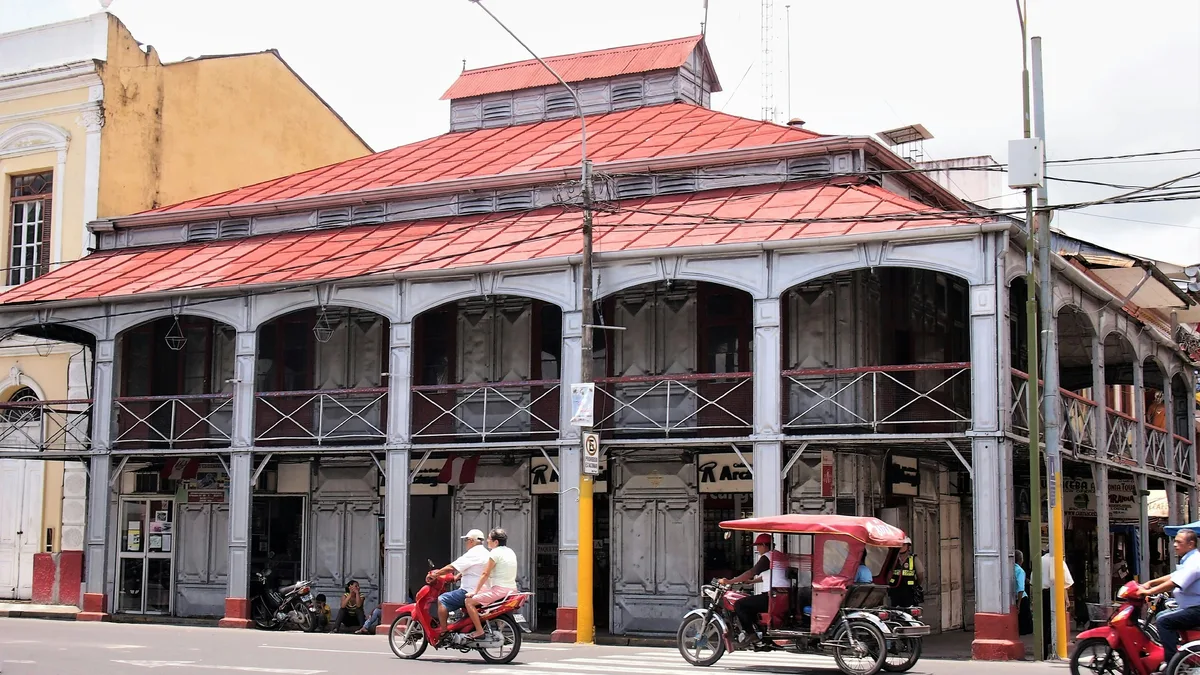
A prefabricated iron building in downtown Iquitos, long said to have been designed by Gustave Eiffel's firm and shipped to the Amazon during the city's rubber boom era, now one of its most distinctive landmarks.
Visitor guide
Casa de Fierro, or the Iron House, is a prefabricated iron-sheet building on the main plaza of Iquitos in the Peruvian Amazon. It is a landmark of the rubber-boom era and is widely, though doubtfully, linked to Gustave Eiffel.
Iquitos became a centre of rubber exports from the Amazon Basin in the late nineteenth and early twentieth centuries and attracted European immigrants. Rubber declined after seedlings were taken to plantations in Southeast Asia. Wikipedia lists the Casa de Fierro among the landmarks of central Iquitos, alongside the Plaza de Armas and the Iglesia Matriz. The house stands in front of the main square between Prospero and Putumayo streets.
The accounts of how the house reached Iquitos disagree. English Wikipedia says the rubber baron Anselmo del Aguila bought it at the International Exposition of Paris in 1889, that it was dismantled and brought to Iquitos in pieces, with the metal sheets carried by hundreds of men through the jungle, and that it was assembled there in 1890. It adds that well-substantiated claims since 2011 show it was built in the Belgian workshops of Les Forges d'Aiseau, using the Joseph Danly process. The Spanish-language article instead says the buyer at the Paris exposition was Julio H. Toots, who called it the Great House, and that the structure arrived in 1890 aboard the Brazilian ship Perseveranca. That article says it was too large to move in one piece and was split in two: one part, bought by Antonio Vaca Diez, was never taken to its intended destination and was eventually scrapped, with some pieces reported to have been reused in the Central Market, while the second part became the house on the plaza.
Many guides credit Gustave Eiffel. English Wikipedia says the claim is popular but that there is no evidence for it and that the building does not reflect his architectural style, while the Spanish article states his authorship as fact. Given the weight of the English-language account and the Belgian workshop evidence, the Eiffel link is best treated as a popular story rather than established history.
The walls, ceiling and balcony are plastered in rectangular sheets of iron, and the Spanish article describes a portico of columns on the ground floor, a pyramid-shaped roof and a second floor supported by silvery columns. Wikipedia calls it one of the finest and best-preserved examples of civil architecture in Peru and says it is sometimes described as the first prefabricated house in the Americas, a claim to treat cautiously. The Spanish article lists owners including the businessman Francisco Borges and Anselmo del Aguila, who used it as a mansion, and says that as the rubber boom declined in 1914 it was bought by the Spaniard Julio Queija, who turned it into a restaurant. It was later used as a sweet factory, a shopping centre and a grocery store. Since 1985 it has been administered by the Club Social de Iquitos, which has contributed to its restoration.
Wikipedia notes that Mario Vargas Llosa's comic novel Captain Pantoja and the Special Service tells a completely different story of the house's origin, a reminder that the building has long attracted tall tales.
The house is in the centre of Iquitos, near the plaza, and is usually seen from outside. A private guided visit with a driver and guide can place it in the city's rubber history alongside other central sights.
See every tour and attraction we cover in Iquitos.