TorontoOntario · 36 tours
 Niagara FallsOntario · 25 tours
 New York CityNew York · 30 tours
 Las VegasNevada · 8 tours
 San FranciscoCalifornia · 16 tours
 VancouverBritish Columbia · 17 tours
 DubaiUAE · 54 tours
 Abu DhabiUAE · 5 tours
 Buenos AiresArgentina · 23 tours
 AthensGreece · 31 tours
 AucklandNew Zealand · 38 tours
 CancunMexico · 54 tours
No destinations match “”. Try searching all tours instead — that search understands full questions, not just place names.
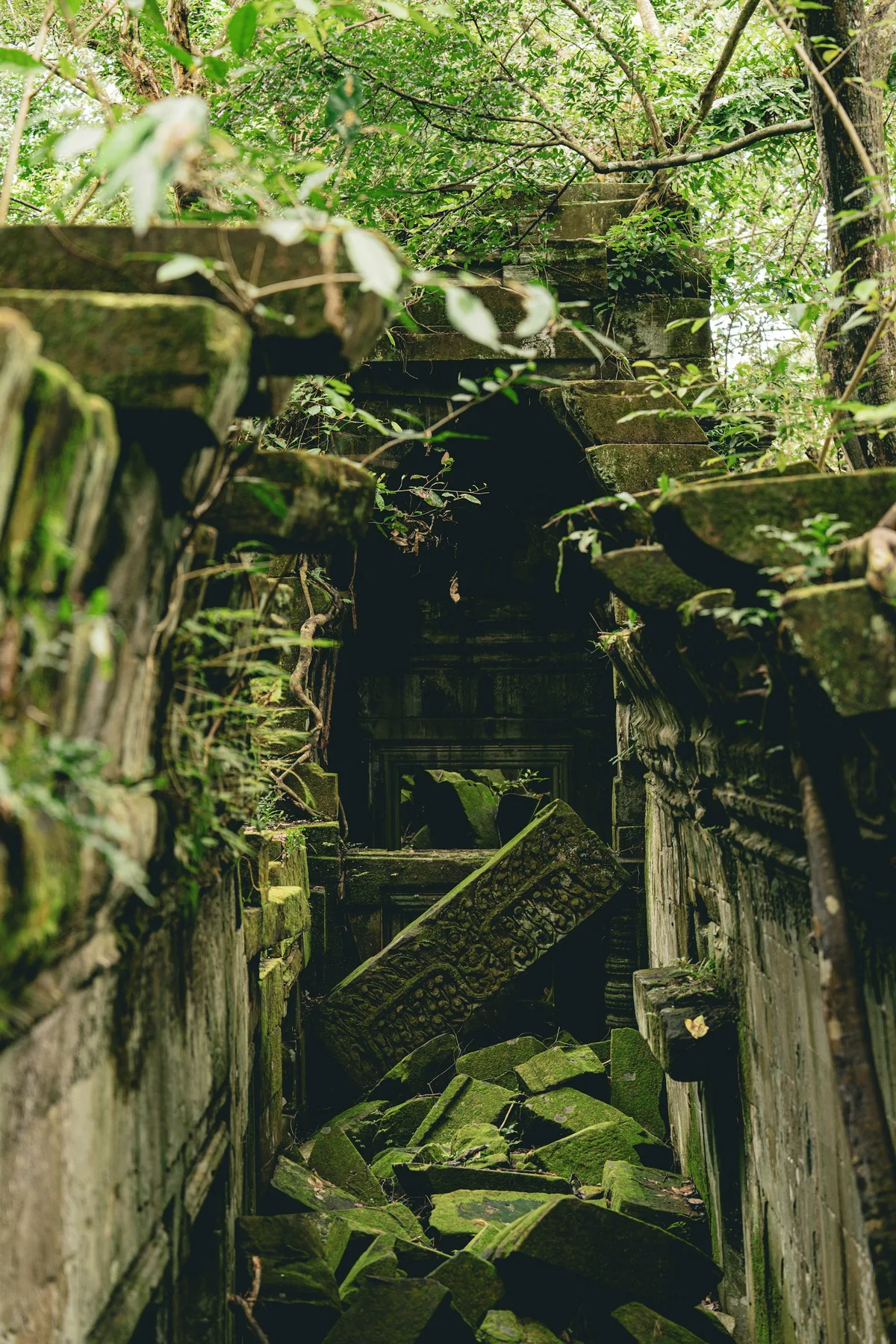
A 12th-century temple built to the same floor plan as Angkor Wat but left unrestored, roughly 40 km east of the main Angkor complex, with its sandstone galleries collapsed and overtaken by jungle.
Visitor guide
Beng Mealea is a Hindu temple in Siem Reap Province, Cambodia, about 40 kilometres east of the main Angkor group on the ancient royal highway to Preah Khan Kompong Svay. Built in the early 12th century on a plan close to that of Angkor Wat, it has been left largely unrestored, with trees and fallen stones filling its courtyards.
The name Beng Mealea is often translated as Lotus Pond. The temple has no recorded history of its own, so it is dated by style. Its architecture matches Angkor Wat, and scholars attribute it to the reign of King Suryavarman II in the early 12th century. It was built for Vishnu, though some carvings show Buddhist motifs.
The temple faces east but has entrances on the other three sides. Three enclosing galleries surround a central sanctuary that has now collapsed, and cruciform cloisters link the enclosures, as at Angkor Wat. Two structures called libraries stand on either side of the eastern avenue. The outer gallery measures 181 by 152 metres, and the whole temple was the centre of a town surrounded by a moat measuring 1,025 by 875 metres and 45 metres wide. It is smaller than Angkor Wat, yet Wikipedia ranks it among the larger temples of the Khmer Empire.
The carvings include scenes from Hindu mythology such as the Churning of the Sea of Milk and Vishnu carried by the bird god Garuda. The causeways have long balustrades shaped like seven-headed nagas. The temple is built mainly of sandstone, and the quarries of Phnom Kulen, which supplied stone for Angkor, lie about 7 kilometres away in a straight line. Scholars presume that sandstone for Angkor was moved along artificial canals that passed through this area.
Beng Mealea is largely unrestored. Trees and thick brush grow among its towers and courtyards, and many stones lie in large heaps. The central sanctuary has collapsed, and a wooden walkway of about 250 metres crosses the collapsed centre so visitors can move through the ruins. French scholars took an interest in the temple soon after it was discovered, drawn by the quality of its architecture and decoration.
The APSARA National Authority excavated and restored the eastern causeway between 2024 and 2025 with funding from the Lancang-Mekong Cooperation Special Fund. Wikipedia reports that the restored section is about 100 metres long and 13 metres wide, and that the authority announced a second phase for the wider complex. UNESCO added Beng Mealea to its Tentative List for World Heritage on 27 March 2020.
For years the site was hard to reach, but a road built to the Koh Ker temple complex now passes nearby. Its remote setting, away from the main Angkor circuit, gives a very different impression from the restored monuments, and it pairs well with Phnom Kulen and other outlying sites on a private day tour.
See every tour and attraction we cover in Cambodia.