TorontoOntario · 36 tours
 Niagara FallsOntario · 25 tours
 New York CityNew York · 30 tours
 Las VegasNevada · 8 tours
 San FranciscoCalifornia · 16 tours
 VancouverBritish Columbia · 17 tours
 DubaiUAE · 54 tours
 Abu DhabiUAE · 5 tours
 Buenos AiresArgentina · 23 tours
 AthensGreece · 31 tours
 AucklandNew Zealand · 38 tours
 CancunMexico · 54 tours
No destinations match “”. Try searching all tours instead — that search understands full questions, not just place names.
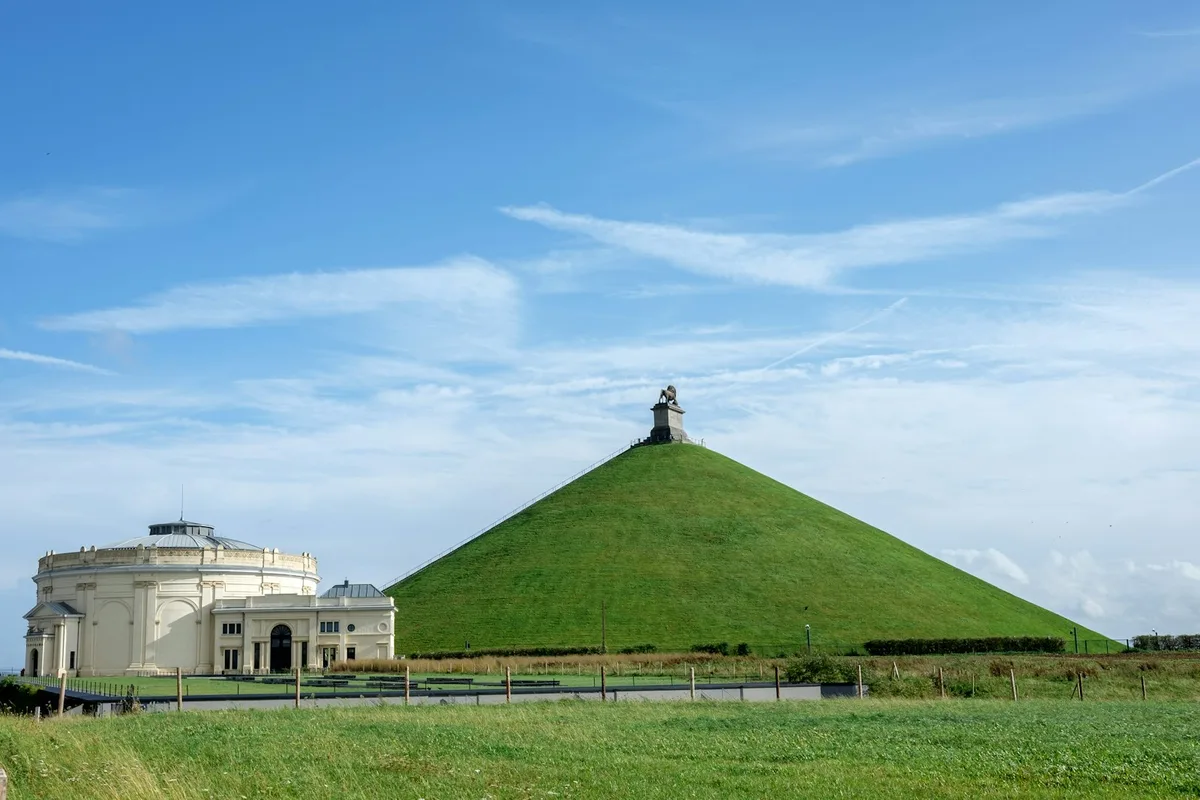
The site south of Brussels where Napoleon was defeated in 1815, marked today by the Lion's Mound, an artificial hill built from battlefield earth with a memorial lion at its summit.
Visitor guide
The Waterloo Battlefield lies south of Brussels in Belgium, near the town of Waterloo, and is the site of the battle fought on Sunday 18 June 1815 that ended Napoleon's rule. The landscape is dominated today by the Lion's Mound, an artificial hill topped by a cast-iron lion, and by the farms and ridges where the fighting took place.
Wikipedia describes Waterloo as the last battle of Napoleon I and the decisive engagement of the Waterloo campaign in the Hundred Days. Napoleon commanded the French Imperial Army, with Marshal Michel Ney in tactical control of most forces for most of the day. Arthur Wellesley, Duke of Wellington, led the Anglo-allied army, whose line ran along the Mont-Saint-Jean ridge across the Brussels road, and Field Marshal Blucher's Prussian army arrived in stages to attack the French flank.
Strengths were roughly 72,000 to 74,500 French against about 68,000 for Wellington, with some 50,000 Prussians. The Anglo-allied army repulsed the final attack of the Imperial Guard, and the French army broke when the Prussians pushed through on its right flank. Napoleon abdicated four days later and coalition forces entered Paris on 7 July. Wellington is reported to have called it the nearest-run thing you ever saw in your life.
Two fortified farms anchored the Allied line. Hougoumont, a walled manor with a chapel, orchard and garden, was held by Nassau troops reinforced by Guards light companies. Napoleon ordered it shelled, the house burned, and only the chapel survived. A French attack broke through the north gate, and Lieutenant-Colonel James Macdonell and others forced it shut. Wellington later said the success of the battle turned upon the closing of the gates. A 1985 dig of its well found no support for Victor Hugo's story of hundreds of bodies thrown in. The Project Hougoumont restoration was completed in June 2015.
La Haye Sainte, at the centre, was defended by about 400 men of the King's German Legion under Major Georg Baring. The garrison held until late afternoon, when its ammunition ran out and Ney's assault took the farm at around 18:00. The farm is privately owned and changed little since 1815, with memorials on its walls.
King William I of the Netherlands ordered the mound in 1820, and it was built in the mid-1820s (sources give 1823 or 1824 as the start, 1826 as completion) from about 300,000 cubic metres of earth taken from the ridge. It stands roughly 41 to 43 metres high, depending on the source, and marks where the Prince of Orange, later William II, was struck by a musket ball. The cast-iron lion weighs 28 tonnes and was cast at William Cockerill's foundry in Liege. A popular belief that it was made from French cannon is described by Wikipedia as untrue. A climb of 226 steps leads to the top, and since the 2015 memorial opened, access has been through the nearby museum, which also covers the Waterloo Panorama.
The fields remain open farmland, and standing on the ridge shows how Wellington used the reverse slope and the farms. A private guided visit lets a guide walk the ground with you in the order the day unfolded.
See every tour and attraction we cover in Belgium.