TorontoOntario · 36 tours
 Niagara FallsOntario · 25 tours
 New York CityNew York · 30 tours
 Las VegasNevada · 8 tours
 San FranciscoCalifornia · 16 tours
 VancouverBritish Columbia · 17 tours
 DubaiUAE · 54 tours
 Abu DhabiUAE · 5 tours
 Buenos AiresArgentina · 23 tours
 AthensGreece · 31 tours
 AucklandNew Zealand · 38 tours
 CancunMexico · 54 tours
No destinations match “”. Try searching all tours instead — that search understands full questions, not just place names.
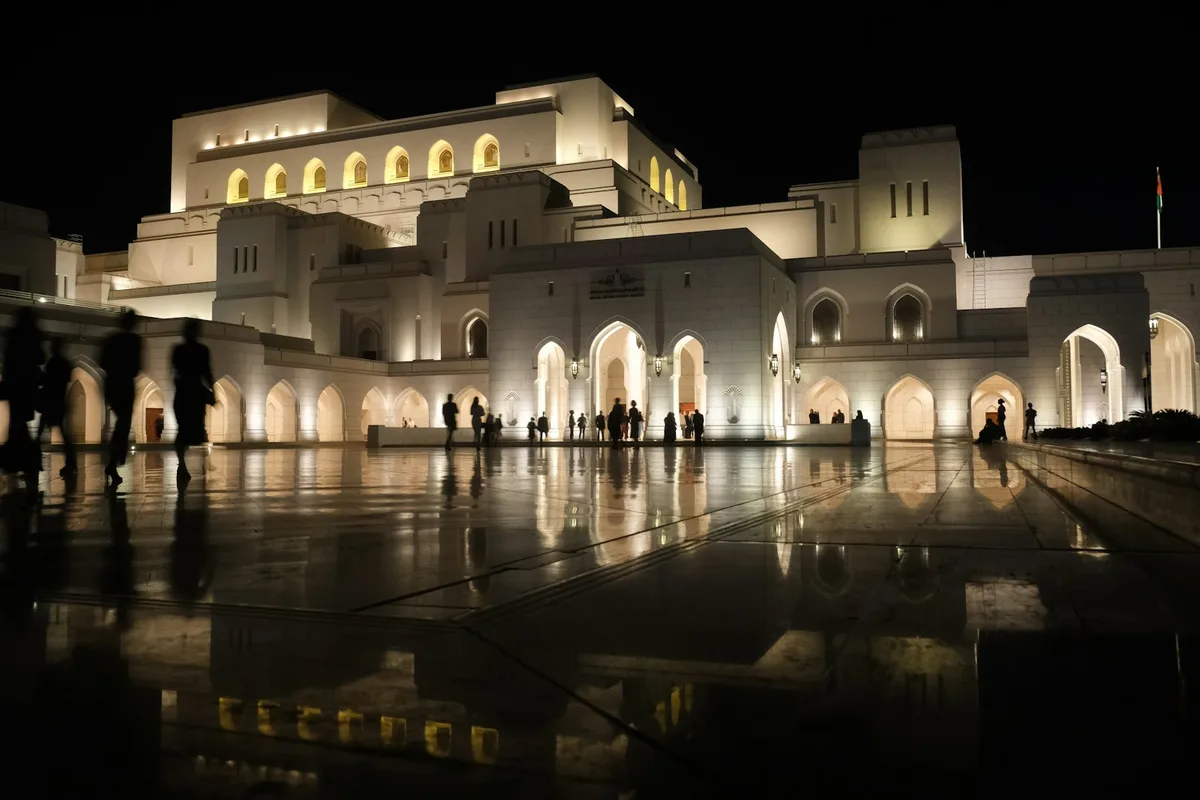
Oman's national opera house, built in traditional Omani-Islamic architectural style with white stone facades and carved wooden doors, hosting international opera, ballet, and concerts.
Visitor guide
The Royal Opera House Muscat is Oman's national venue for opera, orchestral music, ballet and other stage performance, in the Shati Al-Qurm district of Muscat. It opened in October 2011 and combines a modern flexible auditorium with Omani-Islamic architectural detail.
According to Wikipedia, Sultan Qaboos bin Said Al Said ordered the building of an opera house in 2001, a project first called the House of Musical Arts before the Royal Opera House Muscat name was chosen. Construction began in 2007 and was completed in 2011, with Carillion Alawi as main contractor. The house opened on 12 October 2011 with Puccini's Turandot, which Wikipedia says was conducted by Placido Domingo. The first season also included Andrea Bocelli and Renee Fleming.
The venue stands on Sultan Qaboos Street and is described as reflecting contemporary Omani architecture, with Wikipedia listing Islamic and Italianate styles. Other sources describe colonnades, terraces and sculptural tower forms finished in light local stone and stucco, with interiors of marble, gypsum and carved wood, with floor counts that vary by source (one project description cites six levels above three basement floors). WATG is named as the winner of the international design competition, with acoustic design by Acoustic Dimensions, according to Theatre Projects.
The main auditorium is a flexible performance space. Theatre Projects says its concert-hall shell can move on tracks to allow a proscenium to drop into place for a conventional theatre arrangement, with the orchestra pit rising and front rows lowering into the floor. Wikipedia gives a maximum capacity of about 1,100, while a technical listing quotes figures such as 1,091 at maximum, 1,055 in concert mode, 976 in theatre mode and 839 in opera mode with a full orchestra. Wikipedia adds that the house was the first in the world equipped with the Mode23 multimedia interactive seatback display system.
Oman Pocket Guide reports that the Royal Court Affairs invited selected international design firms to compete for the project in 2003, and that London-based WATG won the competition and led the design and supervision team. Its scope is described as covering master planning, architecture, interiors, landscape, decorative lighting, graphics, signage, engineering and acoustics. Construction of the superstructure is said to have started in April 2007. The opera house stands on an eight-hectare site, developed as the start of a new urban quarter, with a formal landscaped park and a cultural souk with shops and coffee shops. The same guide gives about 1,000 seats for concerts, reduced for drama and opera.
Because the venue serves formal occasions, it has a stated dress code that is formal or business, with shoulders covered and skirts below the knee, in keeping with Omani convention. Visitors planning a performance should check dress guidance in advance.
The complex includes a concert theatre, an auditorium, formal landscaped gardens, a cultural market with retail spaces, restaurants and an art centre. According to Wikipedia, the programme has included Yo-Yo Ma with the London Philharmonic Orchestra, American Ballet Theatre, the Mariinsky Ballet and Jazz at Lincoln Center Orchestra, as well as Arab artists such as Majida El Roumi, with the Royal Oman Symphony Orchestra also appearing in the venue's gallery of performances.
Visitors can see the building and its grounds by day, but performance attendance depends on the programme, so a guided stop is best arranged with a private tour driver who can fit it into a Muscat itinerary.
See every tour and attraction we cover in Oman.