TorontoOntario · 36 tours
 Niagara FallsOntario · 25 tours
 New York CityNew York · 30 tours
 Las VegasNevada · 8 tours
 San FranciscoCalifornia · 16 tours
 VancouverBritish Columbia · 17 tours
 DubaiUAE · 54 tours
 Abu DhabiUAE · 5 tours
 Buenos AiresArgentina · 23 tours
 AthensGreece · 31 tours
 AucklandNew Zealand · 38 tours
 CancunMexico · 54 tours
No destinations match “”. Try searching all tours instead — that search understands full questions, not just place names.
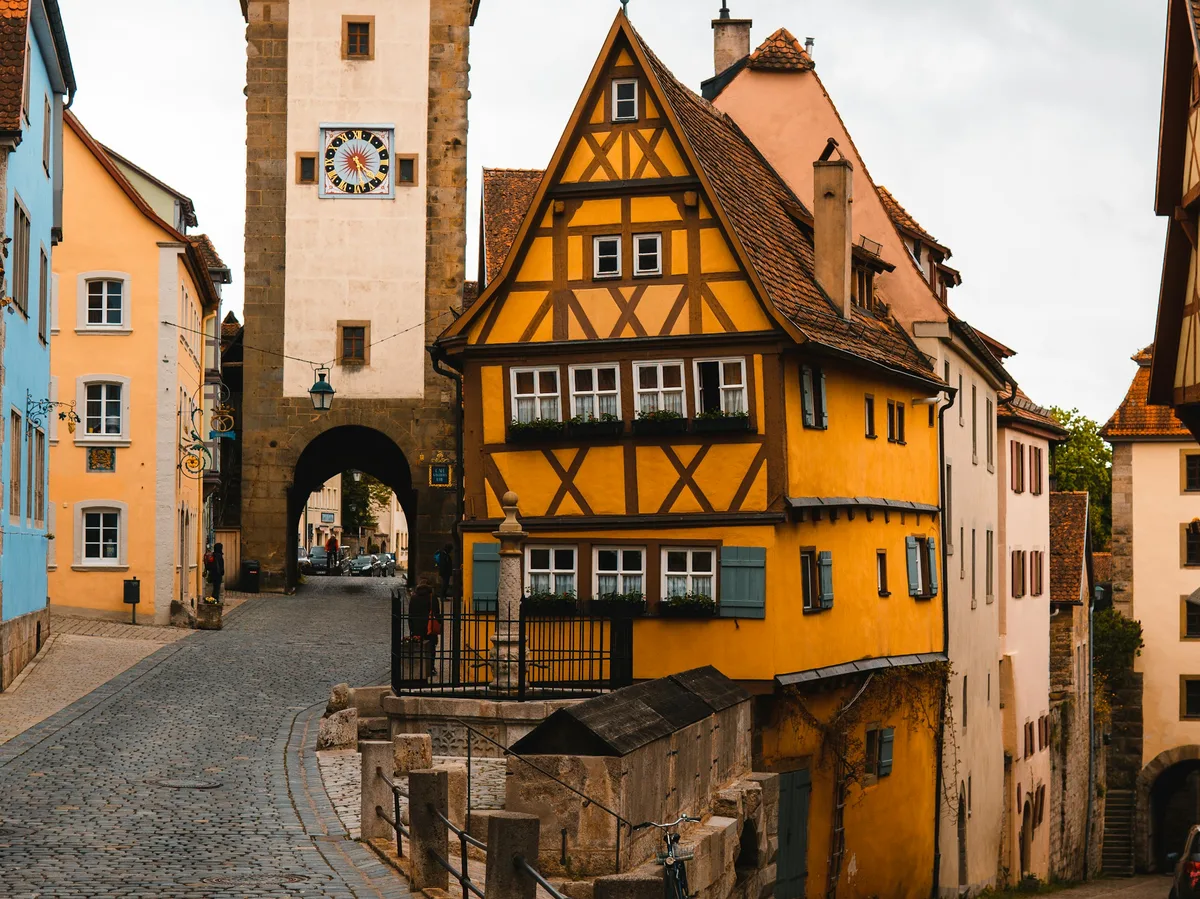
A near-perfectly preserved medieval walled town on the Romantic Road, known for its cobblestone lanes, half-timbered houses, and a town center that looks much as it did centuries ago.
Visitor guide
Rothenburg ob der Tauber is a historic walled town in Middle Franconia, Bavaria, Germany, set on a plateau above the Tauber River. Its name means red castle above the Tauber, and it is celebrated for its well-preserved medieval old town and its place on the Romantic Road through southern Germany.
According to Wikipedia, the counts of Comburg-Rothenburg built a castle on the hilltop above the Tauber in 1070. After the dynasty died out in 1116 the property passed to the Hohenstaufen family, and King Konrad III built a Staufer castle nearby in 1142; the town was founded around it in about 1170. An earthquake destroyed that castle in 1356, and only the St. Blaise chapel remains.
King Rudolf of Habsburg granted Rothenburg the privileges of a free imperial city in 1274. The town held fairs and prospered over the following centuries, with a population commonly given as about 5,500 inside the walls and many thousands more in its surrounding territory. It remained a free imperial city until 1803, when it passed to Bavaria.
In 1631, during the Thirty Years' War, the Catholic commander Count Tilly attempted to quarter troops in the Protestant town. Rothenburg resisted but was quickly overpowered, and an outbreak of plague in 1634 killed many more residents. Wikipedia notes that the town afterwards stopped growing, which helped preserve its 17th-century character.
The famous Meistertrunk is a legend that Mayor Georg Nusch saved the town from burning by draining a huge cup of wine in one go. Historians consider the story almost certainly apocryphal, since it first appears in a chronicle more than a century after the events. The scene is shown on the astronomical clock at the Ratstrinkstube on the market square.
Rothenburg is described as one of only four towns in Germany with completely intact city walls, the others being Nordlingen, Dinkelsbuhl and Berching. The surviving walls and towers date mainly from the 14th century onward, with older fabric in places; the town's tourism office notes that stone from the castle ruined by the 1356 earthquake was reused for the wall. The Rathaus combines a Gothic rear section from about 1250 with a Renaissance front begun in 1572, and its tower, about 61 metres tall, can be climbed for views over the rooftops.
The Church of St. James holds the Holy Blood altarpiece carved between 1500 and 1505 by Tilman Riemenschneider, one of the great sculptors of the German late Gothic. The Plonlein, a small square where two streets fork beneath a tower, is among the town's most photographed corners. The Christmas museum run by the Kathe Wohlfahrt firm reflects the town's year-round festive reputation.
In the 19th century painters of the Romantic movement, including Hans Thoma and Carl Spitzweg, visited the town, and the first tourists followed; laws were later passed to limit major changes to the townscape. In March 1945, bombing killed 37 people and destroyed about 275 houses; the town's tourism office puts the loss at about 45 percent of the walled old town, though figures differ by source. Because incendiary bombs were used, many outer walls survived and were reused in rebuilding. Local commander Major Thommes surrendered the town rather than follow orders to fight on, which spared it further destruction.
Postwar reconstruction relied partly on donations from around the world, and some rebuilt wall sections carry commemorative bricks bearing donors' names. The western part of the old town, which holds most of the historic monuments, was not damaged. A private guided visit suits the compact, walkable old town, where the stories behind the walls and gates add much to the sights.
See every tour and attraction we cover in Germany.