TorontoOntario · 36 tours
 Niagara FallsOntario · 25 tours
 New York CityNew York · 30 tours
 Las VegasNevada · 8 tours
 San FranciscoCalifornia · 16 tours
 VancouverBritish Columbia · 17 tours
 DubaiUAE · 54 tours
 Abu DhabiUAE · 5 tours
 Buenos AiresArgentina · 23 tours
 AthensGreece · 31 tours
 AucklandNew Zealand · 38 tours
 CancunMexico · 54 tours
No destinations match “”. Try searching all tours instead — that search understands full questions, not just place names.
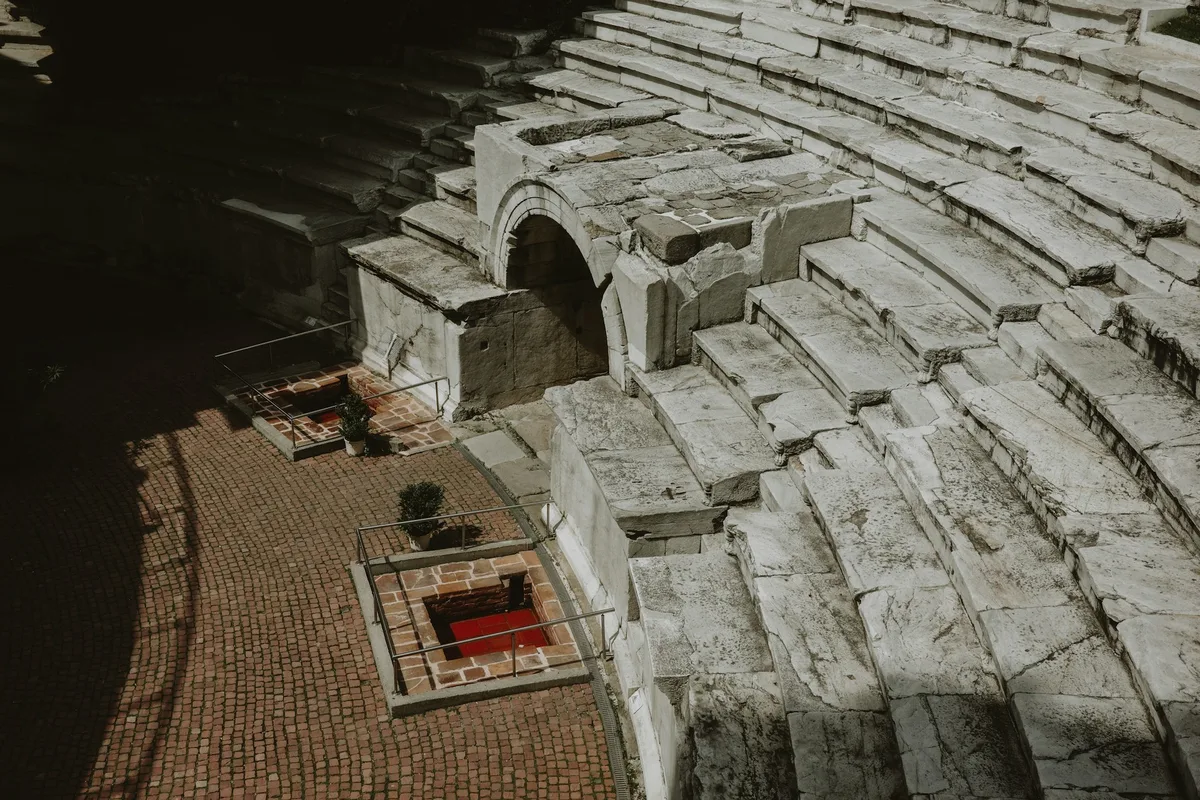
A restored 1st-2nd-century Roman theatre built into Plovdiv's Three Hills, still used for concerts today and one of the best-preserved Roman theatres in the Balkans.
Visitor guide
The Ancient Theatre of Philippopolis, also called the Roman Theatre of Plovdiv, is a well-preserved Roman theatre in the Old Town of Plovdiv, Bulgaria. Wikipedia says it hosts between 5,000 and 7,000 spectators and is still used for performances.
Sources differ on when the theatre was built. Wikipedia's text says it was constructed in the 1st century CE, probably under Domitian, while its infobox credits Trajan, and other sources including Lonely Planet attribute it to Trajan in the 2nd century. The theatre belonged to the Roman city of Philippopolis, named after Philip II of Macedon, which became the capital of the Roman province of Thracia.
The theatre was found in the early 1970s after a landslide, and excavation removed about 4.5 metres of earth. The infobox gives excavation dates as 1968 to 1979, and another section says ruins were found in the late 1960s by staff of the Plovdiv archaeological museum, so the exact sequence is given inconsistently. Restoration followed the principle of anastylosis, and the new material is clearly visible. Wikipedia calls it one of the best achievements of the Bulgarian Conservation School. The text also gives two accounts of the damage, an attack by Attila the Hun in the 5th century and destruction by fire or earthquake at the end of the 4th century.
The theatre is semicircular, with an outer diameter of 82 metres. The cavea was cut into the hill and left unroofed, and the horseshoe-shaped orchestra is 26.64 metres long. Twenty-eight concentric rows of marble seats form two tiers separated by an aisle, and radial stairways divide the seating into wedge-shaped sectors. The scaenae frons had three floors, and the facade had two two-storey porticos, Roman Ionic and Corinthian, with three symmetrical gates. Vaulted passages run from the centre of the orchestra under the stage building, and under the top tier to the Three Hills area.
The theatre hosted spectacles, and remains of safety barriers before the first row suggest animal fights, which were added for the visit of Emperor Caracalla in 214 CE. Honorary inscriptions show it also served as the seat of the Thracian provincial assembly. Seats were engraved with the names of city quarters so that citizens knew where to sit, and honorary inscriptions on marble seats honour city councillors, magistrates and friends of the emperor.
The seats face south toward the lowland city and the Rhodope Mountains. Today the theatre hosts summer plays, musical shows, concerts and public events, and it hosted the prize ceremony of the 21st International Olympiad in Informatics.
The theatre sits in the Old Town of Plovdiv, so a visit combines naturally with a walk past the National Revival houses. A private guided visit lets your group sit in the seats and look out toward the city, and a guide can explain which parts are original and which are restoration.
See every tour and attraction we cover in Bulgaria.