TorontoOntario · 36 tours
 Niagara FallsOntario · 25 tours
 New York CityNew York · 30 tours
 Las VegasNevada · 8 tours
 San FranciscoCalifornia · 16 tours
 VancouverBritish Columbia · 17 tours
 DubaiUAE · 54 tours
 Abu DhabiUAE · 5 tours
 Buenos AiresArgentina · 23 tours
 AthensGreece · 31 tours
 AucklandNew Zealand · 38 tours
 CancunMexico · 54 tours
No destinations match “”. Try searching all tours instead — that search understands full questions, not just place names.
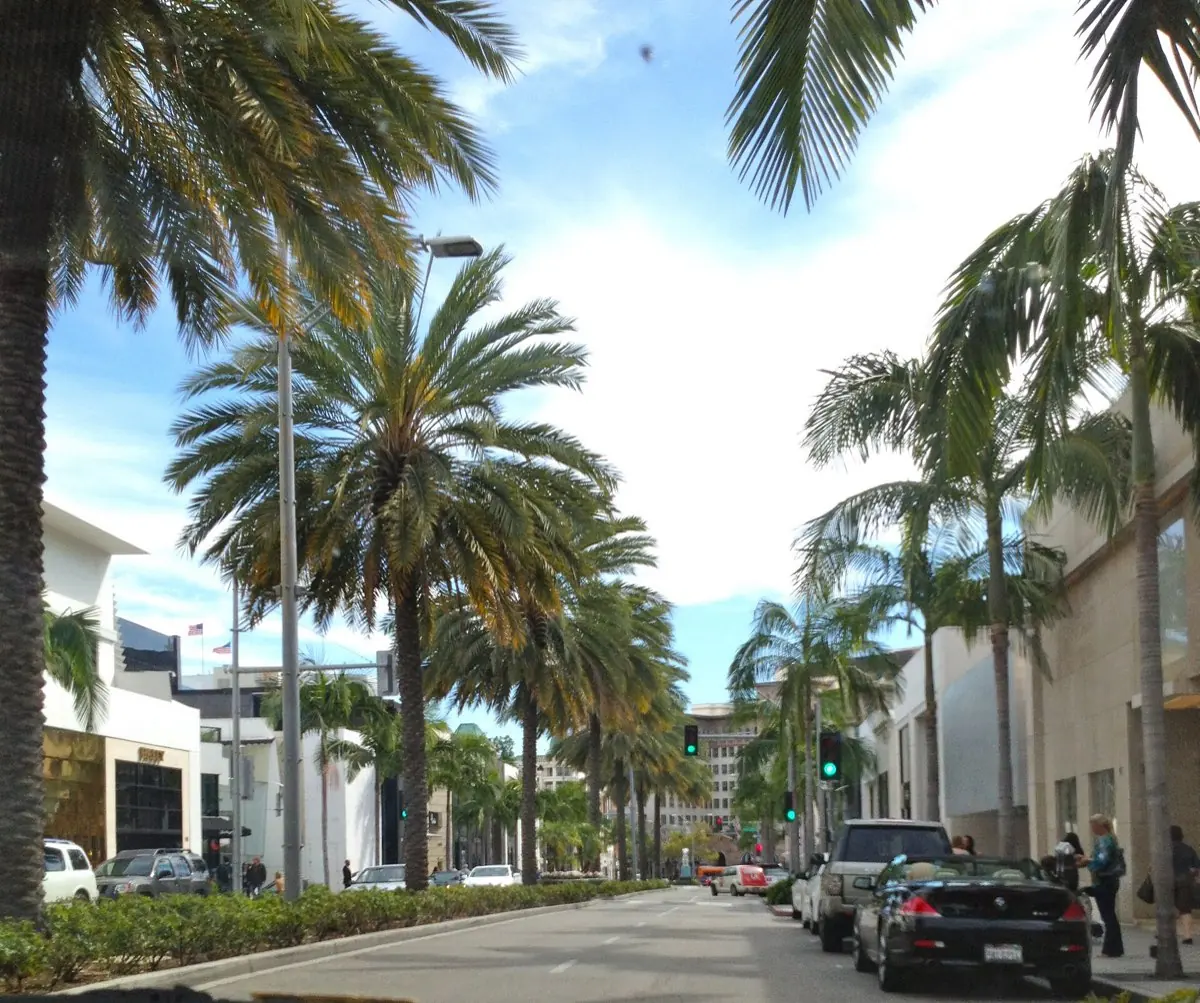
Beverly Hills' famous three-block strip of luxury flagship stores.
 Private Tours Popular Pick
A private, fully customizable tour of Los Angeles — Hollywood, Beverly Hills, Santa Monica, and the neighborhoods in between — in your own vehicle with a dedicated local guide.
 Private Tours
A private tour hitting Los Angeles' must-see stops — Hollywood, Beverly Hills, and a beach finish — built for visitors short on time.
Visitor guide
Rodeo Drive is a street of about two miles in Beverly Hills, though the name usually means the three blocks between Wilshire Boulevard and Little Santa Monica Boulevard, where luxury boutiques sit beneath palm trees. It is one of the most recognized shopping streets in the United States, tied closely to Hollywood's image of glamour.
The land that became Beverly Hills was once part of Rancho Rodeo de las Aguas, a Mexican-era grant of about 4,500 acres. Later owners farmed lima beans, and in 1900 Burton E. Green and other investors formed an oil company to search the land; they found no commercially viable oil. In 1906 the investors reorganized as the Rodeo Land and Water Company, renamed the property Beverly Hills (after Beverly Farms in Massachusetts), and platted the street. A Pacific Electric line ran over the street from 1907 to 1923, and the Beverly Hills Hotel, built in 1912 on a former lima bean field, turned the nearby road into a bridle path. The city incorporated in 1914. The Spanish stress is used for the name: roh-DAY-oh.
For decades Rodeo was an ordinary business street with hardware stores, gas stations, beauty shops and bookstores. In 1952 Frank Lloyd Wright designed the Anderton Court Shops there, a building that still stands out from the fashion boutiques around it.
Rodeo became a fashion address gradually. Fred Hayman opened Giorgio Beverly Hills in 1961, described as the street's first high-end boutique (one 2011 source dates the shop to 1964). Gucci arrived in 1968, followed by Van Cleef & Arpels in 1969, Vidal Sassoon in 1970 and a freestanding Polo store in 1971. In 1977 the Rodeo Drive Committee began a publicity campaign to promote the street as a shopping destination, and by 1980 the city estimated the district produced up to a quarter of its sales tax revenue. Wikipedia describes about two and a half blocks of high-fashion stores, roughly 65 shops, in 1981.
The Rodeo Collection, a four-story complex with its first floor below street level, opened in 1983. Two Rodeo Drive, a curving cobbled shopping lane that opened in 1990 with Christian Dior and Valentino among its first tenants, was styled as a European-looking alley; some architects compared it to a theme park. By the early 1990s Rodeo Drive ranked among the most visited destinations in the Los Angeles area. The street was reworked in 2003 in an $18 million project that widened sidewalks, added crosswalks and replaced ficus trees with palms.
Film helped build the myth. Scenes of Pretty Woman (1990) are set on the street, which cemented its place as shorthand for Los Angeles luxury, and it has appeared in many other films and songs since.
The Rodeo Drive Committee describes more than 100 international luxury brands operating in architect-designed boutiques, alongside galleries, outdoor dining and sculptures along the street. The Beverly Hills Hotel and the Beverly Wilshire are both a short distance away. The Rodeo Drive Walk of Style honors fashion figures with plaques set in the sidewalk and was developed in 2003; Giorgio Armani is reported to have been the first honoree. Its symbol is "Torso," a nude sculpture by Robert Graham at Rodeo and Dayton Way, and honorees receive a small version of it. Frank Lloyd Wright's Anderton Court Shops are an architecture stop that surprises many visitors who expect only fashion.
The street hosts annual events such as the Rodeo Drive Concours d'Elegance on Father's Day weekend and its Rodeo Drive Celebrates Timepieces & Fine Jewelry week; confirm current dates before you plan around them.
Within a short drive are the Sunset Strip, the Getty Center, and Santa Monica, so Rodeo Drive pairs easily with other Los Angeles sights on a single private tour.
See every tour and attraction we cover in Los Angeles.