TorontoOntario · 36 tours
 Niagara FallsOntario · 25 tours
 New York CityNew York · 30 tours
 Las VegasNevada · 8 tours
 San FranciscoCalifornia · 16 tours
 VancouverBritish Columbia · 17 tours
 DubaiUAE · 54 tours
 Abu DhabiUAE · 5 tours
 Buenos AiresArgentina · 23 tours
 AthensGreece · 31 tours
 AucklandNew Zealand · 38 tours
 CancunMexico · 54 tours
No destinations match “”. Try searching all tours instead — that search understands full questions, not just place names.
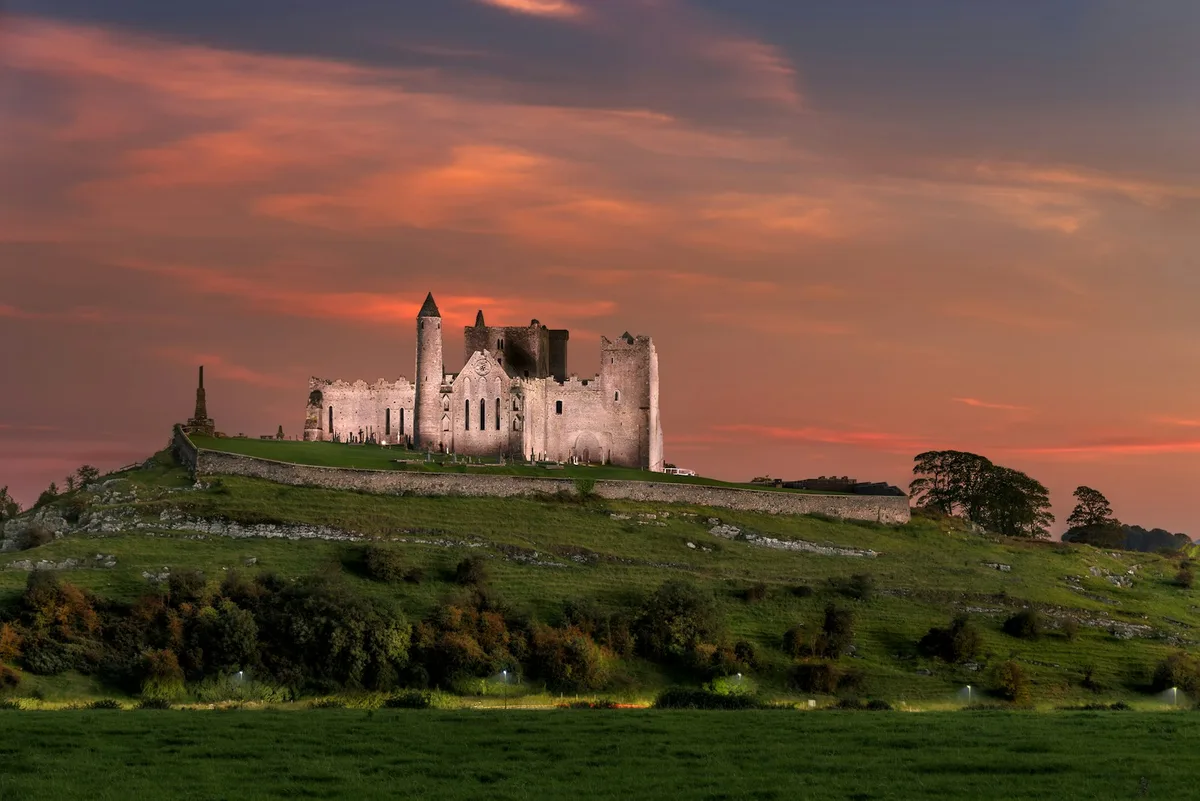
A dramatic limestone outcrop in County Tipperary topped with a cluster of medieval ecclesiastical buildings, once the seat of the kings of Munster.
Visitor guide
The Rock of Cashel is a historic hilltop site in Cashel, County Tipperary, Ireland, rising above the surrounding plain and crowned by a group of medieval ecclesiastical buildings. Also known as Cashel of the Kings and St. Patrick's Rock, it was the traditional seat of the kings of Munster for centuries.
Local legend says the Rock originated at the Devil's Bit, a mountain about 30 kilometres to the north, when St. Patrick banished Satan from a cave and the Rock landed at Cashel. The Tripartite Life of Saint Patrick associates Cashel with the 5th-century conversion of the King of Munster by Patrick. According to Wikipedia, the Rock was the traditional seat of the kings of Munster from as early as the 4th century, the Eoganachta clan built a fortress there in the 5th century, and Brian Boru was crowned king at Cashel in 977. In 1101 King Muirchertach Ua Briain donated the fortress to the Church.
The Round Tower, dating from about 1100, is the oldest and tallest structure at about 28 metres, with an entrance raised 3.7 metres above the ground. Cormac's Chapel, begun in 1127 and consecrated in 1134 for King Cormac Mac Carthaigh, is a sophisticated building with vaulted ceilings and wide arches. Its twin towers are unusual in Ireland and may reflect carpenters sent by Abbot Dirmicius of Regensburg. It became an icon of the Hiberno-Romanesque style and contains the only surviving Romanesque frescoes in Ireland.
The cathedral, built between 1235 and 1270, is an aisleless cruciform church with a central tower and, at its west end, a massive residential tower house. Part of it is roofless today. The 15th-century Hall of the Vicars Choral houses St. Patrick's Cross, which stands over seven feet tall, and visitors now enter the site through it.
In 1647 during the Irish Confederate Wars, English Parliamentarian troops under Murrough O'Brien, 1st Earl of Inchiquin, sacked Cashel, and Irish Confederate troops and Catholic clergy were massacred, with many religious artefacts looted or destroyed. Around the mid-1730s Anglican Archbishop Arthur Price had the cathedral roof removed, a decision criticised then and since. In 1763 a large number of Whiteboys levelled the wall around the Rock.
Wikipedia notes that the cathedral's west end carries a massive residential tower house, a reminder that this was a fortified clerical centre as well as a place of worship. Scully's Cross, an 1860 monument in the graveyard, was destroyed in 1976 when lightning struck its metal rod, and Archbishop Malcolm Hamilton is among those buried on the Rock. The Office of Public Works restored the Hall of the Vicars Choral in 1975 for European Architectural Heritage Year. The vicars choral were laymen, sometimes minor canons, who helped chant cathedral services.
The whole plateau is walled and contains an extensive graveyard with several high crosses. Queen Elizabeth II visited the Rock during her 2011 visit to Ireland. Because Cormac's Chapel is vulnerable to damp, access to it has been limited, so it is wise to check current arrangements. The Rock sits on a main route through Tipperary, which makes it a natural stop on a private guided journey.
See every tour and attraction we cover in Ireland.