TorontoOntario · 36 tours
 Niagara FallsOntario · 25 tours
 New York CityNew York · 30 tours
 Las VegasNevada · 8 tours
 San FranciscoCalifornia · 16 tours
 VancouverBritish Columbia · 17 tours
 DubaiUAE · 54 tours
 Abu DhabiUAE · 5 tours
 Buenos AiresArgentina · 23 tours
 AthensGreece · 31 tours
 AucklandNew Zealand · 38 tours
 CancunMexico · 54 tours
No destinations match “”. Try searching all tours instead — that search understands full questions, not just place names.
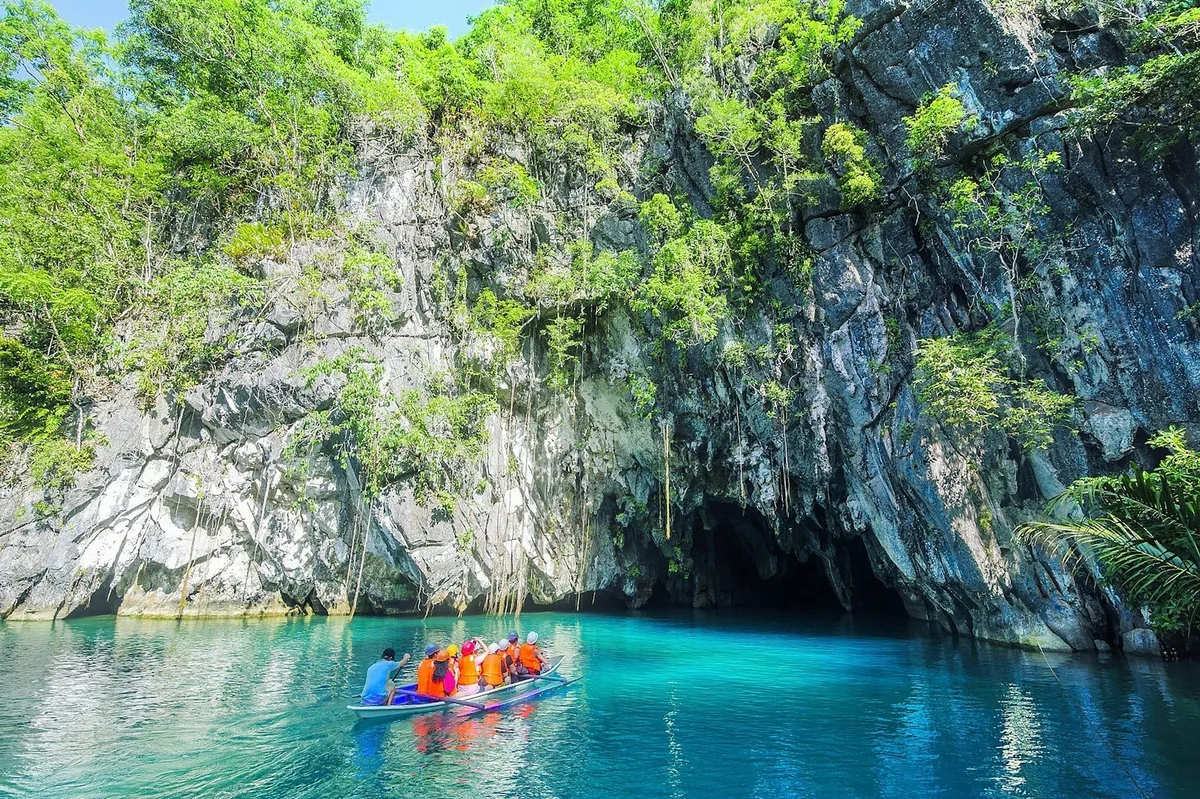
A navigable underground river winding through a limestone cave system in Palawan, one of the New7Wonders of Nature, explored by paddleboat past stalactite chambers.
Visitor guide
The Puerto Princesa Subterranean River is a navigable river that flows through a limestone cave system on the western coast of Palawan in the Philippines before emptying into the South China Sea. It lies within a national park about 80 km north of Puerto Princesa city and is a UNESCO World Heritage Site.
According to Wikipedia, the park lies in the Saint Paul Mountain Range and was established on 12 November 1999, covering 22,202 hectares. The river includes an 8.2 km underground section of the Cabayugan River, within a cave system at least 32 km long. Saltwater mixes with the freshwater up to about 6 km inside the cave, creating a stratified water column that disappears during heavy rain. Until 2007 it was reputed to be the world's longest underground river, before a discovery in Mexico's Yucatan Peninsula, and Wikipedia now calls it the second-longest.
The park is a limestone karst landscape with major stalactite and stalagmite formations. Italian's Chamber is given as 360 metres long, described as one of the largest cave rooms in the world. A 2010 survey by environmentalists and geologists reported a second floor with small waterfalls, a cave dome about 300 metres above the river, a deep water hole and more channels. The river is described as navigable by boat for part of its length from the sea, a figure the article marks as needing a citation, so only a portion of the cave system is open to ordinary visits.
The site contains a full mountain-to-sea ecosystem and some of the most important forests in Asia, with 13 forest types found in tropical Asia. Researchers have identified more than 800 plant species, including at least 295 tree species dominated by dipterocarps. Wikipedia counts 165 bird species, including all 15 endemic Palawan bird species, about 30 mammal species such as the long-tailed macaque, Palawan bearded pig and bearcat, and 19 reptile species, eight of them endemic. The caves hold nine bat species and two swiftlet species, and dugongs and hawksbill turtles feed in the coastal area.
UNESCO inscribed the park on 4 December 1999 under criteria vii and x. It was designated a Ramsar wetland on 30 June 2012 and was named one of the New7Wonders of Nature, officially confirmed on 28 January 2012. The article notes that the voting was criticised because repeat voting was not prohibited, so the title reflects a popularity poll rather than a scientific ranking. The park is managed by the Puerto Princesa city government and is an IUCN Category III natural monument.
Sabang is the seaside village that serves as the main access point, reached mostly by road from Puerto Princesa, with bangkas taking visitors from there to the park. A private tour with a driver suits the road journey and gives time to visit the surrounding forest and shoreline.
See every tour and attraction we cover in Philippines.