TorontoOntario · 36 tours
 Niagara FallsOntario · 25 tours
 New York CityNew York · 30 tours
 Las VegasNevada · 8 tours
 San FranciscoCalifornia · 16 tours
 VancouverBritish Columbia · 17 tours
 DubaiUAE · 54 tours
 Abu DhabiUAE · 5 tours
 Buenos AiresArgentina · 23 tours
 AthensGreece · 31 tours
 AucklandNew Zealand · 38 tours
 CancunMexico · 54 tours
No destinations match “”. Try searching all tours instead — that search understands full questions, not just place names.
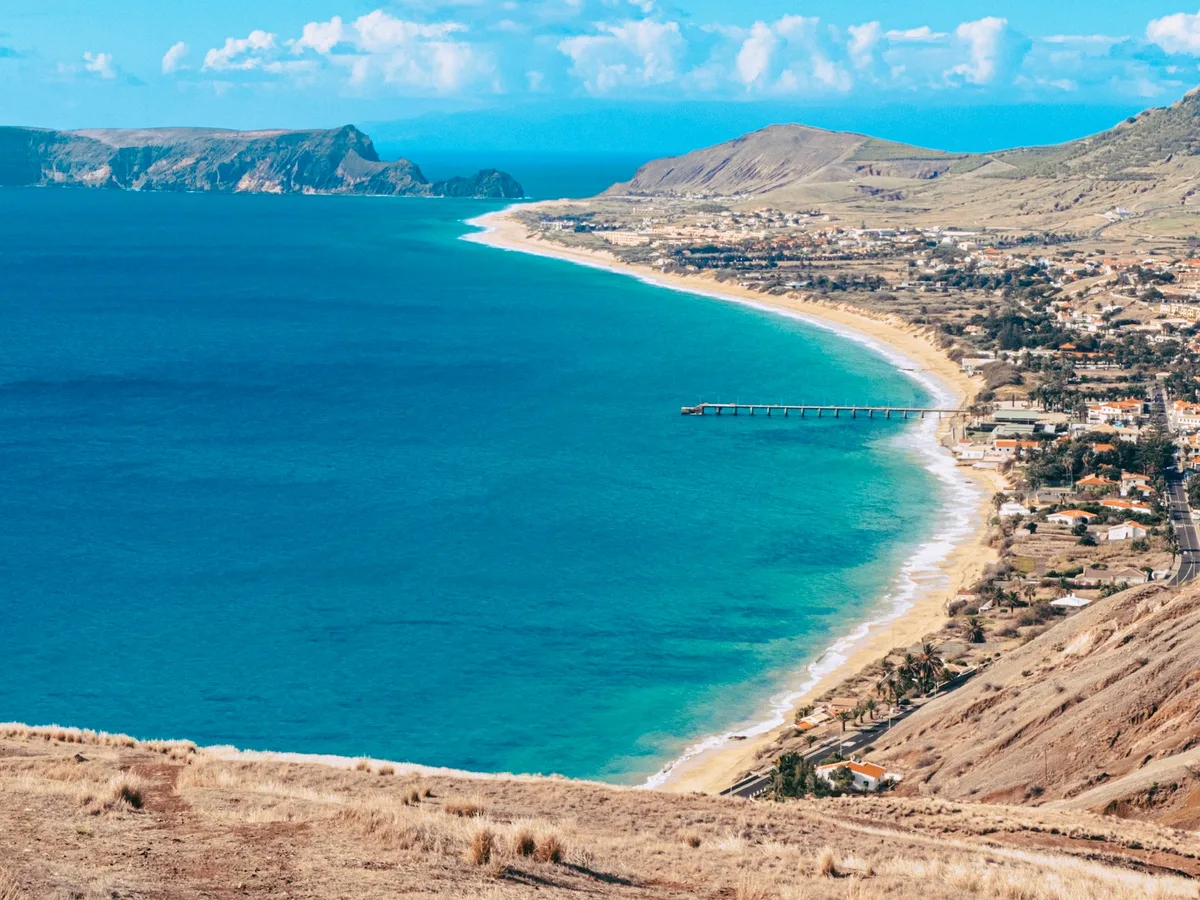
A 9km stretch of golden sand on Madeira's sister island, reached by ferry, a rarity in the otherwise black-sand, volcanic archipelago.
Visitor guide
Porto Santo Beach is a long, golden sand beach on the southwest coast of Porto Santo, the northeasternmost island of the Madeira archipelago in Portugal. Wikipedia describes a nine-kilometre white sand beach along the island's coastal plain, an unusual sight in an archipelago otherwise known for dark volcanic shores.
Porto Santo lies about 43 kilometres northeast of Madeira island and covers roughly 42 square kilometres. It is the northernmost and easternmost island of the archipelago. The northeast of the island is mountainous with cliffs, with peaks such as Pico do Castelo at 437 metres and Pico do Facho, the highest point, at 517 metres, while the southwest is relatively flat. The island's main settlement is Vila Baleira, also known as Porto Santo, with a population of about 5,000 according to the most recent census figure on Wikipedia.
The name means holy harbour. Wikipedia explains that in 1418 the Portuguese navigators João Gonçalves Zarco and Tristão Vaz Teixeira were driven by a storm into the island's sheltered harbour, and the first settlers arrived in the 1420s. Bartolomeu Perestrelo became the first captain-donatary in 1445. Christopher Columbus married Filipa Moniz Perestrelo and lived on the island for a time, and a house associated with him is now a museum. Released rabbits multiplied and damaged the island's native vegetation, and in 1617 Barbary pirates took 663 inhabitants after the sack of Madeira.
The climate is classed as semi-arid, much drier and sunnier than Madeira. The airport recorded roughly 382 millimetres of annual rainfall in the 1991 to 2020 normals, with about 2,400 hours of sunshine a year and July and August the driest months. Wikipedia notes brownish-red alluvial layers along the island's flanks and beach.
Volcanic activity shaped the island in the Miocene with basaltic eruptions that continued into the Quaternary, and trachyte domes formed several of its peaks, including Pico da Juliana and Pico do Facho.
Wikipedia notes that the introduced rabbits caused the loss of much of the island's native flora, and that a lichen, Ramalina confertula, survives only in a few spots on the island's volcanoes. Humidity averages about 77 percent through the year, and the sunniest months are August and September. The record high at the airport is given as 35.3 degrees Celsius, so summer afternoons on the open sand can be hot.
Porto Santo has an airport with daily flights to Madeira that take about 15 minutes, and a ferry from Funchal takes around two hours according to Wikipedia. Tourism is the main industry, built on the beach and mild climate, with hotels developed through the twentieth century. The island has a golf course designed by Seve Ballesteros that hosted the 2009 Madeira Islands Open. Most visitors come as a day trip or short stay from Madeira.
The beach is at its busiest in summer, while the island is quieter at other times of year. A private guided day, planned around the ferry schedule, can combine the beach with a visit to the Columbus museum in Vila Baleira and a viewpoint such as Pico do Castelo.
See every tour and attraction we cover in Madeira.