TorontoOntario · 36 tours
 Niagara FallsOntario · 25 tours
 New York CityNew York · 30 tours
 Las VegasNevada · 8 tours
 San FranciscoCalifornia · 16 tours
 VancouverBritish Columbia · 17 tours
 DubaiUAE · 54 tours
 Abu DhabiUAE · 5 tours
 Buenos AiresArgentina · 23 tours
 AthensGreece · 31 tours
 AucklandNew Zealand · 38 tours
 CancunMexico · 54 tours
No destinations match “”. Try searching all tours instead — that search understands full questions, not just place names.
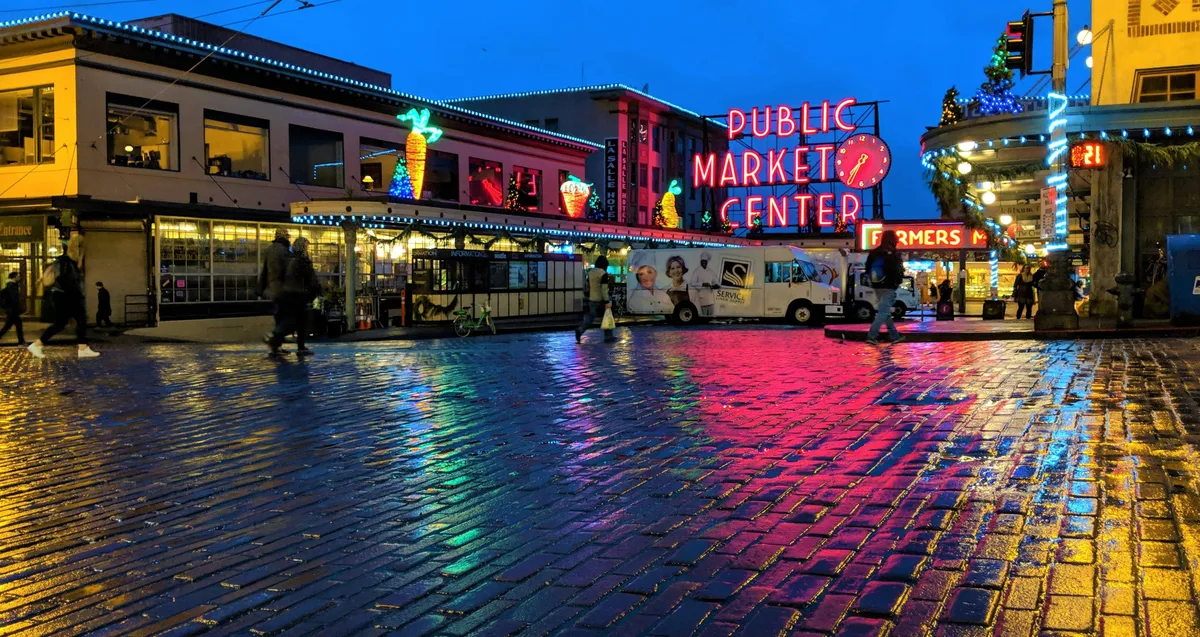
A working public market on the Seattle waterfront, open continuously since 1907.
Visitor guide
Pike Place Market is a historic public market overlooking Elliott Bay in Seattle, in operation since 1907. It is listed on the National Register of Historic Places and is managed by a public development authority created by the city.
The market's official history says it began after farmers complained about middlemen and steep price markups, and council member Thomas Revelle pushed an ordinance creating a public market on Pike Place. The council approved it on August 5, 1907, and opening day followed on August 17, when the few farmers who showed up sold out within minutes. Accounts differ on how many wagons came that first day, with figures ranging from about six to a dozen, and one source reports nearly 70 wagons by the following Saturday. Wikipedia notes that the Main Arcade opened on November 30, 1907, the Corner Market building dates to 1912 and the Economy Market was added in 1916, with Frank Goodwin and his brothers developing most of the core buildings and keeping ornament modest so attention stayed on the products. A fire at the Corner Market Building in 1941 is documented in University of Washington collections.
Demand grew fast: Wikipedia reports the number of farmers' stalls had doubled by 1911, and in 1921 the city council voted to keep the market on its site and expand in place. In 1911 the city also created a market inspector post, later called the market master, and the official history says stalls were assigned by daily lottery. By 1922, when a Seattle Public Library branch opened on the lower level in the area now called the Down Under, the market's footprint was largely what it is today. The Sanitary Market, designed by Daniel Huntington, opened in 1910; a December 1941 fire struck it, and the official history describes it as destroyed while Wikipedia says it was damaged and rebuilt as a two-story building in 1942.
The official history says Japanese farmers made up more than 75 percent of the roughly 500 farmers selling at the market in its early years, and that they fought discriminatory rules to keep their selling rights. After Executive Order 9066 in 1942, nearly 15,000 Japanese Americans in Washington were forced from their homes. Aki Sogabe's Song of the Earth mural, hung under the Farmers Market sign, honors them. During the Depression, the history adds, the Economy Market sold discounted day-old produce and served as a community gathering place with a ballroom upstairs. The three-story neon Public Market Center sign dates to 1937.
Wikipedia says a 1963 proposal to demolish the market and replace it with a project called Pike Plaza met community opposition. The official history says Friends of the Market, led by architect Victor Steinbrueck, organized in 1964 and gathered 53,000 signatures in 1969. The Pike Place Public Market Historic District was added to the National Register of Historic Places on March 13, 1970. On November 2, 1971, Seattle voters passed a citizen initiative creating a historic preservation zone. The market's official history page says the 1971 vote created the Pike Place Market Historic District and the Market Historical Commission to preserve its physical and social character. In 1973 the city chartered the Pike Place Market Preservation and Development Authority (PDA), a not-for-profit that manages day-to-day operations, overseen by a twelve-member council. Its charter calls on it to preserve the buildings, increase farm and food retail, support small businesses and provide services for low-income people; the Market Foundation, established in 1982, supports services such as a medical clinic, senior center, food bank and childcare.
The official market site says the market has 70-plus farmers and 180-plus craftspeople, along with 220-plus independently owned shops and restaurants across nine historic acres. It describes itself as one of the oldest and largest continuously operating public markets in the United States, a claim best read as the market's own description. Wikipedia notes that the first Starbucks opened in 1971 and moved within the market in 1977; the shop is in the Soames-Dunn Building, which dates to 1918. Rachel, a 550-pound bronze piggy bank by sculptor Georgia Gerber installed in 1986, collects donations that fund the Market Foundation's social services.
Wikipedia also describes the Pike Street Hill Climb, designed in 1976, which connects the market to the waterfront along the corridor of an old wooden overpass that farmers once used to bring produce up from boats.
Vendors keep different hours, and traffic arrangements around the market have been changing, so check the market's official site for current hours and access.
Parking and street access near the market can be complicated, so a private vehicle and driver with door-to-door pickup makes it easy to add the market to a Seattle day.
See every tour and attraction we cover in Seattle.