TorontoOntario · 36 tours
 Niagara FallsOntario · 25 tours
 New York CityNew York · 30 tours
 Las VegasNevada · 8 tours
 San FranciscoCalifornia · 16 tours
 VancouverBritish Columbia · 17 tours
 DubaiUAE · 54 tours
 Abu DhabiUAE · 5 tours
 Buenos AiresArgentina · 23 tours
 AthensGreece · 31 tours
 AucklandNew Zealand · 38 tours
 CancunMexico · 54 tours
No destinations match “”. Try searching all tours instead — that search understands full questions, not just place names.
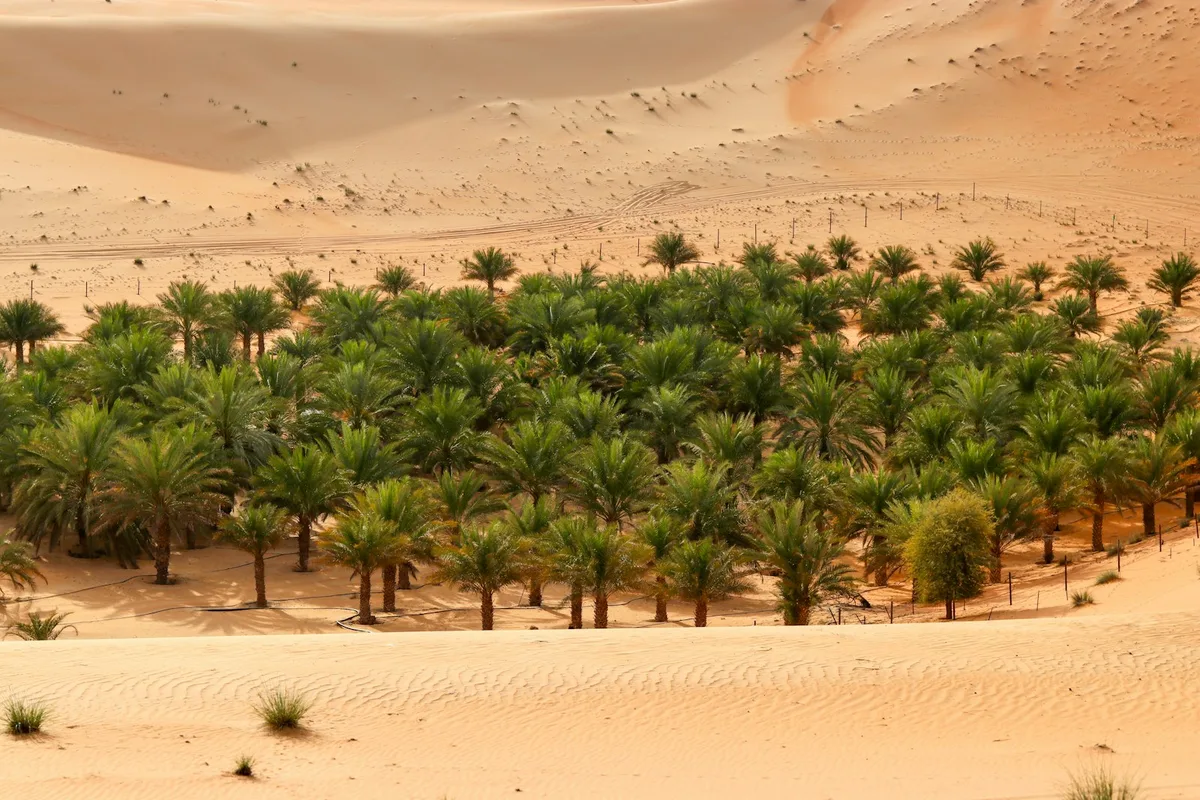
A crescent of date-palm oases on the edge of the Rub' al Khali (Empty Quarter), one of the largest continuous sand deserts on Earth, with some of the tallest dunes in the UAE.
Visitor guide
Liwa Oasis is a large oasis in the Western Region of Abu Dhabi, United Arab Emirates, on the northern edge of the Rub' al Khali, or Empty Quarter, one of the great sand deserts of the Arabian Peninsula. It lies about 150 kilometres southwest of Abu Dhabi city and is known for its towering dunes.
According to Wikipedia, Liwa stretches about 100 kilometres east to west along a northward-curving arc and contains some 50 villages, about 98 kilometres south of the Persian Gulf coast. Muzayri' is its geographic and economic centre, where the highway from Abu Dhabi enters the oasis and divides east, 65 kilometres to the easternmost village Mahdar Bin Usayyan, and west, 45 kilometres to Aradah. The villages are the southernmost settlements of Abu Dhabi and the UAE, with the Saudi Arabian border 16 to 35 kilometres away. The 2005 census counted 20,196 people, and Wikipedia notes that earlier satellite-based estimates of 50,000 to 150,000 were too high.
Date farming is a traditional mainstay, using drip irrigation and greenhouses, and tourism is growing, with hotels including Qasr Al Sarab. Liwa men of the Bani Yas tribe traditionally worked as pearl divers on the coast during summer, an extra source of income. The oasis is described as the birthplace of the ruling families of Abu Dhabi and Dubai, and the Al Nahyan family moved its residence from Liwa to Abu Dhabi in 1793. Wikipedia's article on Abu Dhabi adds that the Bani Yas were originally settled in Liwa before the 1761 settlement on the coast.
About 22 kilometres south of Muzayri', Moreeb Dune is roughly 300 metres high and is described by Wikipedia as one of the largest dunes in the world. A separate article reports a slipface of about 50 degrees and a length of 1,600 metres, calling the dune the tallest in the UAE and one of the great hill climbs, though these are reported figures. It hosts the annual Liwa festival, with off-road events and camel racing. Dates and details of festivals vary from year to year.
The Rub' al Khali covers about 650,000 square kilometres across Saudi Arabia, Oman, the UAE and Yemen, about 1,000 kilometres long and 500 kilometres wide. Its surface elevation varies from 800 metres in the southwest to near sea level in the northeast. Most of the terrain is ergs with dunes up to about 250 metres high, interspersed with gravel and gypsum plains, and the sand is reddish-orange because of feldspar. The climate is hyper-arid, with annual precipitation generally under 50 millimetres. Wikipedia notes that shallow lakes existed in the desert 6,000 to 5,000 and 3,000 to 2,000 years ago, and fossils show hippopotamus, water buffalo and long-horned cattle once lived around them.
Wilfred Thesiger crossed the Empty Quarter several times between 1946 and 1950 and mapped large parts of it, describing his journeys in his 1959 book Arabian Sands. Wikipedia says his first crossing, from Mughshin in Oman, ended at Liwa in December 1946, and that he returned in March 1948 on his second crossing. He later spent a quiet period at Liwa, where he went hawking with Sheikh Zayed. The Bani Yas of the UAE are among the tribes of the Empty Quarter, and Wikipedia records a 2013 on-foot expedition that ended at Liwa.
Desert conditions demand planning, and summer heat is intense. A private guided visit with a driver suits the distance from Abu Dhabi and the dune terrain.
See every tour and attraction we cover in Abu Dhabi.