TorontoOntario · 36 tours
 Niagara FallsOntario · 25 tours
 New York CityNew York · 30 tours
 Las VegasNevada · 8 tours
 San FranciscoCalifornia · 16 tours
 VancouverBritish Columbia · 17 tours
 DubaiUAE · 54 tours
 Abu DhabiUAE · 5 tours
 Buenos AiresArgentina · 23 tours
 AthensGreece · 31 tours
 AucklandNew Zealand · 38 tours
 CancunMexico · 54 tours
No destinations match “”. Try searching all tours instead — that search understands full questions, not just place names.
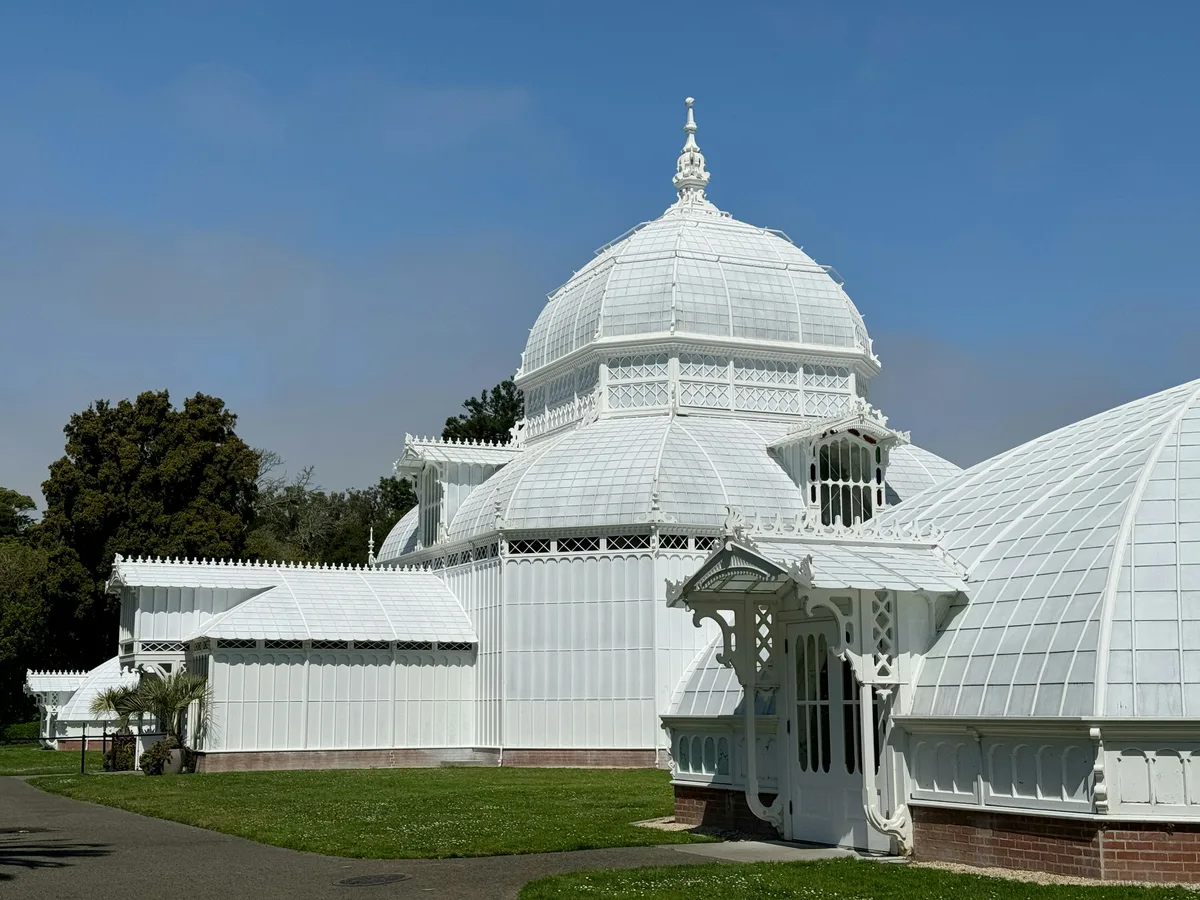
An urban park larger than New York's Central Park, stretching from the Haight to the Pacific, home to the Victorian glass Conservatory of Flowers, the de Young Museum, and the city's own Japanese Tea Garden.
Visitor guide
Golden Gate Park is a 1,017-acre park running more than three miles from the Haight-Ashbury area to the Pacific, and about half a mile wide. It holds museums, gardens, lakes and meadows, and it was built on what had been shifting sand dunes.
The park dates its founding to April 4, 1870, when the state legislature passed the act to improve public parks in San Francisco, on dune land then known as the Outside Lands. Frederick Law Olmsted offered a plan in 1865 that favored native species, but it was set aside in favor of a Central Park style design. William Hammond Hall surveyed the site, completed his survey report in February 1871 and was appointed engineer of the park that August; San Francisco Recreation and Parks calls him the park's first superintendent, and his assistant John McLaren developed the planting plan and later served as superintendent. Dunes covering roughly three-quarters of the park were stabilized with planting, including bent grass seed grown from France, and by 1879 about 155,000 trees had been planted.
The California Midwinter International Exposition of 1894 left a mark on the eastern end: the Music Concourse was excavated for it, and the Japanese Tea Garden and the original fine arts building that became the de Young Museum date from the fair. In 1967 the Polo Fields hosted the Human Be-In, drawing tens of thousands and helping launch the Summer of Love in nearby Haight-Ashbury. The park was added to the National Register of Historic Places in 2004.
The Conservatory of Flowers, opened in 1879, is the park's oldest building. The Japanese Tea Garden covers about 3.5 acres according to San Francisco Recreation and Parks (the garden's own site gives about five) and is widely described as the oldest public Japanese garden in the United States; Makoto Hagiwara expanded and tended it for years, and the Hagiwara family was removed during World War II. The de Young Museum in its present building opened in 2005, and the California Academy of Sciences, founded in 1853, opened its current building in 2008. The San Francisco Botanical Garden spans 55 acres, with planting beginning in 1937. Spreckels Temple of Music anchors the Music Concourse.
Near the western end, the North Windmill, built around 1902 and about 75 feet tall, was part of the system that pumped water for park irrigation, and the Murphy Windmill was restored in 2011. Spreckels Lake opened in 1904, and the island-ringed lake long called Stow Lake was renamed Blue Heron Lake in January 2024.
The Haight-Ashbury neighborhood lies at the park's eastern edge, and Ocean Beach and the Cliff House area are at the western end.
See every tour and attraction we cover in San Francisco.