TorontoOntario · 36 tours
 Niagara FallsOntario · 25 tours
 New York CityNew York · 30 tours
 Las VegasNevada · 8 tours
 San FranciscoCalifornia · 16 tours
 VancouverBritish Columbia · 17 tours
 DubaiUAE · 54 tours
 Abu DhabiUAE · 5 tours
 Buenos AiresArgentina · 23 tours
 AthensGreece · 31 tours
 AucklandNew Zealand · 38 tours
 CancunMexico · 54 tours
No destinations match “”. Try searching all tours instead — that search understands full questions, not just place names.
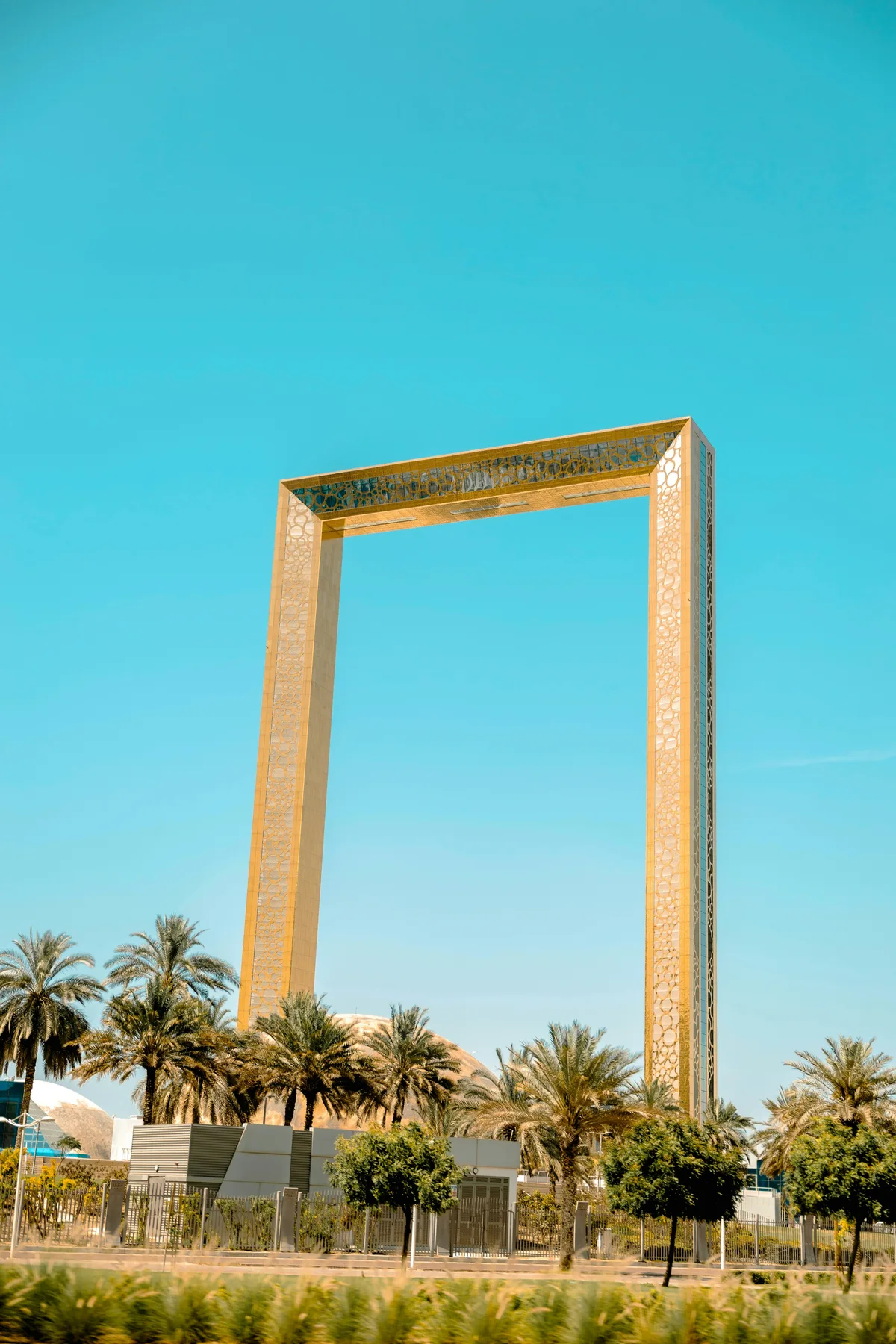
A 150-metre, gold-toned picture-frame structure in Zabeel Park with a glass-floored sky deck connecting its two towers, looking out over Old Dubai on one side and the new-city skyline on the other.
Visitor guide
The Dubai Frame is a picture-frame-shaped observatory, museum and monument in Zabeel Park, Dubai, United Arab Emirates. Standing roughly 150 metres tall and clad in a gold-toned finish, it was designed so that one side looks toward the skyscrapers of modern Dubai and the other toward the older districts of the city.
According to Wikipedia, the idea traces back to the 2009 ThyssenKrupp Elevator Architecture Award, a competition run with Dubai Municipality that drew 926 proposals. An international jury of 11 architects selected a design by the Mexican architect Fernando Donis. His concept was not to add one more tower to the skyline but to create a void that frames the city's existing landmarks, so that the structure would stand for Dubai's past, present and future at once.
Construction began in 2013, and the Frame opened to the public on 1 January 2018, with Dubai Municipality as the developer. The final project was completed by Hyder Consulting, part of Arcadis. Wikipedia also records a dispute: Donis has said his design was used without credit or compensation and filed a lawsuit in a US federal court in December 2016, while Dubai Municipality has said that the built structure differs significantly from his proposal, and ThyssenKrupp described the matter as a commercial disagreement. The case did not reach a conclusion, so the credit for the design is a matter on which sources differ.
The structure is commonly given as about 150 metres high and about 93 metres wide, built from glass, steel, aluminium and reinforced concrete. Its proportions follow the golden rectangle, with sides in a ratio of 1 to 1.618, and designs linked to Expo 2020 are embedded in its outer facade. Two vertical towers are joined at the top by a horizontal span that carries the observation deck, which includes glass-bottomed floor sections looking almost straight down.
A lift carries visitors up to the Sky Deck, and Wikipedia gives the ride as roughly 75 seconds. The Zabeel Park description also refers to the span as a glass skybridge of about 93 metres between the two towers, a figure that is consistent with the structure's overall width.
Beyond the viewpoint, the Dubai Frame works as a small museum. Wikipedia describes a lower-level exhibition that traces the story of Dubai and a video presentation that projects the city's possible future. The story told is the transformation of the emirate from a modest fishing and pearl-diving settlement into a major global city, which gives the viewing deck a narrative to match the view.
The orientation is deliberate. Looking one way, visitors see the high-rises along Sheikh Zayed Road and the modern downtown skyline. Looking the other way, they see districts such as Deira, Umm Hurair and Karama, which belong to the older urban fabric of the city. The top deck is meant as a symbolic bridge between the two.
The Frame stands inside Zabeel Park, which Wikipedia says opened in December 2005 on roughly 47.5 hectares between Al Karama and the Dubai World Trade Centre area. The park was conceived as a technology-themed urban park with zones devoted to alternative energy, communications and technology, and it includes lakes, jogging paths, play areas and thousands of palm and other trees. That makes the Frame an easy addition to a relaxed day of sightseeing in central Dubai.
The Dubai Frame suits a private, guided city tour because the viewpoint and the museum make most sense when someone explains which part of the panorama is old Dubai and which is new. A private vehicle and driver can link it with other central sites such as the Al Fahidi Historical Neighbourhood and Dubai Creek, so that the views from the deck can be matched with places seen on the ground.
See every tour and attraction we cover in Dubai.