TorontoOntario · 36 tours
 Niagara FallsOntario · 25 tours
 New York CityNew York · 30 tours
 Las VegasNevada · 8 tours
 San FranciscoCalifornia · 16 tours
 VancouverBritish Columbia · 17 tours
 DubaiUAE · 54 tours
 Abu DhabiUAE · 5 tours
 Buenos AiresArgentina · 23 tours
 AthensGreece · 31 tours
 AucklandNew Zealand · 38 tours
 CancunMexico · 54 tours
No destinations match “”. Try searching all tours instead — that search understands full questions, not just place names.
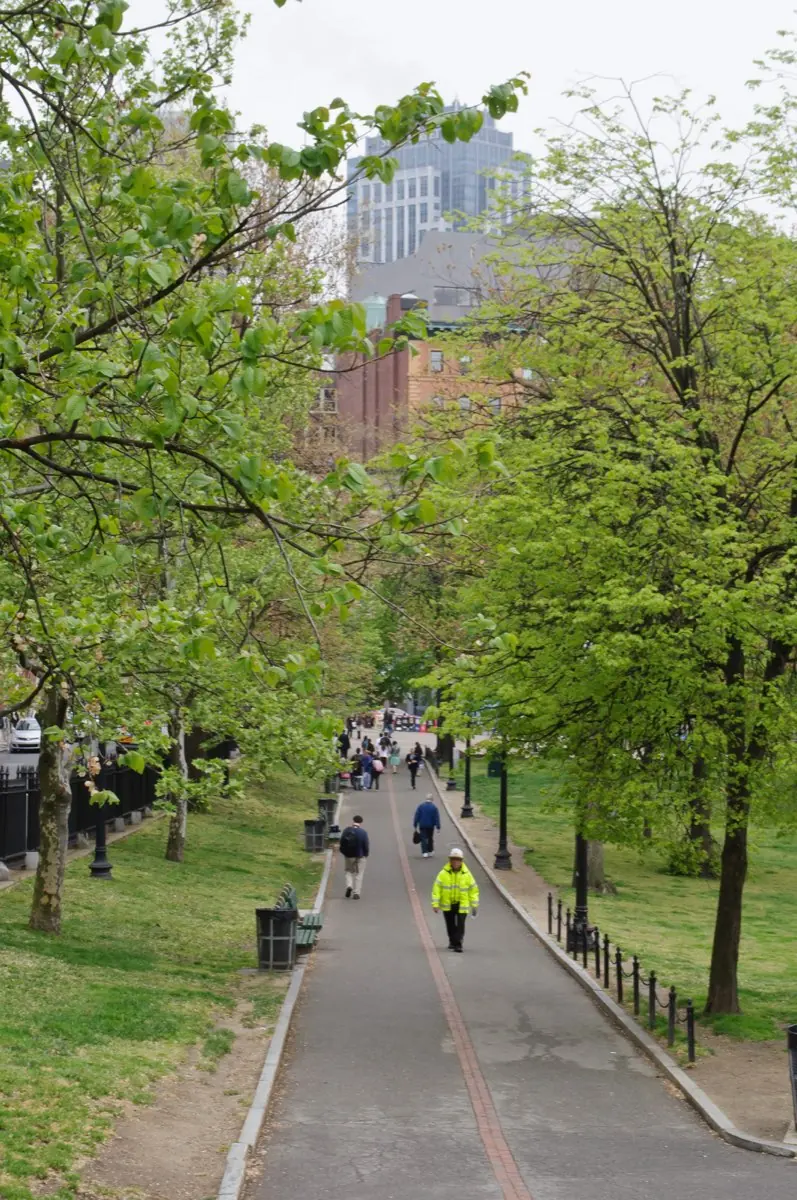
The oldest city park in the United States, dating to 1634.
Visitor guide
Boston Common is the 50-acre green heart of downtown Boston and, by long-standing description, America's oldest city park. Colonial Bostonians bought the land for shared use in 1634, and it is the first stop on the Freedom Trail.
Wikipedia and the Freedom Trail both trace the Common to 1634, when the town acquired roughly 44 acres from William Blaxton (also spelled Blackstone), the area's first European settler; sources give the price as 30 pounds, raised by a tax on residents. For two centuries it was common pasture, with a town herdsman tending livestock; grazing was limited to 70 cows in 1646, and cows were finally banned in 1830. It was also a place of punishment: the Freedom Trail notes a whipping post, pillory and stocks, and public hangings continued until 1817. Mary Dyer, a Quaker, was hanged there on June 1, 1660.
The Common also fills the Revolutionary story. The City of Boston says British troops camped here for eight years beginning in 1768, and the Freedom Trail notes that three brigades left the Common in 1775 on the march toward Lexington and Concord. John Hancock held a celebration here in 1765 for the repeal of the Stamp Act. In the 19th century it hosted Civil War recruitment and anti-slavery meetings, and later gatherings included rallies for civil rights and against the Vietnam War, one led by Martin Luther King Jr. Pope John Paul II celebrated Mass on the Common on October 1, 1979, before a crowd Wikipedia puts at about 400,000.
The Frog Pond serves as a skating rink in winter, a reflecting pool in spring and fall, and a spray pool and carousel area in summer. The Central Burying Ground holds the graves of the painter Gilbert Stuart and the composer William Billings, among others. The Soldiers and Sailors Monument on Flag Staff Hill commemorates Civil War dead, and the Parkman Bandstand sits in the eastern part of the park. Brewer Fountain stands beside Park Street Station; the Park Street and Boylston stations were the first two subway stations in the country when the Tremont Street subway opened on September 1, 1897.
The Robert Gould Shaw and 54th Regiment Memorial, dedicated in 1897, honoring the first all-Black volunteer regiment recruited in the North during the Civil War, according to the Freedom Trail, is also part of the Common's story. The city also lists ballfields and a playground among the park's amenities.
The Common was listed on the National Register of Historic Places in 1972 together with the adjoining Public Garden, became a Boston Landmark in 1977 and a National Historic Landmark in 1987. The City of Boston Parks and Recreation Department manages it, and the nonprofit Friends of the Public Garden, founded in 1970, works with the city to care for the Common, the Public Garden and the Commonwealth Avenue Mall. The city notes that the firm of Frederick Law Olmsted's sons supervised paving and soil work around 1913.
Because the Common is the first Freedom Trail site and borders Beacon Hill and the Public Garden, it works well as the opening or closing point of a private Boston day. With Voyzo, your driver can pick you up at your door, drop you at the park, and meet you at the far end of your walk. Check the City of Boston for current event schedules, rink operations and any park notices.
See every tour and attraction we cover in Boston.