TorontoOntario · 36 tours
 Niagara FallsOntario · 25 tours
 New York CityNew York · 30 tours
 Las VegasNevada · 8 tours
 San FranciscoCalifornia · 16 tours
 VancouverBritish Columbia · 17 tours
 DubaiUAE · 54 tours
 Abu DhabiUAE · 5 tours
 Buenos AiresArgentina · 23 tours
 AthensGreece · 31 tours
 AucklandNew Zealand · 38 tours
 CancunMexico · 54 tours
No destinations match “”. Try searching all tours instead — that search understands full questions, not just place names.
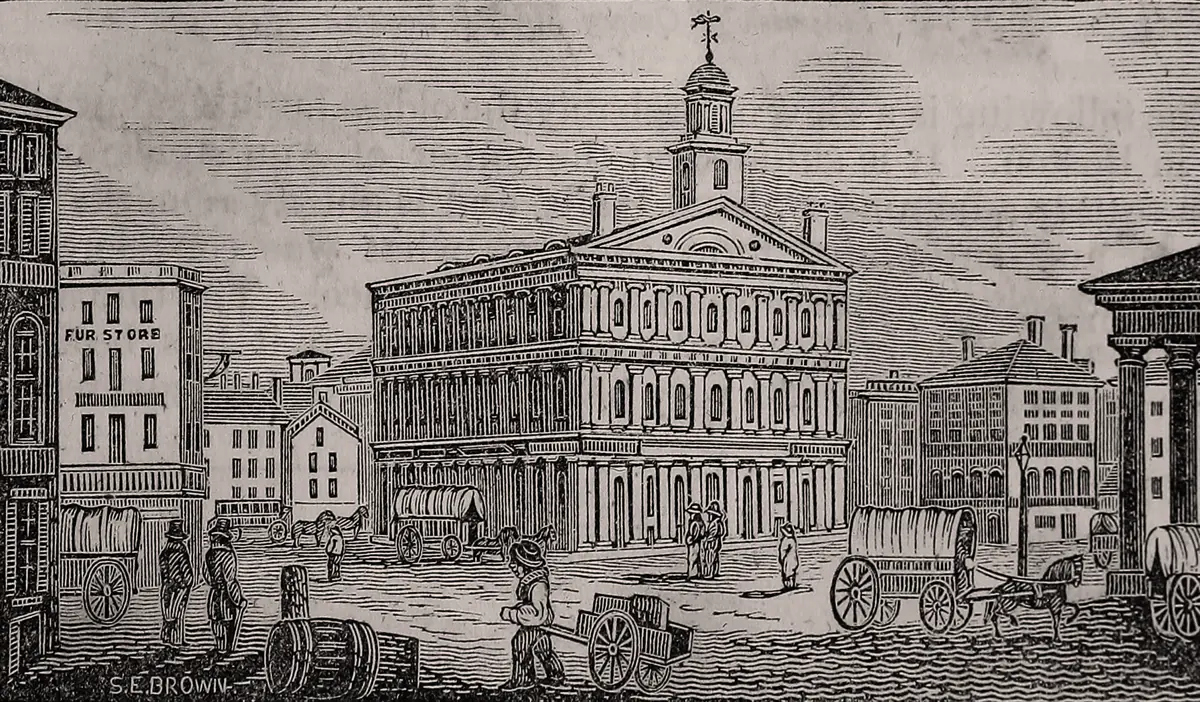
A historic marketplace and meeting hall known as the 'Cradle of Liberty.'
Visitor guide
Faneuil Hall is a market and meeting hall in Boston, given to the town by the merchant Peter Faneuil and completed in 1742. The National Park Service says it became known as the 'Cradle of Liberty' for its role in early Revolutionary protests, and today it serves as a visitor center within Boston National Historical Park.
The market tradition came first. A public marketplace was organized in 1658, markets were established in 1734, and rioters demolished the central market in 1737. In 1740 Faneuil offered to fund a market building, and the town accepted by a close vote of 367 to 360 on July 14, 1740; Wikipedia says the vote was controversial. The hall opened on September 10, 1742, designed by the artist John Smibert, whose only building design it was. The ground floor held market stalls and the Great Hall above housed town meetings, with room for roughly 1,000 people.
A fire on January 13, 1761 destroyed the interior, leaving the brick walls. The hall was rebuilt and on March 14, 1763 the lawyer James Otis Jr. rededicated it to the 'Cause of Liberty'. Charles Bulfinch, then chairman of the selectmen, expanded it, with work completed in March 1806. He added a third floor, doubled the width and moved the cupola to the east end, and the NPS says the Bulfinch design nearly quadrupled its size. The NPS and Wikipedia both say Faneuil owned enslaved people and funded slave-trading voyages, and a permanent exhibit on slavery opened in 2023.
In the 1760s leaders including Samuel Adams, John Hancock and James Otis rallied here against the Sugar and Stamp Acts. Wikipedia notes that selectmen let both Patriots and Loyalists use the hall but barred British military personnel and customs officials, and that protests connected with the Boston Tea Party were held here in 1773. When about 2,000 British troops landed on October 1, 1768, the 14th Foot was quartered in the building until late 1770.
Later speakers included William Lloyd Garrison and Frederick Douglass, and Lucy Stone and others held a women's rights event in 1873. Wikipedia lists abolition speeches as especially prominent in the mid-19th century. John F. Kennedy gave his final pre-election speech there in 1960. The Great Hall measures 76 by 76 feet and is 28 feet high, and the NPS says the Bulfinch interior is virtually unchanged. Bulfinch added a gallery for women, who could not vote on town matters.
Boston became a city in 1822, after which the hall served as a public forum rather than the seat of government, and the city charter barred selling or leasing it. Mayor Josiah Quincy III pushed for a new market to the east, and Quincy Market was built between 1824 and 1826. In 1827 Alexander Parris renovated Faneuil Hall and split its first floor into eight storefronts. Meat merchants became the main tenants after market operations resumed in 1858, and stayed until the 1970s.
A full restoration and fireproofing, designed under architect Frank W. Howard, took place in 1898 and 1899, replacing combustible woodwork with iron, steel and stone. Bulfinch's wooden doors were kept. The festival marketplace opened in 1976, and the building reopened in 1992 after an NPS-led renovation by Goody, Clancy & Associates.
The Great Hall displays portraits and busts, including George Healy's painting 'Webster Replying to Hayne', which measures 16 by 30 feet and depicts 130 notable Americans, and a bust of Frederick Douglass installed in 1995. A stone eagle and a clock donated by Boston's children sit at the east end. Naturalization ceremonies are held there, including one in April 2023 that welcomed 342 new citizens.
The gilded grasshopper weathervane was made by Shem Drowne in 1742 and weighs about 25 pounds. Sources do not agree on why that shape was chosen; theories include a link to the London Royal Exchange vane and Drowne's childhood, and a time capsule sits inside it. Legend holds that it was used to spot spies in the War of 1812, which should be treated as legend. The hall is a National Historic Landmark, designated October 9, 1960. The Ancient and Honorable Artillery Company of Massachusetts, which moved into the attic in 1746, has headquarters in the building, with NPS pages disagreeing on whether that is the third or fourth floor.
NPS rangers give Faneuil Hall Talks in the Great Hall when it is open. Hours and events change, so check the NPS. Faneuil Hall is the 11th stop on the Freedom Trail, and Voyzo can add it to a private Boston day with door-to-door pickup.
See every tour and attraction we cover in Boston.