TorontoOntario · 36 tours
 Niagara FallsOntario · 25 tours
 New York CityNew York · 30 tours
 Las VegasNevada · 8 tours
 San FranciscoCalifornia · 16 tours
 VancouverBritish Columbia · 17 tours
 DubaiUAE · 54 tours
 Abu DhabiUAE · 5 tours
 Buenos AiresArgentina · 23 tours
 AthensGreece · 31 tours
 AucklandNew Zealand · 38 tours
 CancunMexico · 54 tours
No destinations match “”. Try searching all tours instead — that search understands full questions, not just place names.
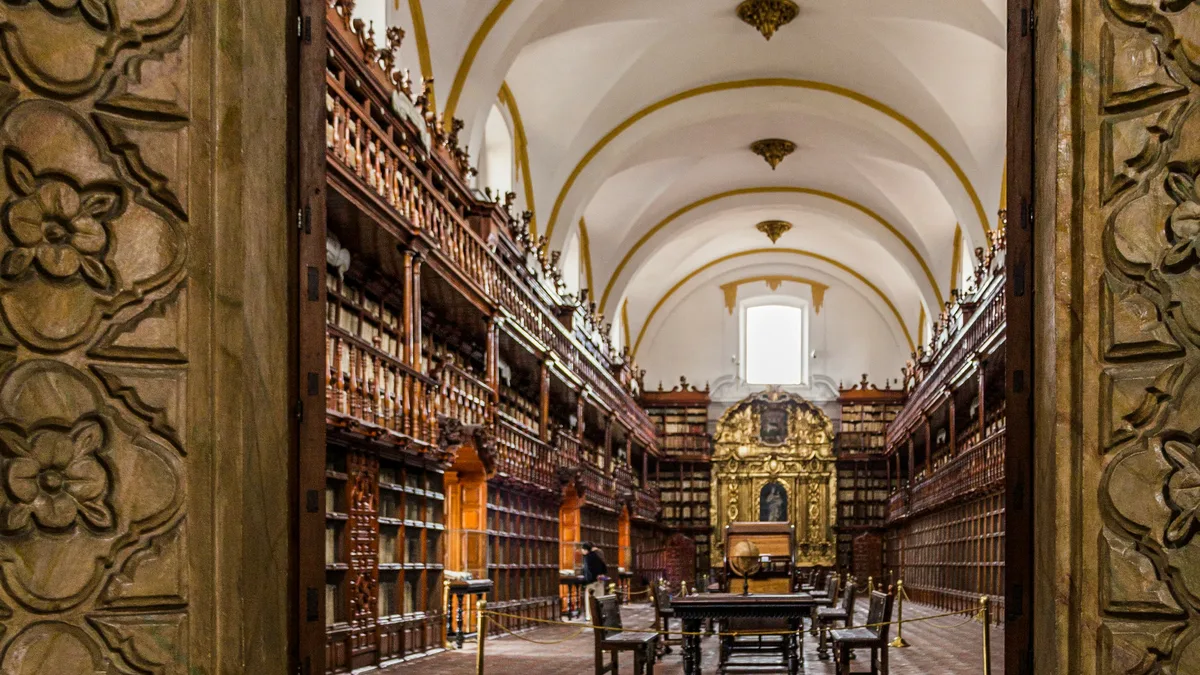
Founded in 1646 by Bishop Juan de Palafox, this is recognized as the first public library in the Americas and was named to UNESCO's Memory of the World Register in 2005. Its original carved-wood shelving still holds tens of thousands of historic volumes, including rare 15th- and 16th-century incunabula, inside a genuinely original colonial reading hall.
Visitor guide
The Biblioteca Palafoxiana is a historic library in the historic center of Puebla, Mexico, founded in 1646 by Bishop Juan de Palafox y Mendoza. UNESCO describes it as the first and oldest public library in the Americas and inscribed it on the Memory of the World Register in 2005, according to Wikipedia.
On 6 September 1646 Juan de Palafox y Mendoza, bishop of Puebla, donated about 5,000 items from his own collection to the Colegio de San Juan, an institution he had founded, on condition that the public could use them. He wrote that in a public library all sorts of people would be able to study as they wished. Spanish Wikipedia stresses that the books were to be open to everyone and not only to clergy and seminarians. The library took his name.
Later, Francisco Fabian y Fuero ordered the construction of the current building and donated his own collection. The holdings grew through gifts from several bishops, a cathedral dean, religious schools and private individuals, along with books confiscated from the Jesuits after their expulsion in 1767. Spanish Wikipedia says the works span theology, law, science and literature in roughly fourteen languages.
The building was completed in 1773 and consists of a 43-metre vaulted hall on the second floor of the Colegio, with two levels of bookshelves. A third shelf level was added by the middle of the nineteenth century. A retablo of the Madonna of Trapani, attributed to Nino Pisano, was acquired for the room. The carved wooden shelving is what most visitors remember. Spanish Wikipedia says the bookshelves were largely built in 1773.
Wikipedia gives the holdings as over 45,000 books and manuscripts from the fifteenth to the twentieth centuries in one passage, and more than 41,000 in another, so the exact number is uncertain. Spanish Wikipedia gives about 45,058 old books, 5,348 manuscripts, nine incunabula and about 2,000 loose printed items. Incunabula are books printed before 1501. The oldest text is the Nuremberg Chronicle of 1493, and Spanish Wikipedia names Vesalius's De humani corporis fabrica and Cervantes's Don Quijote among the notable works.
Earthquakes in 1999 damaged the building and its shelves. Spanish Wikipedia says a large restoration and cataloguing project followed, reopening the library in April 2005, the same year as its Memory of the World inscription. Since 2003 it has hosted temporary exhibitions and published catalogues and books, and it received the 2017 Premio Ciudad de Alcala de Patrimonio Mundial, according to the same source. It has also been a Mexican historic monument since 1981.
The library is part of the Historic Centre of Puebla, which UNESCO inscribed in 1987. As a fragile collection, it is a place for quiet observation. A private guided visit can set the library in the context of Bishop Palafox and the city's role as a centre of learning in colonial New Spain.
See every tour and attraction we cover in Puebla City.